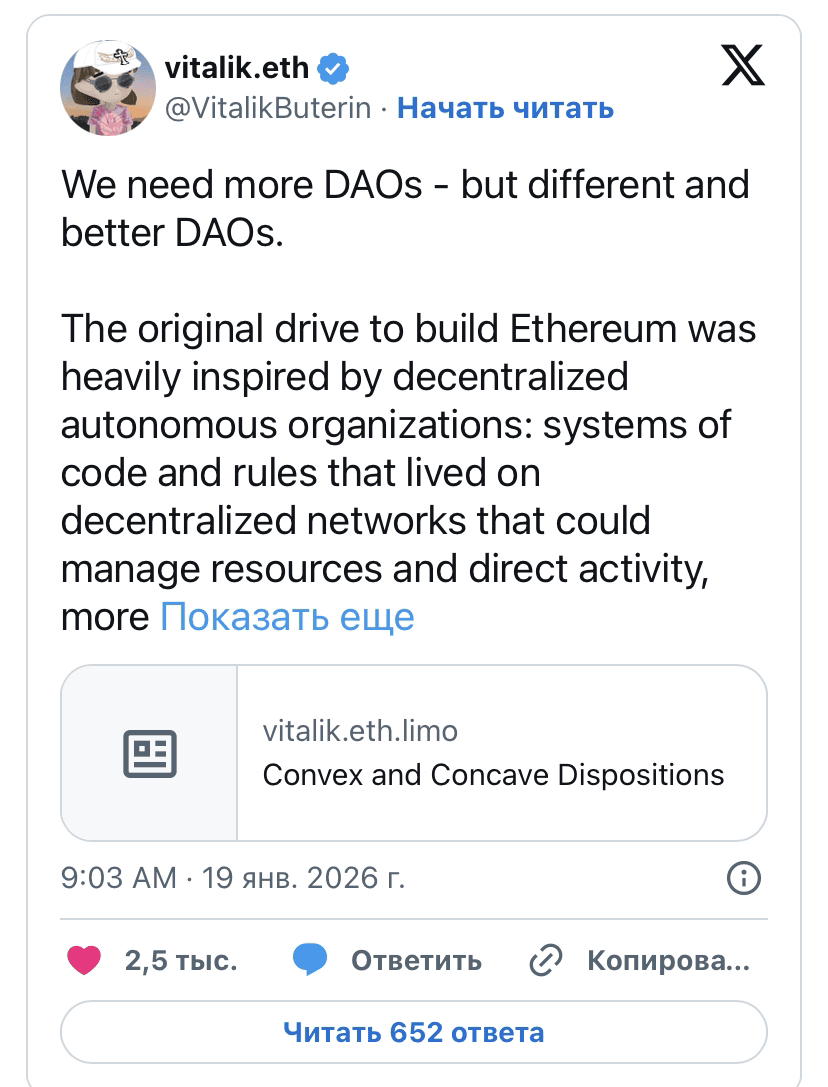
Co-founder of Ethereum Vitalik Buterin called on the crypto community to develop more advanced and efficient DAOs.
“The impetus for creating Ethereum is heavily inspired by decentralized autonomous organizations: systems made of code and rules existing in decentralized networks that could manage resources and direct activities more effectively and sustainably. […] Since then, the concept of DAO has essentially been reduced to a treasury,” he wrote.
The dominant token-based governance model was termed unproductive and weak by the programmer.
According to him, the current design works, but is unproductive, vulnerable to capture, and "completely fails to mitigate the shortcomings of human politics." It is in this that Buterin saw the reason for the community's skeptical attitude towards the concept of DAOs.
What to do?
The co-founder of Ethereum highlighted several key areas that require progress in DAO architecture. One of them is the creation of more sophisticated oracles to support decentralized finance.
"Today, key elements of DeFi — stablecoins, prediction markets, and others — rely on vulnerable oracle models. The main problem is that an attack on a tokenized oracle can never cost more than its market capitalization. This means that to ensure security, it is forced to extract excessive rent exceeding the risk-free rate," he noted.
Among other important areas, Buterin highlighted:
arbitration for complex smart contracts: creating on-chain dispute resolution systems necessary for advanced applications (e.g., decentralized insurance);
curation of critical data: maintaining up-to-date and reliable registries — from lists of vetted and secure applications to standard interfaces and token addresses;
operational launch of initiatives: tools for rapid mobilization of resources and funding from the interested community for specific, often short-term tasks;
project sustainability: mechanisms that allow the community to take on long-term support and development of projects after the original team has departed.
The main barriers to the "normal" functioning of decentralized autonomous organizations, Buterin believes, are the lack of privacy and "decision fatigue."
"Without privacy, governance becomes a social game. And if people have to make decisions every week, in the first month you see active participation, but over time the willingness to participate and even stay informed decreases," he emphasized.
As a solution, the programmer suggested using ZK-proofs and artificial intelligence. However, he is cautious about AI: in his opinion, the technology should not replace but enhance human judgment.
Buterin also pointed to the importance of the communication component of DAOs. He believes that forums and discussion platforms need to be more deeply integrated into governance mechanisms.
"Only in this way can we guarantee that the decentralization and sustainability of the underlying Ethereum layer extend to the world being built on top of it," he concluded.
Recall that Vitalik Buterin stated that by 2026 the project will regain lost ground in issues of self-governance and lack of trust.