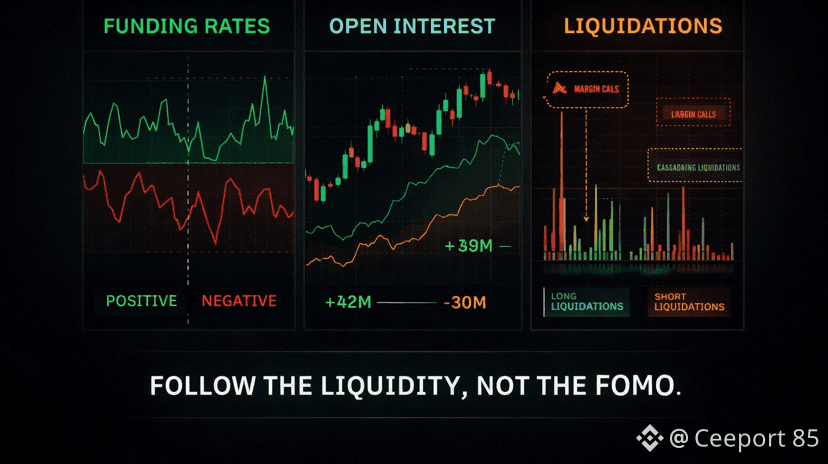
In crypto derivatives trading, most traders lose not because they make directional errors, but because they do not understand what liquidity is doing. Funding rate, open interest, and liquidations are the only tools that allow one to read the market before the crowd. The funding rate is not a directional signal but a thermometer of positioning: when it is extremely positive, it means that the market is already too long, and the real risk is not staying out but entering late. Similarly, a deeply negative funding rate is not an invitation to short but often indicates that short pressure has already been absorbed and that the market is preparing for a technical rebound or a phase of compression. Open interest should never be read in isolation but always in relation to price, because a price that rises with increasing open interest indicates new participation and a healthy trend, while a price that rises with decreasing open interest signals short covering and thus a fragile movement destined to exhaust quickly; likewise, a price that falls with increasing open interest is aggressive distribution, while a price that falls with flat or decreasing open interest is often a final capitulation phase and not the right point to open new shorts. Liquidations are the most common mistake of retail traders because they are chased, when in reality a cascade of liquidations almost always represents the end of a market leg and not its beginning, since the market has already taken the necessary liquidity and now has more interest in moving against those who arrive late. Professional traders do not enter during liquidations but wait for the subsequent pullback when the price returns towards value areas like EMA, VWAP, or mid Bollinger, and the funding stops worsening because it is at that moment that the risk becomes asymmetric in their favor. When funding, open interest, and price are extremely aligned, the market rarely continues in a straight line, preferring instead to lateralize, bounce, or hit the stops of those who have followed the movement emotionally. That is why the best trades arise when no one is convinced, funding is close to zero, open interest grows gradually, and price builds structure instead of rushing. Understanding these dynamics means stopping predicting the market and starting to read where liquidity is located because the market does not reward those who are right about direction but those who enter when the majority is already positioned and has no more room to maneuver.

Article
Funding, Open Interest and Liquidations, without censorship!