🌍 Where does Dusk originate?
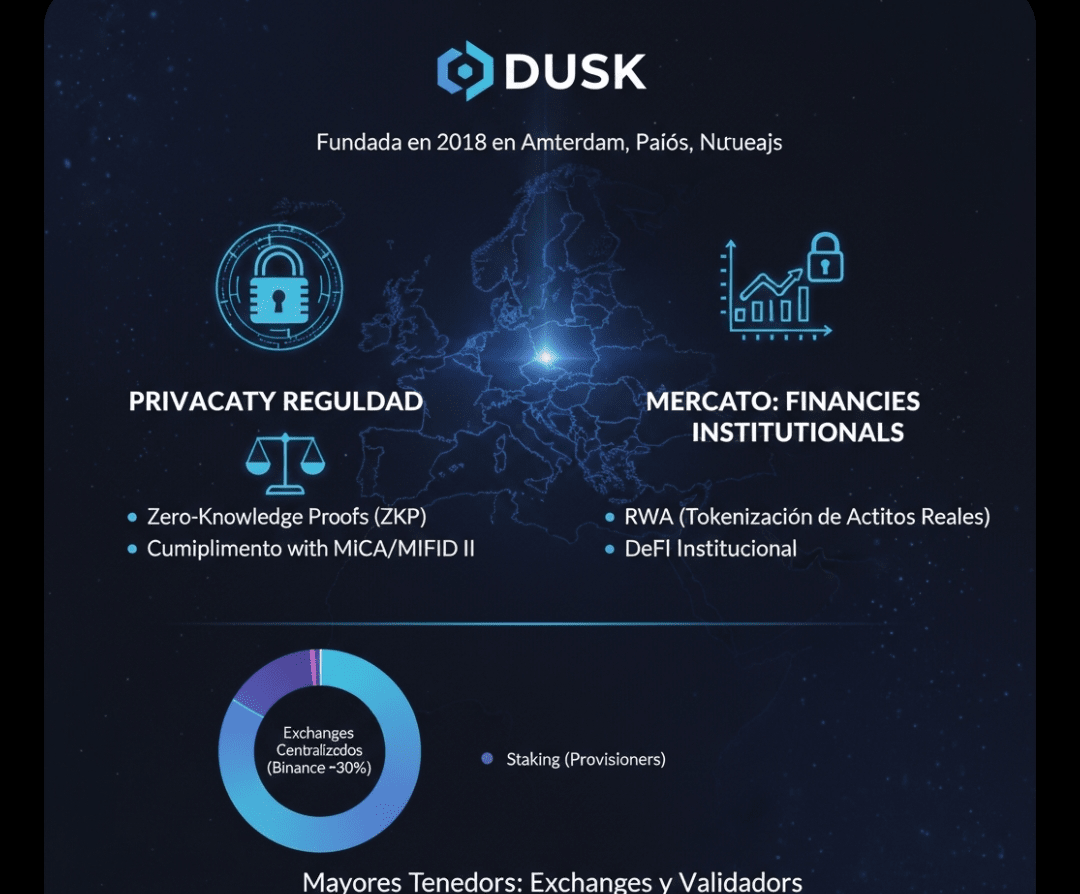
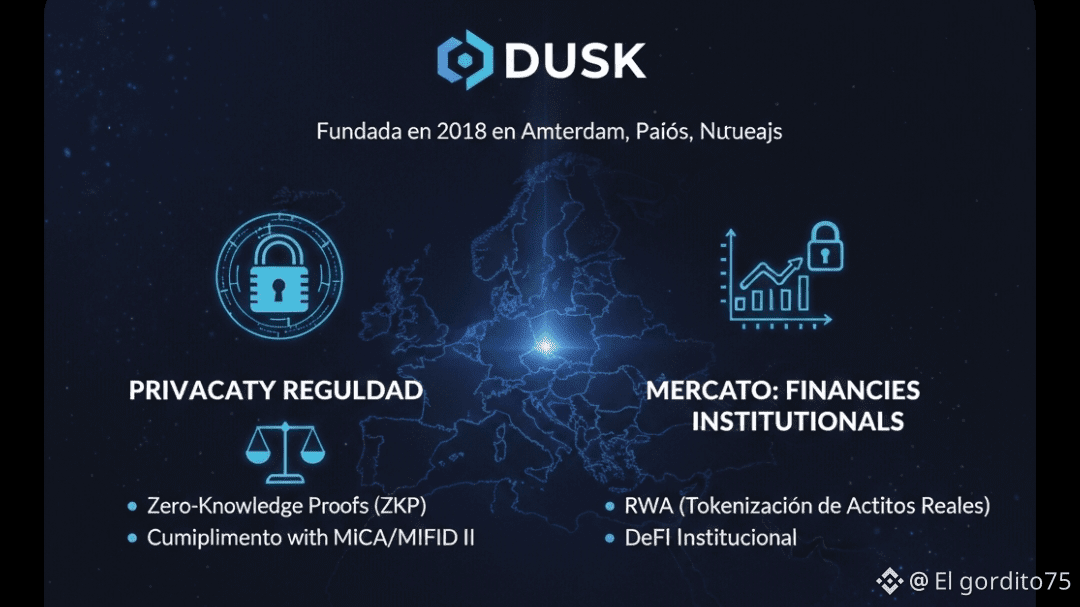
Dusk Network was founded in 2018 in Amsterdam, Netherlands. Its main creators are Emanuele Francioni (CEO) and Jelle Pol, who combined their experience in cryptography and traditional finance to create a unique Layer 1 (L1) network.
💡 What need does it satisfy?
Dusk was born to solve a fundamental conflict in blockchain: Privacy vs. Compliance.
Institutional Privacy: Companies cannot use public blockchains if all their data (clients, amounts, strategies) is visible. Dusk hides this information through Zero-Knowledge Proofs.
Legal Compliance: Unlike "dark" privacy coins (like Monero), Dusk allows audits and complies with laws like MiCA (Europe). It meets the need of financial institutions to move assets into the digital world (tokenization) without violating regulations or exposing trade secrets.
🏦 Main Market
Their target market is not just retail users, but financial institutions, banks, and asset managers. They aggressively focus on:
RWA (Real World Assets): Tokenization of bonds, stocks, and real estate.
Institutional DeFi: Decentralized finance where participants are verified (KYC) but their transactions are private.
🐋 Major Holders and Distribution
Dusk has a maximum supply of 1,000 million tokens ($DUSK).
Centralized Exchanges (CEX): A large portion of the circulating supply is found on platforms like Binance (which holds one of the largest wallets with almost 30% of the volume), followed by MEXC and Gate.io.
Staking (Provisioners): Many of the largest individual holders are validating nodes (called Provisioners), as a minimum of 1,000 $DUSK is required to participate in consensus and earn rewards, and whales often lock up large amounts to secure the network.
Dusk Foundation: They maintain a reserve for the ongoing development of the ecosystem and grants for projects building on their technology.