
Some blockchain projects feel like they were created to win attention. Dusk Network feels like it was created to solve a quiet problem that keeps getting louder every year. It starts with a reality most people don’t notice until they experience it personally. Public blockchains don’t just store transactions. They store history. Permanent history. And for financial activity, permanent public history can become a burden instead of a benefit.
In traditional finance, privacy is built into the system. Your balance is not public. Your salary is not public. Your investment strategy is not public. Even in regulated environments where reporting is required, that information does not get published to the entire world. It is shared with the right entities, at the right times, for the right reasons. That is how financial systems protect individuals and institutions from unnecessary exposure.
Crypto flipped this model. It made everything visible by default, and then it told the world that visibility is a feature. At first, that felt revolutionary. It promised fairness. It promised proof. It promised openness. But as crypto evolved, the industry began to understand the hidden cost of extreme transparency. Financial life becomes traceable. Wallets become profiles. Strategies become visible. Competitors can observe every move. Normal users start to feel uncomfortable because privacy is not a luxury, it is a basic human boundary.
Dusk Network was built to restore that boundary without losing the most valuable part of blockchain technology, public trust through verifiable systems. Dusk is designed as a privacy-first blockchain for financial applications, especially those tied to regulated markets and real-world assets. It is not trying to hide everything from everyone. It is trying to create a system where confidentiality exists when it should, while correctness and trust remain provable. If it becomes a major settlement layer for tokenized finance, we’re seeing the beginning of a different kind of blockchain era, one where privacy becomes normal again and financial infrastructure becomes mature.
I’m going to walk you through the full lifecycle of Dusk, from its earliest motivation to its design philosophy, its technical direction, its token purpose, and where it may be heading years from now. I’ll keep the language simple, the flow calm, and the writing human. This isn’t a hype piece. It’s a full deep dive that explains everything as one unified story.
The earliest idea behind Dusk begins with a simple question that often gets ignored in crypto conversations. What happens when the people who actually move large value want to use blockchain, but they can’t afford to expose their activity publicly. This includes institutions, businesses, and regulated market participants. But it also includes everyday people who don’t want their financial lives turned into public data.
The traditional answer in crypto has been to say, “Use a private chain,” or “Use privacy tools,” or “Use a separate layer.” But Dusk chose a different path. It wanted privacy to be native, not optional. It wanted a blockchain where the default environment is capable of confidentiality, not a system that starts transparent and then tries to hide things later.
This matters because privacy is not only about hiding transactions. It is about enabling entire categories of financial products that cannot function in full public view. Real-world assets are one of those categories. Tokenized securities, regulated bonds, compliant equity-like instruments, and institutional financial products come with rules. They come with restrictions. They come with eligibility requirements. They come with transfer policies. They come with reporting obligations. And they come with confidentiality expectations.
A chain that wants to host this kind of financial activity must behave differently than a typical DeFi playground. It must combine privacy with compliance logic in a way that feels practical.
Dusk’s vision is essentially to make blockchain infrastructure usable for finance without forcing finance to become something it isn’t. Finance is not designed to be a public performance. It is designed to be a system of trust, settlement, and fair access. Dusk tries to build an environment where that trust remains visible, but the private details remain protected.
To do this, the project leans heavily on zero-knowledge cryptography. Zero-knowledge proofs are one of the most important technologies in modern blockchain design because they allow verification without exposure. In simple terms, they let someone prove a statement is true without revealing the underlying data. That can mean proving a transaction is valid without revealing amounts publicly. It can mean proving eligibility without revealing identity to the entire world. It can mean proving that a smart contract executed correctly without revealing every private variable inside it.
This is the bridge Dusk tries to build. It does not want a world where finance is hidden in darkness. It wants a world where finance is private but provably correct. That distinction is important, because it keeps Dusk aligned with real market requirements. Markets need confidentiality, but they also need trust.
This is where Dusk’s identity starts to feel serious. It is not just building privacy features. It is building a financial system that can handle complex assets and regulated behavior.
A major part of that system is confidential smart contracts. Smart contracts are the engines of programmable finance. They define rules, execute logic, and move value. On most blockchains, smart contracts are transparent, meaning anyone can inspect the contract state and see how people interact with it. That is useful for open DeFi protocols, but it is not acceptable for many financial products where trade terms, balances, and participant behavior must remain confidential.
Dusk’s approach is to support smart contract execution in a way that allows confidentiality, so applications can run financial logic without exposing everything publicly. This is one of the most important steps in the lifecycle of Dusk, because it shows what the chain is designed to host. It is designed to host serious financial products that require privacy. If it becomes widely adopted, it could change how we think about what “on-chain finance” really means.
On-chain finance does not have to mean fully public finance. It can mean provable finance.
Now, if privacy is the emotional foundation of Dusk, settlement reliability is the structural foundation. Financial markets need finality. Finality means when a transaction is confirmed, it is settled. Not likely settled. Not mostly settled. Settled with confidence.
This is especially important when you move from casual transfers into regulated asset movement. In regulated markets, settlement risk has costs. Delays create inefficiency. Uncertainty creates fear. Institutions will not operate on rails that feel unstable.
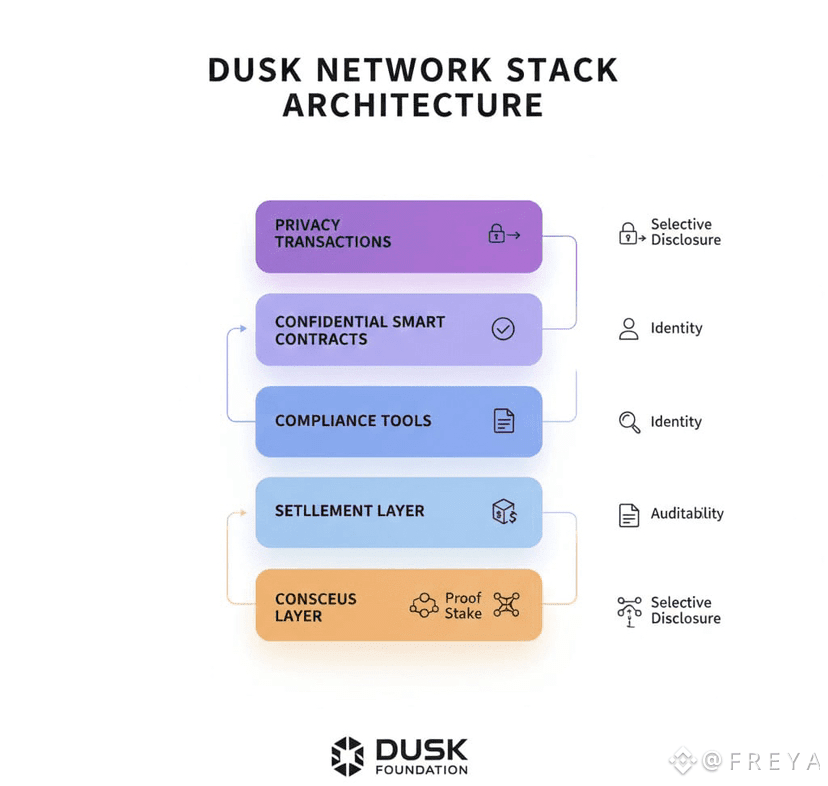
Dusk is built with a Proof-of-Stake-based consensus approach that emphasizes strong finality and secure agreement. It has described its consensus model as designed to reach agreement efficiently and resist adversarial behavior. This is a major part of its value proposition, because Dusk is not trying to be a chain that only works when the market is quiet. It is trying to be a chain that can serve as infrastructure.
When a chain aims to become financial infrastructure, everything changes. The design must be more conservative. Security must be stronger. Upgrades must be careful. Developer tooling must be stable. The chain’s purpose becomes less about excitement and more about trust.
Now, let’s talk about the DUSK token, because every serious blockchain needs an economic layer that supports its security and operation.
DUSK is the token that supports the Dusk Network. It is used as part of the network’s incentive system, enabling staking and supporting validators that secure the chain. It also plays a role in paying for network usage and sustaining the economic structure that keeps the chain running.
In a Proof-of-Stake environment, the token is not only a currency. It is security. It is the economic weight that makes it expensive to attack the network and rewarding to defend it. The more real value a network carries, the more important the token’s security role becomes.
But the true meaning of DUSK depends on what Dusk becomes. If Dusk grows into a chain that hosts private financial products and regulated assets, then DUSK becomes the security fuel behind confidential markets. It becomes part of a system that could matter far beyond speculative cycles. If it stays niche, then the token remains mostly market-driven.
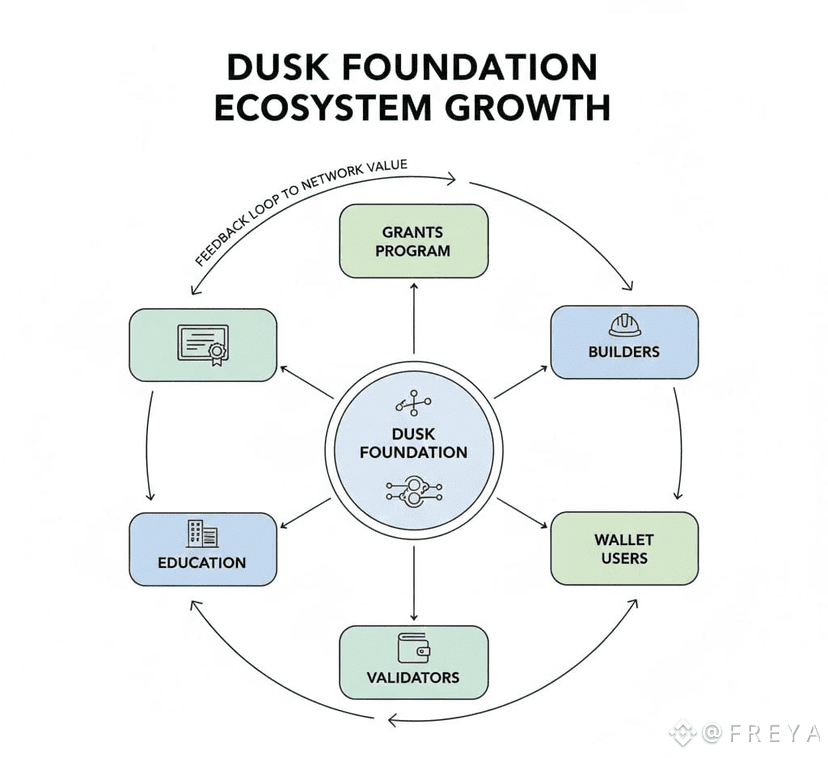
This is why Dusk’s ecosystem growth is the most important next chapter.
A network can have strong cryptography and good consensus, but it still needs developers. It needs applications. It needs real usage. The future of Dusk will be shaped by whether builders choose it for the kind of products it is designed to support.
This is not easy, because privacy systems are harder to build on. Confidential smart contracts can be complex. Testing is harder because you can’t observe everything publicly. Debugging private state is more difficult. Developers need strong tools, documentation, and support to build comfortably.
This is one of the biggest challenges Dusk must overcome. It must make privacy practical, not just possible. It must offer a developer experience that encourages builders to experiment and ship production applications.
And it must offer a user experience that feels simple. Because in the end, users want privacy but they don’t want to think about it. They want privacy the same way they want a lock on their door. They don’t want to study the lock’s engineering. They just want the lock to work.
If Dusk can make private finance feel normal, then it has a powerful chance to become an important rail for the next era of tokenization.
That next era is already forming. We’re seeing increasing interest in tokenized real-world assets. We’re seeing institutions explore on-chain settlement. We’re seeing regulated frameworks evolve around digital assets. We’re seeing governments and large players experiment with digital infrastructure. This environment creates a demand for chains that can handle regulated assets in a realistic way.
Dusk is positioned for this environment because it started with the assumption that regulated finance needs privacy. It did not treat privacy as optional. It treated privacy as foundational.
This is why Dusk might be one of those projects that grows quietly. It may not dominate attention during every market wave, but it can become extremely relevant when markets mature. Infrastructure projects often feel slow, until they suddenly become obvious.
Now, where can Dusk be heading in five or ten years.
In one future, Dusk becomes a recognized settlement network for private regulated assets. Companies issue tokenized instruments that require confidential handling. Marketplaces exist where trades can occur privately but settle correctly. Investors participate without exposing their identity to the public. Compliance checks happen through cryptographic proofs rather than public disclosure. The chain becomes a place where financial privacy and public trust coexist naturally.
In that future, Dusk becomes a bridge between traditional finance and open blockchain rails, not by rejecting regulation, but by building a system that can comply without becoming invasive.
In another future, Dusk becomes a specialized network that serves a smaller number of high-value applications. Not every chain needs to be mass consumer. Some chains win by being the best for a specific category. Dusk could become the quiet home for private finance, even if it is not a mainstream social chain.
And of course, there is the harder future where the ecosystem fails to grow. Competition in tokenization is intense. Many chains want RWA adoption. Some may offer easier developer tooling. Some may add privacy modules that become “good enough.” Dusk must prove that its native privacy-first architecture is not only elegant but essential.
But even with these uncertainties, Dusk’s core problem remains real. Finance cannot fully move on-chain if it must live in public. And privacy cannot be treated as suspicious if we want mainstream adoption.
This leads to the deeper meaning of Dusk in the broader story of blockchain.
Dusk is part of a shift from blockchain as radical transparency to blockchain as mature infrastructure. Early crypto celebrated transparency because it created trust without authority. But mature systems require nuance. They require selective disclosure. They require confidentiality with accountability. They require proof without surveillance.
Dusk is built for this nuance.
It is built for a future where trust comes from correctness, not constant observation. Where private information remains private, but the system remains verifiable. Where people can participate in financial markets without turning their lives into public datasets.
That is a future worth building.
I’m not saying Dusk will be the only chain that matters in this space. But I can say the philosophy behind it feels increasingly aligned with where the world is going. We’re seeing more regulated adoption. We’re seeing more tokenization. We’re seeing more demand for privacy. We’re seeing more awareness that transparency without boundaries can become harmful.
If Dusk succeeds, it will not be because it shouted louder than everyone else. It will be because it built something the world actually needed, a private financial layer that still earns public trust.
And that is the meaningful ending that stays with you.
Because years from now, when tokenized finance becomes normal, the most important question won’t be which chain had the loudest marketing. It will be which chain respected human privacy enough to be trusted, and which chain built settlement strong enough to carry real value without fear.
If it becomes that chain, then Dusk won’t just be a project. It will be a quiet proof that the future of finance can be both open and human.