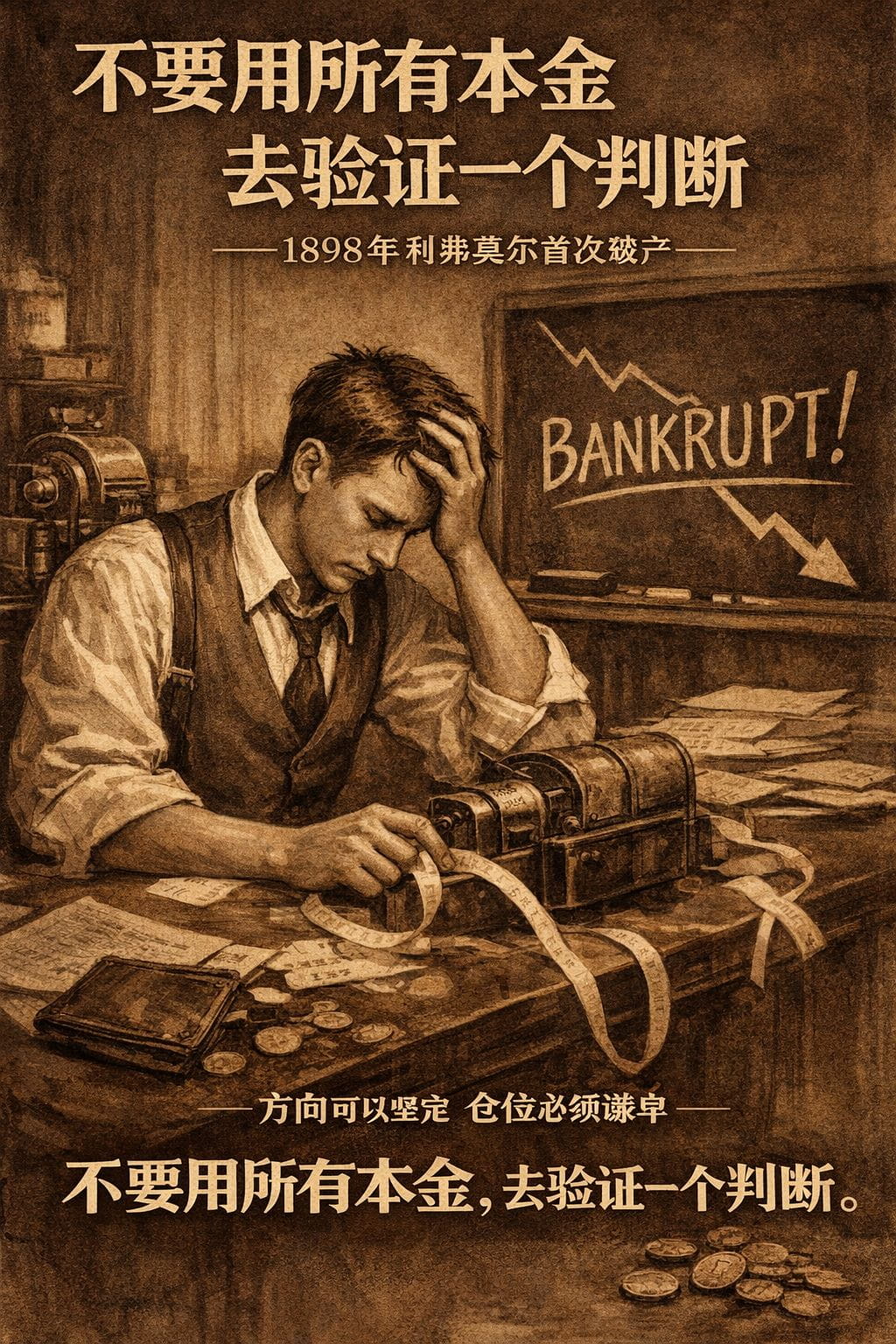
—Starting with Livermore's first bankruptcy in 1898
In 1898, 21-year-old Jesse Livermore experienced his first true 'zero' in his trading career.
It was not because he couldn't read the market; on the contrary—his judgment at that time was correct.
The problem lay in one thing:
He used all his capital to validate a judgment.
That year, Livermore had already made quite a bit of money in the speculative market with 'market dynamics and rhythm', and his confidence rapidly inflated. He firmly believed he had grasped the essence of the market, thus making a mistake that all new geniuses tend to commit:
Heavy positions, full positions, betting everything.
The market deviated from his judgment in the short term.
It is not that the trend is wrong, but that the timing is wrong.
And the market never pays for 'late correctness.'
Thus, he went bankrupt.
The market is not there to 'prove you are right.'
Many traders are still repeating Livermore's mistake from 1898.
They treat trading as a logical exam:
If I judge correctly, I should earn it all;
If I judge incorrectly, I should be denied by the market.
But the market is not a referee; it only recognizes the capital curve.
You can judge the direction correctly, but lose to volatility;
You can see the trend correctly, but die from a pullback;
You may even be completely right in the long term, but exit early due to a full position.
The most dangerous thing in trading is not making a wrong judgment, but:
Using all your capital to validate a judgment.
The first mission of capital: to stay alive.
Livermore later repeatedly emphasized one thing:
"The big money is not in the thinking, but in the sitting."
But in 1898, he still didn't understand what the premise of 'being able to sit' was.
There is only one answer:
You must still be in the market.
Capital is not meant to express beliefs,
Capital is your 'respiratory system' in the market.
Once you bet all your capital on one judgment, you are essentially not trading but betting.
There are only two outcomes for a bet:
Either become rich or exit.
There is no third option.
Mature trading does not need to be validated.
Expert traders never rush to prove themselves.
They take one thing for granted:
Any judgment may be wrong in the short term.
So they will:
Use position management to combat uncertainty.
Use incremental positions to digest volatility.
Use stop-loss to protect your 'future judgment right.'
They allow for judgment failures,
Because what they care more about is:
Whether one can take action next time.
Livermore took a long time to truly understand this after his first bankruptcy.
It was only after that that he transitioned from a 'genius speculator' to the 'king of trend trading.'
Written at the end.
If you are still thinking about it today:
"This time I am particularly confident, should I go all in?"
Then I suggest you remember Livermore in 1898.
The direction can be firm, but the position must be humble.
Judgments can be repeatedly corrected, but capital can only accumulate slowly.
The market is always there, opportunities never miss.
What is truly scarce is
is you being able to continue trading.
——
Do not use all your capital to validate a judgment.