Storage is no longer a utility — it is becoming a core strategic resource for Web3 applications. On Sui, where applications are data-heavy and stateful, infrastructure failures ripple immediately. @Walrus 🦭/acc and $WAL address this by making storage verifiable, composable, and economically enforceable. This is not about keeping files safe. It is about ensuring applications, AI agents, and NFT ecosystems can function reliably, even under network churn.
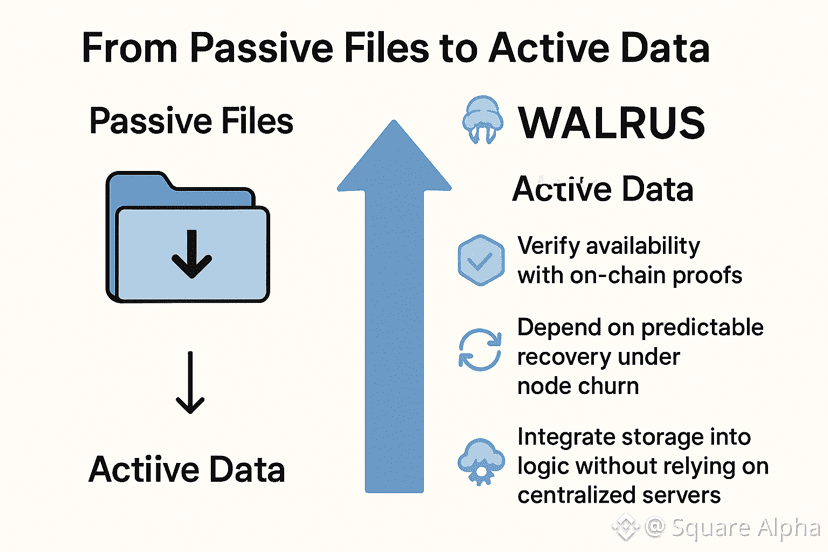
From Passive Files to Active Data
Most storage solutions treat data as inert: upload it once, hope it survives. Walrus takes the opposite approach. Every blob is active state, governed by lifecycle rules on Sui and backed by economic incentives in WAL. Applications can:
Verify availability with on-chain proofs
Depend on predictable recovery under node churn
Integrate storage into logic without relying on centralized servers
This makes Walrus a foundational layer, not just a peripheral tool.
Operational Resilience That Matters
High-throughput networks like Sui stress-test storage in ways most protocols ignore. Nodes leave. Applications scale. Demand spikes unpredictably. Walrus is designed to survive this:
RedStuff erasure coding ensures efficient reconstruction even if multiple nodes fail
Incentives in WAL align validators to maintain availability continuously
Data isn’t “probably there” — it is verifiably maintained
This is infrastructure that doesn’t just promise uptime — it enforces it.
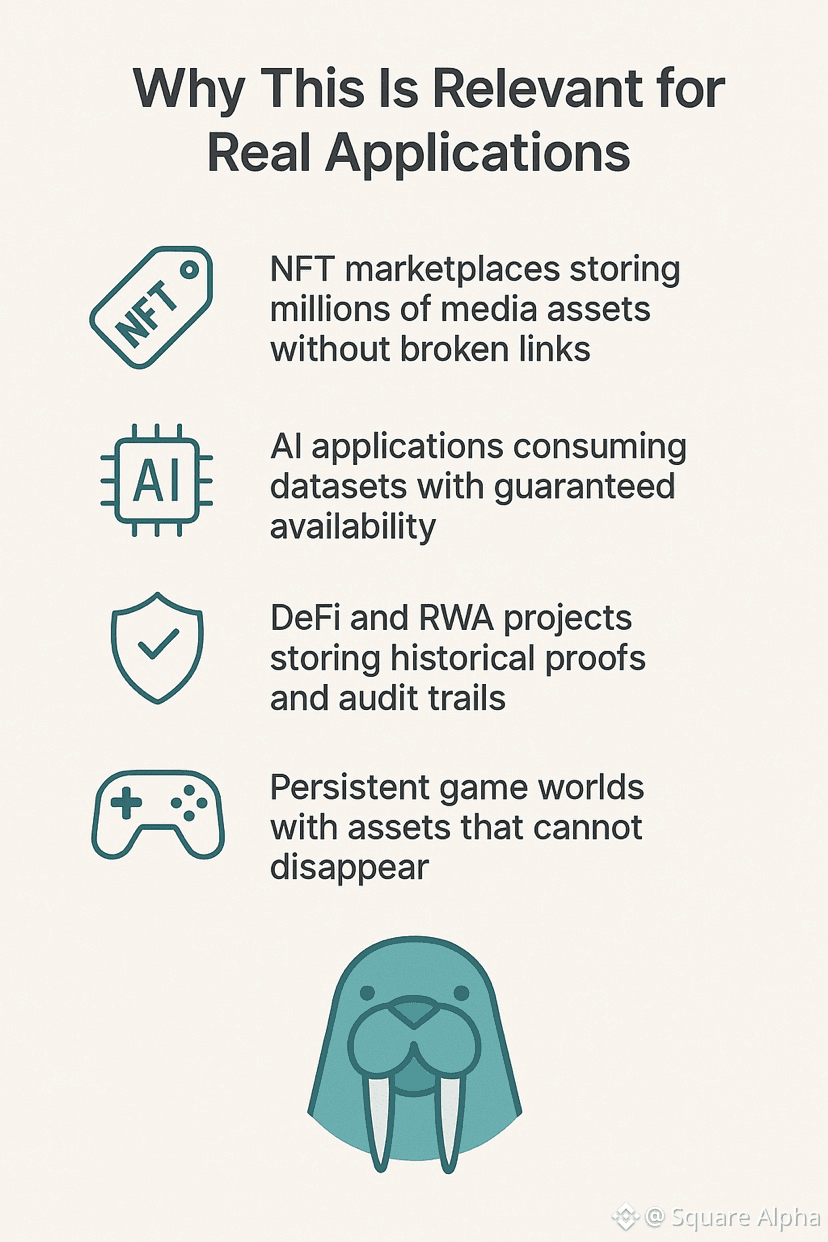
Why This Is Relevant for Real Applications
Think beyond token holders. Consider real use cases:
NFT marketplaces storing millions of media assets without broken links
AI applications consuming datasets with guaranteed availability
DeFi and RWA projects storing historical proofs and audit trails
Persistent game worlds with assets that cannot disappear
For these systems, storage is no longer optional. Walrus becomes a non-negotiable dependency, creating stickiness that grows naturally over time.
WAL: Not a Speculative Token, But a Network Tool
The WAL token enforces real economic behavior:
Rewards storage validators for uptime
Penalizes downtime or broken availability
Supports governance to upgrade protocols
Aligns incentives with long-term reliability
This ensures that storage is not just decentralized in theory, but in practice.
Decentralization With Accountability
Many decentralized networks decentralize responsibility and hope it sticks. Walrus codifies responsibility: if availability is broken, the system knows who is accountable, how corrections happen, and how continuity is restored. This creates a functional, stress-tested decentralization, which is rare and valuable.
Final Take
Walrus is quietly building a critical Web3 backbone. By turning storage into verifiable, composable, and economically enforced state, it shifts how developers, applications, and markets treat data.
On Sui, @Walrus 🦭/acc and WAL are no longer optional — they are the infrastructure that ensures applications can scale, persist, and remain trustworthy.
Storage isn’t just a service anymore. It’s a strategic asset.