

Introduction: The Great Encryption Mirage 🌅
We were promised a world where "code is law" and no central authority could freeze our digital lives.
We moved from Web2 to Web3 to escape the "god mode" of big tech companies and governments.
Now, new buzzword: FHE (Fully Homomorphic Encryption), with $ZAMA leading the charge. On paper, it looks like magic computing on encrypted data.
But if we look past the $1 Billion valuation and the VC-funded marketing, a dark reality emerges. Zama isn't building a decentralized revolution; it’s building a more sophisticated digital cage.
@Dusk is also similar like a ZAMA but its working on ZK protocol, in short-term i'm bullish on #DUSK but in long term if EVM adoption in large scale then both the protocol are booming 🔥
The SSL Trap (Privacy vs Sovereignty) 💻
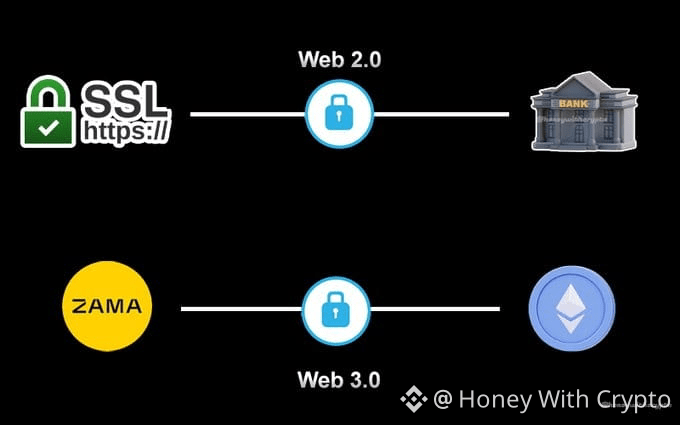
In Web2, we have HTTPS (SSL). It protects our data from the neighbor, but the "Bank" and the "Server" still own the keys. They can pause your account, freeze your funds, and de-platform you at will.
Zama is essentially "SSL for Blockchains." It offers Confidentiality (hiding data) but completely ignores Sovereignty (owning the system).
If a protocol is built to be "compliant" and "VC-governed," it is just a "Privacy-as-a-Service" model.
If there is a "Freeze" button behind the encryption, we haven't moved to Web3 we havve just given Web2 a face lift.
For E.g 👇
To understand why Zama fails the test of true decentralization, we must look at how it fits into the current ecosystem.
The Bank (It Means Ethereum is a bank) : Today, Ethereum is moving toward becoming a "Regulated Digital Bank." With the arrival of ETFs and the dominance of centralized staking providers (like Coinbase and Lido), Ethereum is increasingly under the thumb of institutional compliance.
The SSL (Zama): Think of Zama as the SSL/HTTPS certificate for this bank. When you use a banking website, the "Lock" icon in your browser hides your password from your neighbor, but the Bank still sees everything. Zama provides Confidentiality (hiding data from other users), but it does not provide Sovereignty (freedom from the system). If the underlying "Bank" (Ethereum) is compromised or regulated, the "Curtain" (Zama) is useless.
Proof, Do you know about DAO Hack (When History Was Rewritten)
"Has Ethereum ever actually been compromised?" The answer lies in its history.
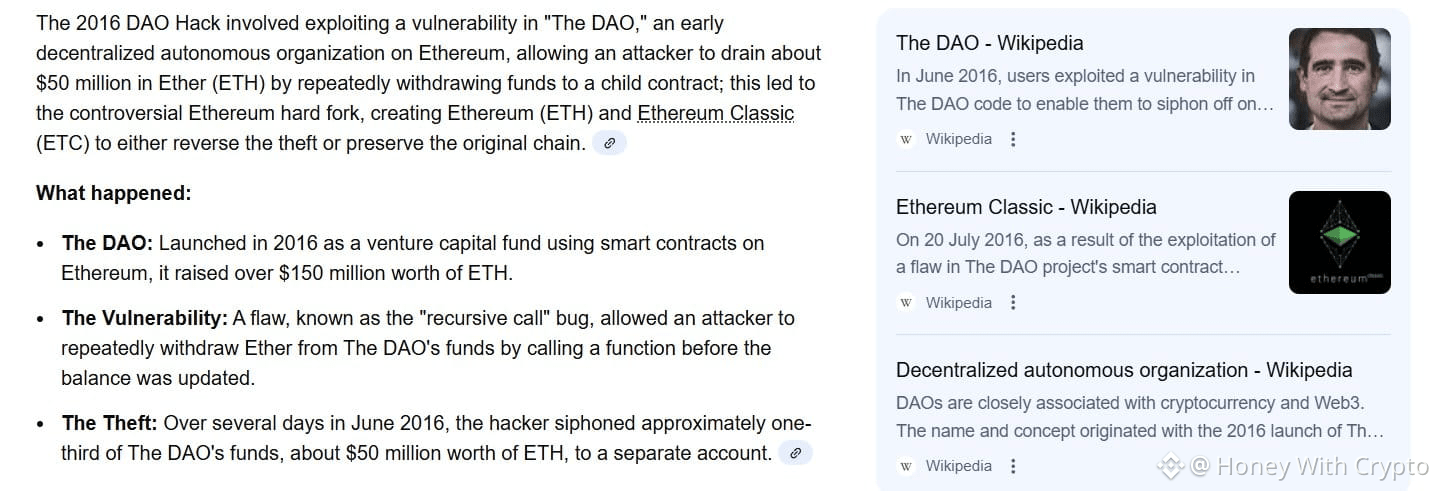
The Event: In 2016, following The DAO Hack, the Ethereum community decided to "Roll Back" the blockchain to recover stolen funds.
The Lesson: This event proved that Ethereum is not "Unstoppable." If the system can rewrite its history to fix a hack, it can certainly rewrite its history or your balance at the request of a government. Zama is an encryption layer on a foundation that has already proven it can be manipulated.
The B2B Pivot (Corporate Privacy, Not Human Rights)🤝
Zama’s true future lies in the B2B (Business-to-Business) sector, not in individual freedom.
Corporate Tool: Institutions love Zama because it allows them to hide trade secrets from competitors while remaining "Compliant" with regulators.
The Difference: Monero $XMR , $Firo, and $ZEC were built as "Human Rights" tools. They have no CEO, no boardrooms, and no "Pause" button. They are built for the sovereign individual. Zama, however, is a VC-funded product built for the boardroom. It is designed to be "Acceptable" to the system, and anything acceptable to the system cannot truly disrupt it.
Conclusion: ZAMA Is Not A Real Decentralization 😱
Zama will likely be a massive financial success. It will likely become the "Amazon Web Services" of private data computation. But it will fail as the future of Sovereign Privacy.
As early adopters, we moved from Web2 to Web3 to escape the "God Mode" of centralized entities. By adopting Zama & $DUSK as the "Standard," we are merely moving back into a system where our data is hidden by a curtain, but the key to the room is still held by a landlord.
Final Verdict: An encrypted jail is still a jail. If you are looking for hype and profit, Zama is a play. But if you are looking for the future of freedom, look toward the chains that have no master.