

Trading has become one of the most talked-about ways to participate in financial markets. From stocks and cryptocurrencies to forex and commodities, millions of beginners are drawn to trading by the promise of flexibility, independence, and potential profits.
But what is trading, really?
And more importantly, how can beginners avoid common mistakes and start the right way?
This guide explains trading in plain English. You will learn:
What trading actually is
How trading works step by step
The main types of trading
Essential trading tips for beginners
Risks, psychology, and realistic expectations
Whether you are curious about trading or planning to start, this article gives you a solid foundation without overwhelming jargon.
What Is Trading and How Does It Work?
At its core, trading is the act of buying and selling financial assets with the goal of making a profit from price movements.
Unlike long-term investing, which focuses on holding assets for years, trading usually involves shorter timeframes, from minutes to weeks.
How Trading Works (Simple Explanation)
You choose a market (stocks, crypto, forex, etc.)
You buy an asset at one price
You sell it later at a higher price (profit) or lower price (loss)
The difference between buy and sell determines your result
Trading is based on price movement, not ownership or dividends.
Types of Trading Beginners Should Know
Understanding the different types of trading helps beginners choose what fits their time, personality, and risk tolerance.
Day Trading
Positions opened and closed the same day
Requires constant market monitoring
High stress and high risk for beginners
Best for: Full-time traders with experience
Not ideal for: Most beginners
Swing Trading
Trades last days or weeks
Focuses on medium-term price movements
Less stressful and more beginner-friendly
Best for: Beginners with limited time
Popular choice for new traders
Scalping
Very short trades (seconds or minutes)
Requires fast execution and discipline
Small profits per trade, high volume
High risk and advanced
Not recommended for beginners
Position Trading
Long-term trading approach
Trades can last months
Combines trading and investing principles
Best for: Patient traders who prefer fewer decisions
Markets You Can Trade As a Beginner
Trading is not limited to one market. Beginners should understand the main options:
Stocks
Shares of public companies
Regulated and widely trusted
Good learning environment
Cryptocurrency
Highly volatile
24/7 markets
Higher risk but high opportunity
Forex (Foreign Exchange)
Trading currency pairs
Largest market in the world
Leverage increases both gains and losses
Commodities
Gold, oil, silver, agricultural products
Often used for diversification
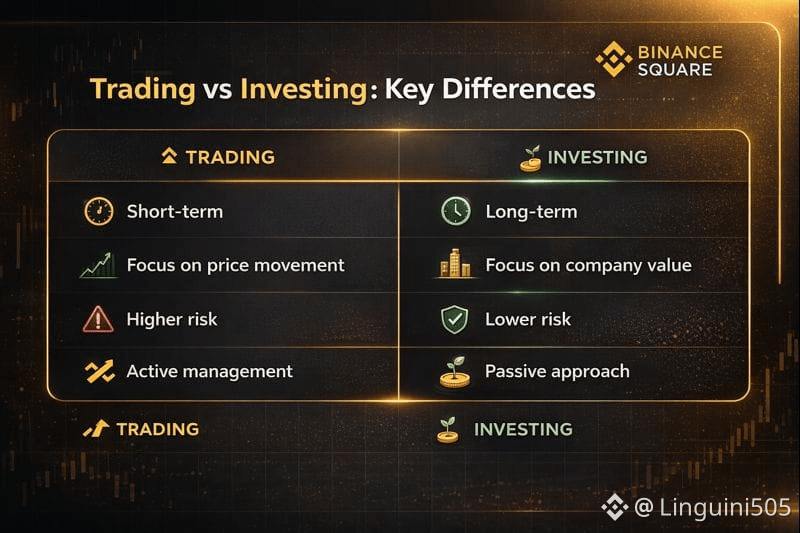
Beginners often confuse trading with investing.
Both are valid, but trading requires more discipline and emotional control.
Core Trading Concepts Every Beginner Must Understand
Risk Management in Trading
Risk management is more important than strategy.
Golden rules:
Never risk more than 1–2% of your capital per trade
Always use stop-loss orders
Protect your capital first, profits second
Most traders fail not because of bad strategies, but poor risk control.
Technical vs Fundamental Analysis
Technical Analysis
Uses charts, indicators, patterns
Focuses on price action
Common for short-term trading
Fundamental Analysis
Evaluates economic data, news, earnings
Focuses on asset value
Better for long-term decisions
Most successful traders combine both.
Trading Psychology – The Hidden Factor
Trading is 80% psychology and 20% strategy.
Common emotional traps:
Fear of missing out (FOMO)
Revenge trading
Overtrading
Panic selling
Successful traders:
Follow a plan
Accept losses as part of the game
Stay disciplined even after winning
Conclusion: Is Trading Worth It for Beginners?
Trading can be rewarding, but it is not easy money.
For beginners, success comes from:
Education
Risk control
Emotional discipline
Long-term consistency
If you treat trading as a professional skill, not a gamble, you dramatically increase your chances of success.
thank you so much ✨✨
#Whatistradingpair
#tradingforbeginners
#howtradingworks
#onlinetradingexplained