
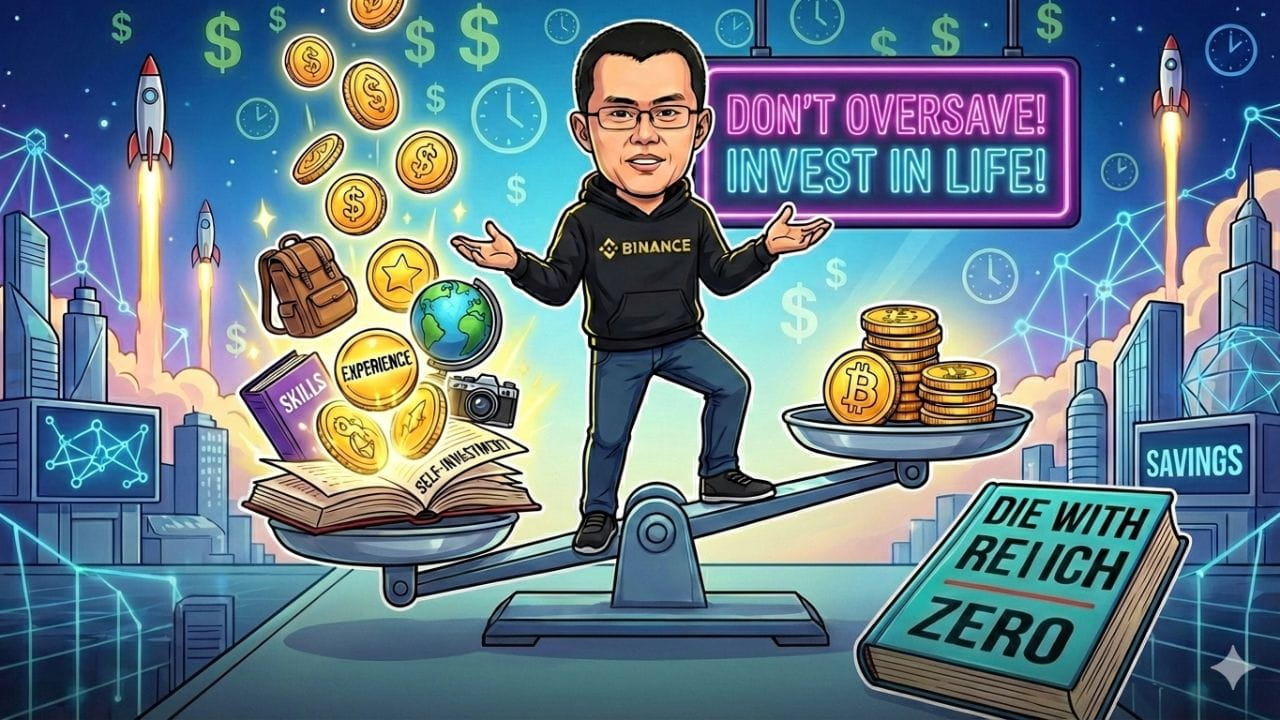

Some people treat life as a money-saving competition: trying to save as much money as possible for some future day. Others treat life as instant gratification: living in the moment, regardless of the consequences. Both extremes can ultimately lead to regret.
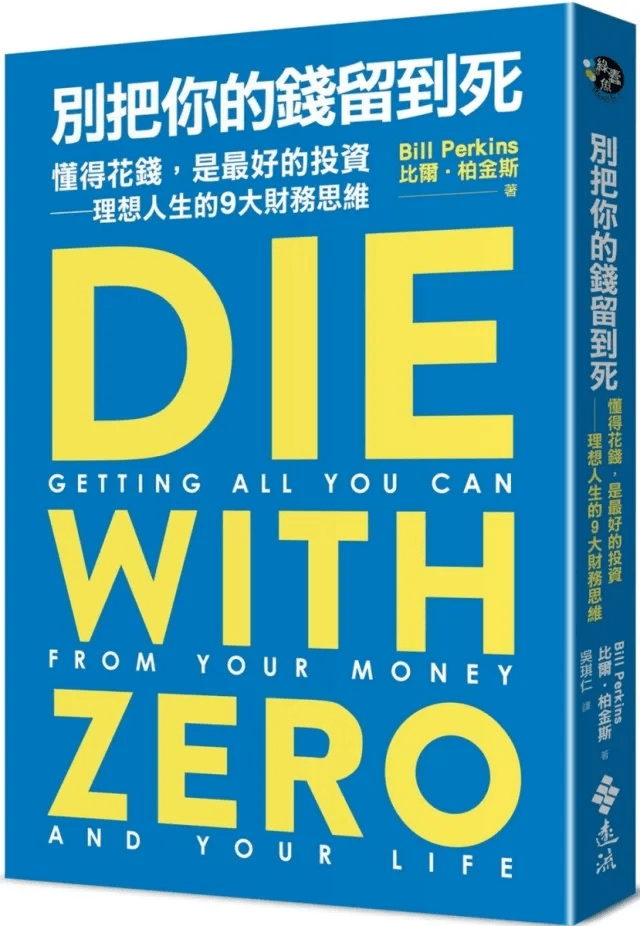
As a long-term holder of Bitcoin (HODLer), I have always advocated for 'sound money' and 'low time preference'. However, an interview with Binance founder Zhao Changpeng (CZ), combined with that book that went viral in the Silicon Valley wealthy circle (Die with Zero), completely shattered many people's views on wealth.
Why do we desperately hoard currency, live frugally, and delay gratification? If we have billions at the age of 80 but have lost the appetite of our 20s, the physical strength of our 30s, and the curiosity of our 40s, have we really won this game of 'wealth'?
Today, I want to talk about the ultimate algorithm that most crypto investors overlook: how to precisely spend all your money at the moment of death.
01 The friend who saved 100 Bitcoins but 'had no life to spend.'
Before discussing the book, let me share a true story.
There was a guy who entered the crypto space in 2017. With incredible willpower and an obsession with halving cycles, he accumulated a three-digit number of Bitcoins through years of ups and downs. In the eyes of others, he was the 'master' of financial freedom.
But what kind of life did he live? To save one more coin, he refused all social interactions, and even hesitated for a long time about buying a better toy for his child. His logic was simple: 'Spending 10,000 yuan now could be 1 million in the future, so spending money now is a crime.'
As a result, last year he suffered a heart attack due to long-term insomnia and anxiety. Although he was rescued, his health was severely compromised. He told me on his hospital bed one sentence that I will remember for a lifetime:
'Looking at the coins in my wallet, I suddenly feel they are like a pile of cold stones. In the past ten years, besides watching the market and saving money, I haven't left a single moment that I can savor repeatedly.'
This is precisely the phenomenon that Bill Perkins, the author of (broke), wants to criticize: Many people sacrifice their lives for the accumulation of numbers, forgetting that money is just a chip for exchanging 'life experiences.' If you die with a large sum of money left, it means that all the labor you invested to earn that money was in vain.
02 What is the 'broke' life algorithm?
(Broke) has a very offensive core idea against traditional concepts: The goal of life should be 'maximizing life experiences,' not 'maximizing wealth values.'
To make everyone understand, I have translated those academic concepts in the book into plain language that we in the crypto circle can understand:
1. Memory dividends: The hardest compound interest in life.
We all know that Bitcoin has halving cycles and compound effects. But Perkins proposed that 'life experiences' also have compounding.
When you wander in Southern Europe for a month at 20, this experience will become your talking point, material for thinking, and source of happiness for the next 60 years. Each time you recall it, you earn a 'dividend.' The earlier you have this experience, the longer you receive these dividends.
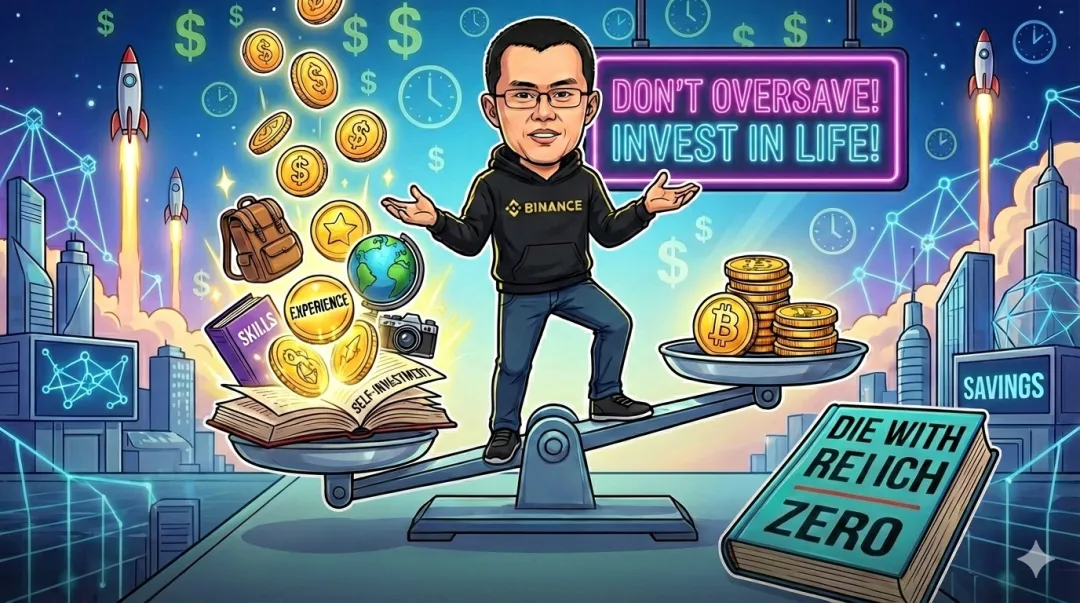
That's why CZ advises young people not to over-save. Because the 'experience compounding' that 10,000 yuan can buy at 20 far exceeds 1 million yuan at 70.
2. The personal version of the stock-to-flow ratio: Don't hold on to sesame and lose the grain warehouse.
CZ said in an interview: Young people have great potential for income in the future, so they can take on higher risks.
In our words, your current savings (stock) may account for less than 1% of the money (total flow) you will earn in your lifetime. To protect this 1% stock while giving up on skill improvement, networking, and broadening your horizons (all of which can significantly increase your flow) is typical 'poor people's thinking.'
3. The diminishing utility of money: At 80 years old, you no longer need a Ferrari.
This is the most heart-wrenching point. The utility of money drops dramatically with age. At 25, 100,000 yuan can take you and your partner around the world; at 85, 1 million yuan might only buy you a better caregiver.
If you choose to be 'extremely stingy' when the utility of money is at its highest and choose to be 'wealthy' when the utility of money is at its lowest, your life logic is completely ineffective.
03 CZ's inspiration: Young people, your risk management is reversed.
On December 13, CZ said something very profound during an interview with Bilal Ben Saki.
He believes that the three things young people should balance are: consumption, savings, and investment (including financial investment and self-improvement).
Many young HODLers fall into an extreme: 0 consumption, 0 self-investment, 100% hoarding coins.
CZ pointed out that this is actually the biggest 'failure in risk management.' Why?
Skill depreciation risk: If you give up expensive industry training or high-end networking to hoard coins, your ability to earn (productivity) will quickly degrade.
Life loss risk: Your youth is a non-renewable scarce resource. If you trade away your most golden 10 years for a cold number, the opportunity cost is incalculably high.
What CZ really wants to say is: You should invest your resources where the ROI (return on investment) is highest—yourself.
If you are a 25-year-old with 50,000 yuan, should you exchange it for Bitcoin or spend it to attend a top industry summit, or even learn a skill that could change your career trajectory?
(If broke) the answer is: Invest in your experiences and skills, because the 'memory dividends' and 'productivity increments' they generate far exceed the volatility of financial assets at a young stage.
04 Redefining 'low time preference': Don't be a slave to wealth.
In the crypto community, we advocate 'low time preference.' But many people misunderstand this term. They think low time preference means 'not spending money.'
Wrong. True low time preference is 'optimizing current decisions for long-term happiness.'
If you skip a health check to save money and end up with a serious illness, that's high time preference (overdrafting the future); if you skip socializing to save money and end up isolated, that's also high time preference (overdrafting opportunities).
What we need to establish is a 'conviction strategy,' but this doesn't mean we should live a life of asceticism.
Another important point we must recognize: Bitcoin is our shield against fiat currency inflation, but it's not everything in our lives.
We hold Bitcoin to have the choice not to be exploited in 10 or 20 years. But if in the process, we have already lost the 'ability to choose' and the 'organs to feel joy,' then this shield only protects a walking corpse.
05 Real-life case studies: What would you choose?
To help everyone understand more clearly, let's look at two comparisons:
Case A (traditional hoarder): Xiao Ming, 25, earns 10,000 a month. He lives frugally, saving 8,000 each month to buy coins. He dares not eat fine meals, date, or travel. Ten years later, at 35, he has 5 million due to the rise in Bitcoin prices. But he finds he has no professional skills (because he never invested in himself), no social circle, and due to long-term repression, he doesn't even know how to spend this money.
Case B (broke practitioner): Xiao Gang, 25, earns 10,000 a month. He saves 3,000 each month to buy coins. The remaining money he uses to enroll in AI tool classes, take his parents on a high-quality trip each year, and regularly attend industry offline gatherings. Ten years later, at 35, he only has 2 million in coins. But he has become an expert in the industry, earning 100,000 a month, with global connections and countless beautiful memories.
Who is the real winner? Data-wise, A has more coins. But from the perspective of 'overall life utility,' B completely crushes A. Because B's 'productivity' and 'memory dividends' have multiplied countless times over the past decade, while A just has a pile of chips he doesn't know how to spend.
06 Three practical suggestions for readers.
If you agree with the logic of CZ and (broke), starting today, I suggest you do the following three things:
First, calculate your 'survival threshold,' and then spend boldly.
Figure out how much money you really need to maintain basic security. Any money above this number, please convert it into 'experiences' prioritized by your age. Remember: The end of life is not about how much you saved, but how much of the world you experienced.
Second, invest in yourself > invest in Bitcoin before the age of 30.
If you are still young, your brain is the only asset in the world that can outperform Bitcoin's appreciation. Buy books, pay for consultations, and try experiences that scare you but will help you grow.
Third, start creating your 'life wish list' and label them with 'expiration dates.'
Some things can only be done at 20; some things become meaningless at 50. Don't wait until retirement to fulfill dreams from when you were 20; that's called 'regret compensation,' not 'enjoying life.'
In conclusion
I truly believe Bitcoin is the 'hard currency' of this era, granting us the right to say 'no' in this turbulent world.
But I want to remind every friend following 'Wealth Thoughts': Don't overlook the one truly scarce thing in your life—time—while excessively pursuing 'scarce assets.'
Money can be regenerated, Bitcoin can be divided, but only your youth and current life are irreversible and absolutely scarce.
People tend to lack what they emphasize. If you keep talking about 'financial freedom' but live like a prisoner of finances, then that is not true freedom.
May we all find the best balance between wealth and life as CZ suggests. When we leave this world, our cold wallet may be empty, but our souls must be full.
This is the highest form of HODL.
Reflection: If today were the last day of your life, what would you regret not spending money on? Feel free to share your stories in the comments and take this opportunity to give a wake-up call to those still in 'excessive savings.'