The market is in a deep slump, with Bitcoin completely stuck between 85k and 90k, clearly signaling a time when skepticism is prevalent.
What remains of blockchain beyond speculation?
Today's article aims to refute this viewpoint, arguing from a technical rather than a marketing perspective that 'blockchain must have significant value.'
Let's talk about the lifeblood of modern finance, the payment system.
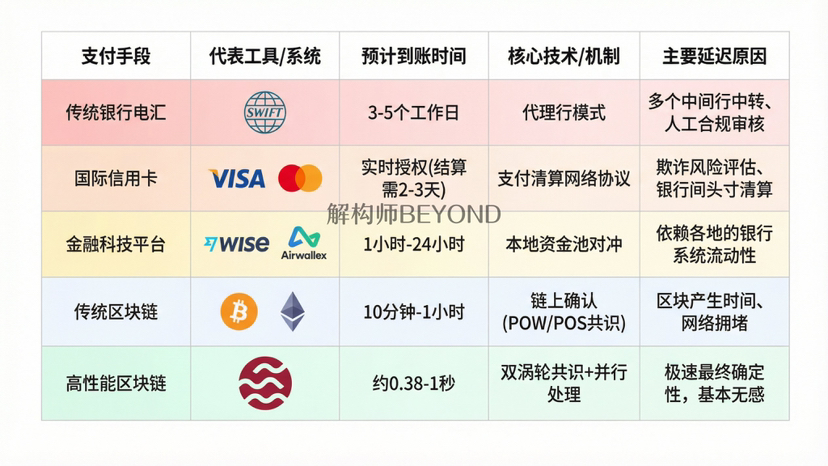
❚ Why do traditional wire transfers take 3-5 days?
In the traditional banking system, especially within the global banking financial telecommunications association SWIFT system, funds do not actually fly to the other party's account like electronic signals instantaneously.
- Intermediate Chain: If the remitting bank and the receiving bank do not have direct business interactions, the funds must go through 1-3 intermediary banks. Each bank requires entry and reconciliation processing.
- Compliance and Review: Every cross-border transaction needs to go through KYC and AML (Anti-Money Laundering) scans. If the system triggers a warning, the transfer will enter a manual review stage, usually resulting in a delay of 24-48 hours.
- Clearing Window Restrictions: Banks only process clearings on working days and are limited by the opening hours of their respective central bank clearing systems. Cross-timezone transfers often have to be postponed by a day if one party enters off-hours.
❚ Why do credit cards 'pay quickly' but 'arrive slowly'?
The 'speed' you feel at the moment of swiping your card is actually just a front-end 'pre-authorization' illusion.
- Front-end Perception: When swiping the card, the bank system only confirms in a few milliseconds whether your limit is sufficient and whether the card is secure, and sends back a 'confirm payment' digital signal to the merchant.
- Back-end is Slow: The actual flow of funds needs to go through the merchant, acquirer, card organizations (Visa/Mastercard), and issuing bank for reconciliation. This settlement usually occurs late at night in a 'batch processing' manner.
- Risk Buffer: The 2-3 days of delay is not only for system reconciliation but also to provide a processing buffer for fraud detection and chargebacks. This 'slowness' is determined by the asynchronicity of traditional accounting systems.
❚ Blockchain Case Analysis: Why can Sei (@SeiNetwork) achieve less than 1 second?
Compared to traditional finance and even early blockchains like Bitcoin, Sei, which is specifically designed for high-performance trading, has achieved a qualitative leap as a Layer 1 protocol.
- Finality (TTF): Sei's testing and operational data show that its finality only takes about 380 milliseconds, with the fastest achieving sub-second settlement, meaning that from the moment you click send to the transaction being unchangeable on the chain, it takes less than 1 second.
- Twin-Turbo Consensus Mechanism: Traditional blockchains process in a serial manner, while Sei optimizes block propagation and prediction mechanisms, allowing validators to reach consensus more quickly, significantly compressing confirmation times.
- Parallelization: Just like SWIFT requires step-by-step reviews, traditional blockchains are often processed in a queue. Sei allows unrelated transactions to be processed simultaneously, similar to transforming a single-lane road into a multi-layered highway, completely solving the delays caused by queuing.
/
Returning to the initial question, blockchain, especially high-performance blockchains like SEI, is the best way to optimize the international payment system from a technical standpoint.
So why worry about not having a future?