
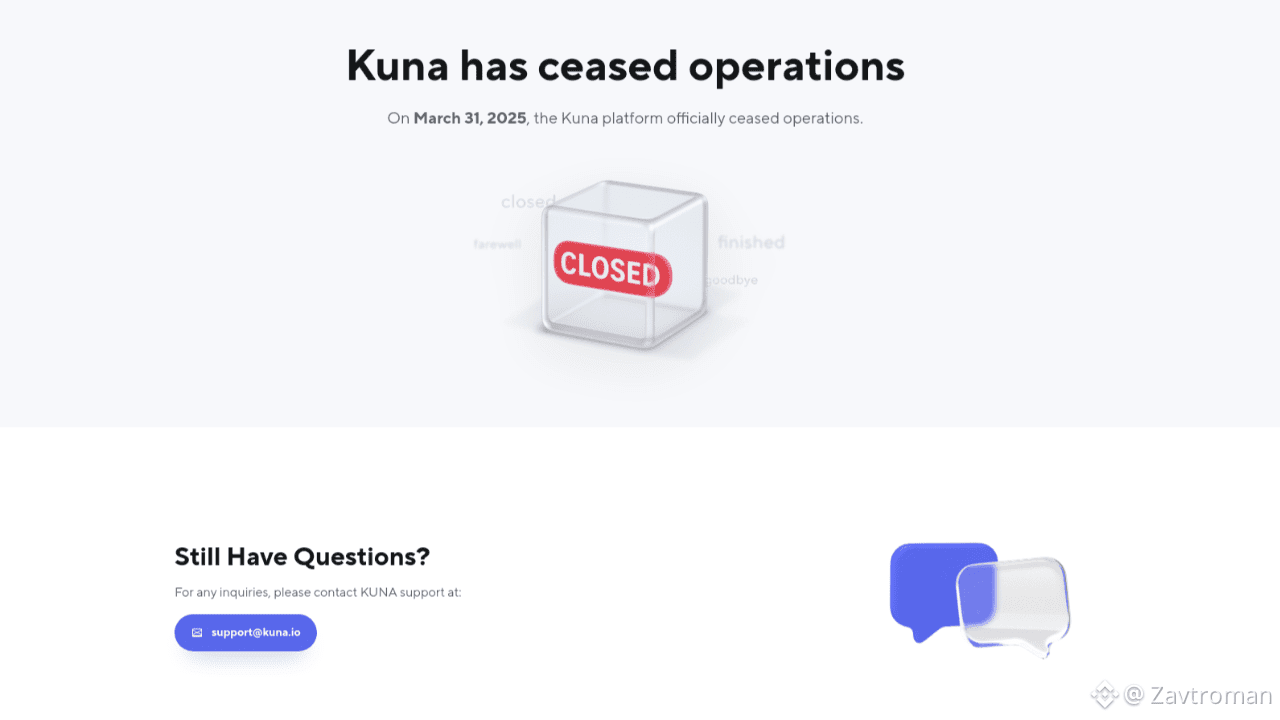
The closure of the Ukrainian cryptocurrency exchange Kuna.io was not just the departure of another platform from the market, but a troubling signal about how fragile the entire structure of the 'local crypto infrastructure' turned out to be. Formally - 'managed termination of activities'. In fact - a sharp and poorly explained collapse, to which a significant part of the users were unprepared.
Speed as a marker of crisis
The key feature of the collapse of Kuna is its swiftness. Between the court ruling to block the domain in Ukraine (January 2025) and the actual halt of trading, only a few weeks passed. For a centralized exchange with a long history, this is an anomalously short period.
There was neither a pre-prepared communication plan nor clear crisis management. Users learned about new restrictions post-factum - through Telegram(!?), rumors, and support messages in chat.
Such a pace of closures does not appear as a 'strategic decision,' but as a reaction to a sudden loss of control and a forceful change of asset ownership.
Incompetence or conscious risk
In light of the events, the question is increasingly being raised: was the exchange team even prepared for regulatory pressure?
Lack of a license in a clear jurisdiction, blurred accountability structure, reliance on 'special status' and public activism instead of legal protection - all of this resembles a systemic management error.
When the exchange is unable to ensure the basics - stable withdrawals and transparent timelines - discussions about 'mission' and 'proof-of-reserves' seem like attempts to divert attention from the main issue: operational failure.
Withdrawal issues: a troubling area
It is precisely the withdrawal of funds that has become the most painful point.
Extremely limited timelines, manual processing of requests, dependence on support, lack of any guarantees - all of this sharply increases risks for clients. For some users, Kuna has de facto turned from an exchange into a black box, where access to their own assets depends on the goodwill of the operator.
Even if funds are formally preserved, the model 'write to support after the deadline' is a red flag for any financial platform.
#Коррупция , legal lawlessness and toxic suspicions
A separate layer of the crisis is complete legal opacity. Blocking at the request of a law enforcement agency without public accusations, without clearly articulated claims, without an open court - all of this fuels the feeling of legal arbitrariness.
Against this backdrop, the harshest versions began to circulate in the public domain:
— possible use of the exchange as a transit platform for dubious flows;
— questions regarding AML controls;
— suspicions that funds related to the drug market or financing of banned structures could have passed through the crypto infrastructure.
— and the most common - the forceful seizure of users' assets by affiliated structures for personal enrichment.
It is important to emphasize: these accusations have not been proven. But the very fact that they have become widely discussed is a direct consequence of the lack of transparency and coherent responses from the exchange and the state. There is no smoke without fire.
Conclusion
Collapse#Kuna — this is not just the story of one company. It illustrates how incompetent management, regulatory vacuum, and pressure can destroy your assets accumulated over years in just a few weeks.
And an already dubious economic reputation this time did not just wobble but cracked seriously, revealing its true face to local and foreign investors.
For users and potential investors, the conclusion is clear and unpleasant:
In conditions of legal uncertainty, lawlessness, and corruption of power structures, any centralized crypto exchange can be shut down quickly, and access to funds can be called into question.
#Ukraine, Odesa, January 2026.