

2026 might be a magical year!
From the perspective of the Kondratiev cycle (Kondratiev long wave, Kondratiev wave) theory:
As of now (January 2026), the global economy is at a critical turning point: at the end of the fifth Kondratiev cycle (driven by information technology/internet) downturn, while about to enter or already in the early phase of the sixth Kondratiev cycle (driven by artificial intelligence, new energy, biotechnology, etc.) recovery.
The mainstream phases and the current positioning of the Kondratiev cycle are usually divided into four stages:
Recovery, prosperity, recession, and depression, each lasting about 50-60 years.
Common divisions are as follows: The fifth Kondratiev wave (approximately 1990-2025): the core drivers are the internet, mobile internet, and information technology.
The prosperity period is roughly around 2000-2008/2010 (growth continued after the internet bubble).
The recession period is approximately from the 2010s to the early 2020s.
The depression period is roughly from 2015 to 2025 (the pandemic, inflation, deleveraging, geopolitical conflicts, etc., compounded, leading to sluggish global economic growth, significant debt pressure, and stagnant productivity).
Most macro analysts believe that 2025 is the last year or bottom year of the fifth Kondratiev wave depression, with 2026 gradually starting to move away from the bottom.
The sixth Kondratiev wave (expected to start around 2025/2026 until the 2070s):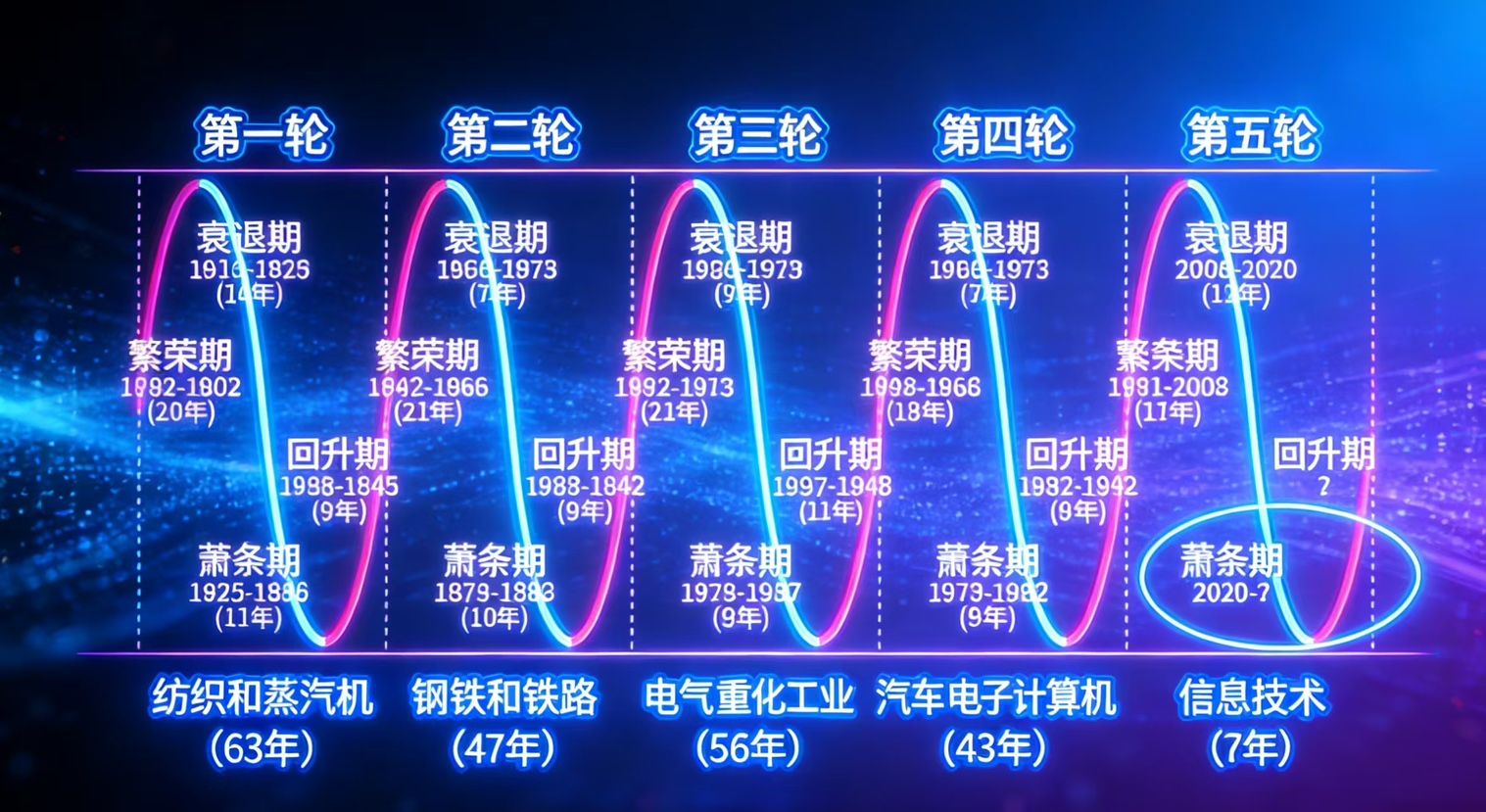
The core technological paradigm shifts towards artificial intelligence (AI), new energy (photovoltaics/storage/hydrogen/electrification), biotechnology/quantum computing, and other integrations. 2026 is widely regarded as the starting point or the official opening year of the recovery period.
Characteristics: New technologies shift from laboratory/early commercialization to large-scale application, infrastructure investment accelerates, productivity begins to recover, the economy gradually emerges from the trough, inflation stabilizes at low levels or gently rises, and emerging industries become the engines of economic growth.
Typical signals and consensus for 2026, as noted by several macro analysts and institutional reports (such as Xueqiu, Dongfang Caifu, and some brokerage research reports), position 2026 as a "turning year" or the "starting point of the Kondratiev recovery."
Globally, there may be a "lard resonance" (pig cycle + oil price/commodity recovery), a shift in Federal Reserve policy towards easing (interest rate cuts or even QE expectations), cross-border capital return, and recovery in emerging markets.
Asset opportunities: AI infrastructure, computing power, new energy chains, gold/precious metals, and some commodities are viewed as a configuration logic balancing artificial intelligence in one hand and physical assets in the other.
However, the early stage of recovery is still accompanied by fluctuations: the clearing of old capacities is not complete, there is pressure from debt restructuring, and geopolitical and policy uncertainties may lead to characteristics of a "W-bottom" or a "U-shaped" bottom.
Kondratiev theory belongs to the long-cycle macro framework, which has strong explanatory power but is not an exact predictive tool. Different scholars have a 1-5 year difference in specific start and end years (for example, some believe the sixth wave started after 2009, but the mainstream view still sees 2025-2026 as a watershed).
Current positioning is more based on the technology diffusion curve, economic data (such as global purchasing managers' index, productivity growth, inflation bottom), and market narrative consensus.
In 2026, we are likely transitioning from the "late stage of the fifth Kondratiev wave depression" to the "early stage of the sixth Kondratiev wave recovery." This represents a potential long-term wealth restructuring window, but in the short term, we must remain vigilant about the pains and uncertainties associated with the cycle switch.