
I’ve started looking at the Web3 space in a slightly different way lately. Not through the usual lens of “who has the highest TPS” or “what’s trending in DeFi,” but through a more human question:
Where will normal people actually feel blockchain?
For years, the answer was mostly financial. Bitcoin as scarcity. Ethereum as programmable money. Everything else was either a remix, a faster settlement layer, or a new way to speculate. But the internet doesn’t run on “settlement” as a user experience. It runs on habits: messaging, media, games, payments, identity, search, memory. The parts of digital life that happen daily, almost unconsciously.
That’s where @Vanar is trying to place itself—less like a chain competing for traders, and more like an infrastructure stack aiming to power consumer experiences and AI-native applications, where blockchain fades into the background and value flows quietly underneath.
The New Bet: Infrastructure That Thinks (Not Just Executes)
Vanar’s most interesting evolution is that it’s no longer selling itself as “just a gaming chain.” The messaging has expanded into something bigger: an AI-powered blockchain stack designed for applications that need memory, reasoning, automation, and domain-specific flows.
On Vanar’s own positioning, the chain is built to support AI workloads natively—things like semantic operations, vector storage, and AI-optimized validation—so apps can become intelligent by default, not AI bolted on later.
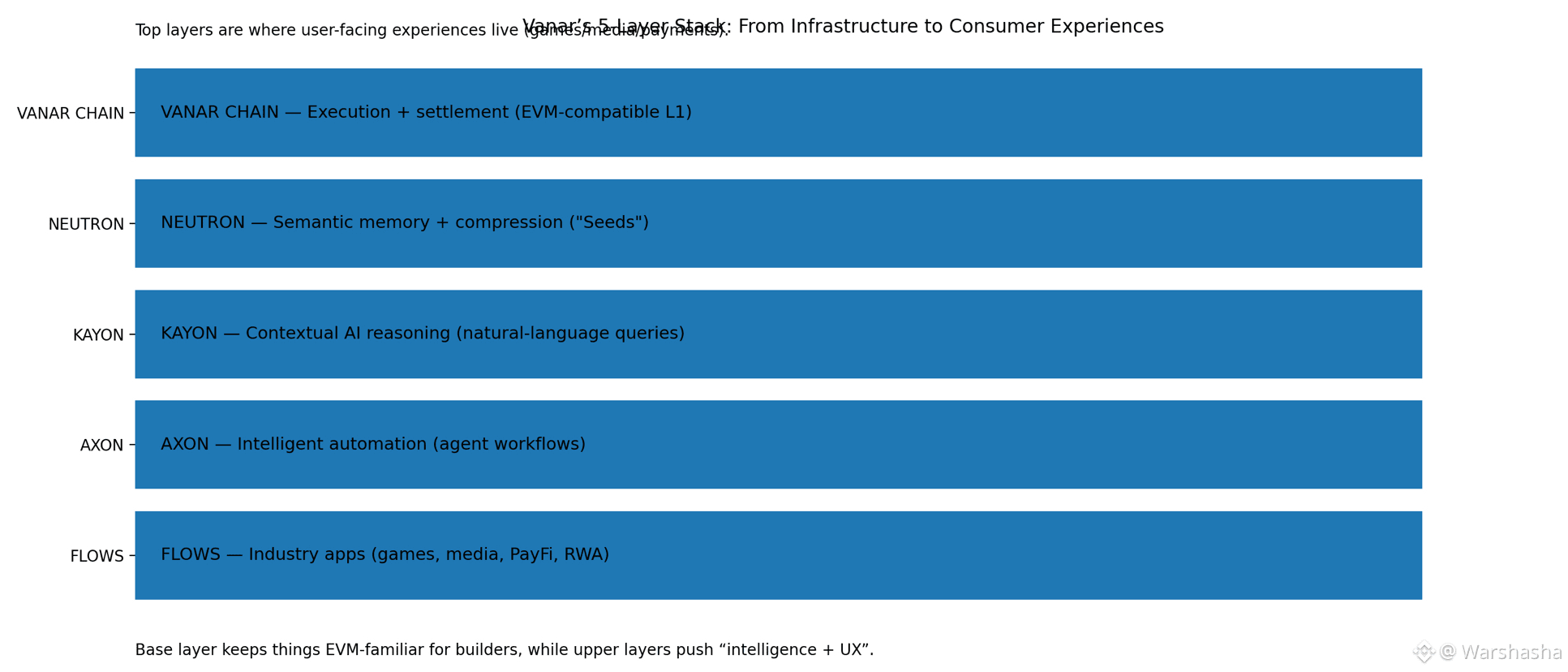
And the way they frame this isn’t as one feature. It’s a full architecture:
#Vanar Chain (base execution + settlement)
Neutron (semantic memory)
Kayon (AI reasoning)
Axon (automation layer, “coming soon”)
Flows (industry applications, “coming soon”)
That stack approach matters. Because it implies Vanar isn’t trying to win a single narrative cycle—it’s trying to become a platform where intelligence compounds, and where end-user products don’t feel like “crypto apps.”
Why “Gaming + Entertainment” Still Makes Sense (Even in an AI-first Pivot)
Gaming and entertainment are still Vanar’s most natural proving grounds—even if the AI stack now steals the spotlight.
Games are already:
always-on economies,
identity systems,
marketplaces,
social graphs,
and retention engines.
The one thing they hate is friction. Nobody wants to “approve a token” to equip a sword.
Vanar’s developer-facing pitch leans into familiar tooling (it describes itself as an Ethereum fork / EVM-familiar environment) and pushes the idea of low-cost and high-speed usage with a fixed transaction price claim on its developer page.
That’s exactly the kind of economic predictability gaming studios want. Not “gas spikes,” not “random fee markets,” but something you can budget like infrastructure.
So even as Vanar expands into PayFi and RWA language, the consumer-experience DNA still fits: consumer apps, gaming loops, creator economies, interactive worlds—these are where “invisible blockchain” either works or fails.
The Part That Feels New: myNeutron as a Consumer Product With Real Revenue Logic
Here’s where Vanar starts looking less like a normal chain roadmap and more like a product company strategy:
myNeutron is positioned as a cross-platform AI memory layer—basically one persistent knowledge base that can travel with you across major AI platforms.
CryptoDiffer described it as capturing pages, emails, documents, and chats and turning them into verifiable on-chain “Seeds,” while linking paid usage to $VANRY buybacks and burns.
And the signal I personally find strongest is this:
Vanar Communities explicitly tied a subscription launch (Dec 1) to “real revenue” funding buybacks and burns—framing it like an economic flywheel rather than token inflation theater.
Whether someone loves or hates the model, it’s a very different kind of thesis than “launch token → hope TVL appears.” It’s closer to:
ship a product normal people can pay for → convert usage into value capture → route value capture back into token economy.
That’s the kind of structure that can survive outside of bull market attention.
$VANRY ’s Value Capture Story (When Utility Isn’t Just a Slogan)

A lot of ecosystems say “utility.” Few actually attach it to a mechanism that’s easy to explain.
One Binance Square analysis (third-party, but aligned with Vanar’s own public messaging around subscriptions) described the model as: AI services paid in $VANRY , with a portion used for market buybacks and permanent burns, aiming for a deflationary pressure that scales with usage.
I don’t treat any single write-up as gospel, but the direction is consistent across multiple references: consumer AI usage + subscription revenue + token value capture.
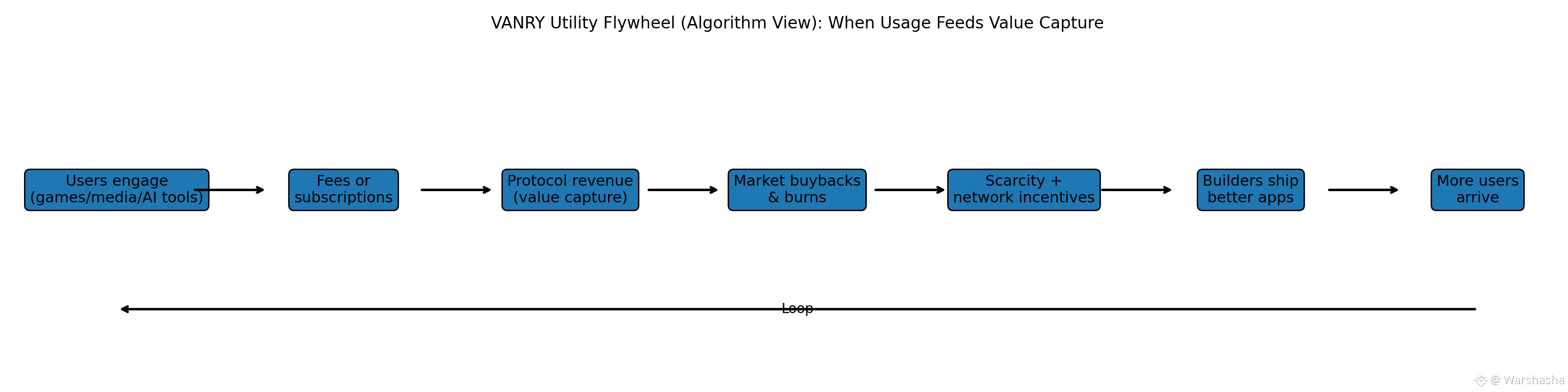
That’s why I built the VANRY Algorithm Flywheel diagram the way I did—because it’s not just “token pays gas.” It’s a loop:
users pay for something real (apps / AI tools),
value is captured,
scarcity/incentives tighten,
builders get rewarded,
better products ship,
more users show up.
And if that loop actually runs with measurable metrics, it becomes a story the market understands fast.
Execution Still Matters: Partnerships, Payments Rails, and Real-World Infrastructure
None of this matters if adoption is just words.
Two real execution signals stand out:
1) Payments infrastructure is being staffed like a serious lane
In December 2025, Vanar appointed Saiprasad Raut as Head of Payments Infrastructure (covered by FF News), explicitly framing Vanar’s as building rails for stablecoin settlement, tokenized value, and agentic financial automation.
That hire is a statement: Vanar isn’t only thinking “consumer gaming.” It’s thinking consumer + payments + automation as a combined future.
2) Builder ecosystem development with real institutional support
A Daily Times report on Vanar’s Web3 Leaders Fellowship described a four-month program backed with Google Cloud support, with teams demoing products and receiving credits and milestone-based grants.
This is the less glamorous part of growth—mentorship, code reviews, product clinics, grants, and repeated cohorts. But it’s exactly how ecosystems stop being “a chain” and become “a place where products ship.”
My Honest Take: Vanar’s Real Differentiator Isn’t “Faster Chain” — It’s the Stack Mentality
If I had to summarize Vanar’s current direction in one sentence, it would be:
They’re trying to turn blockchain from a database into a layered intelligence system.
That’s not a guarantee of success. But it’s a different kind of ambition than most L1s still stuck competing for the same liquidity and the same developer mindshare.
And the biggest strategic advantage here is optionality:
If gaming adoption accelerates → Vanar fits the consumer rails narrative.
If AI agent usage explodes → Vanar’s Neutron/Kayon story becomes the headline.
If payments and tokenized value scale → Vanar is hiring and framing for that too.
In a modular world, you don’t need to be everything—you need to be the best place for a specific kind of application to thrive.
#Vanar is betting that the next wave of Web3 isn’t “more DeFi.”
It’s more life: memory, identity, payments, play, culture—powered by systems that users don’t have to understand to enjoy.
And if that’s the direction the internet is moving, then chains that can hide complexity while still providing real guarantees will be the ones that matter.