

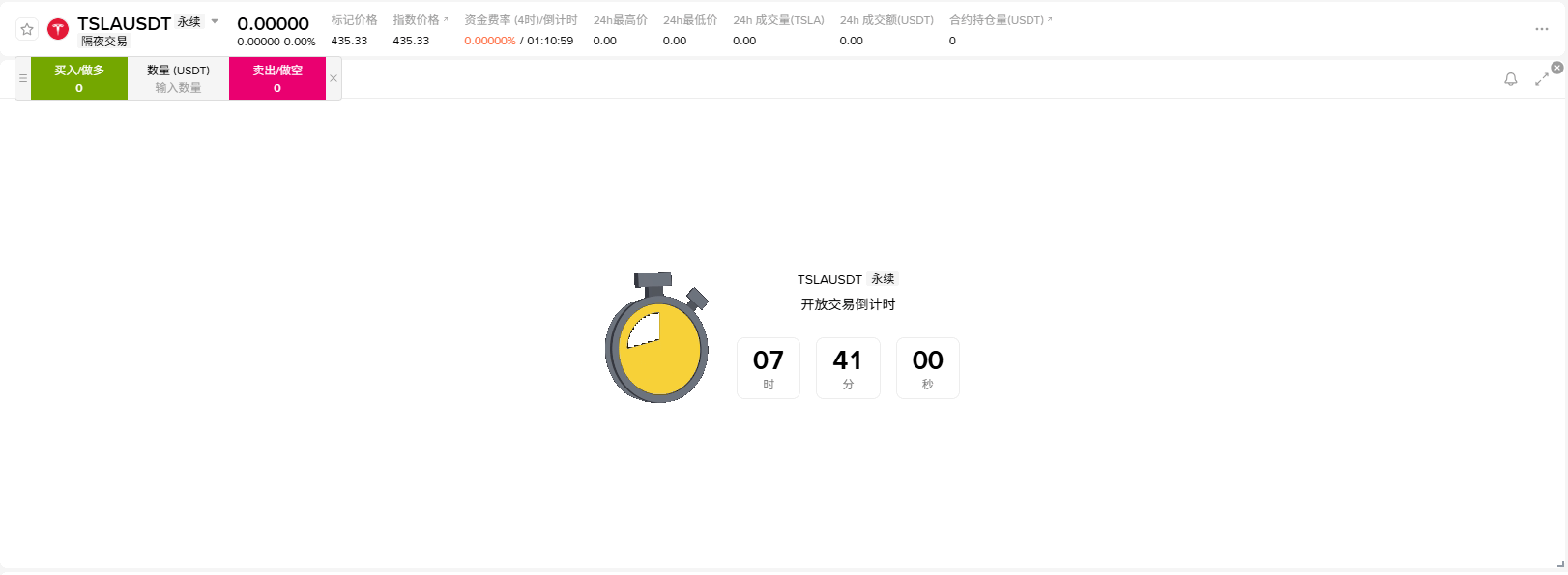
Introduction: The moment I saw $TSLA on Binance
Recently, while browsing Binance, I suddenly froze for a moment.
TSLA, Tesla, appeared on the list of crypto trading pairs.
Not news, not conceptual discussions, but real tradable products.
At that moment, I realized one thing:
This is no longer about 'the crypto market riding the wave of traditional assets,' but rather two originally separate financial worlds beginning to overlap on the same trading interface.
Moreover, if we extend the timeline, TSLA is not the starting point.
Starting from gold and silver: the crypto market does not exclude traditional assets.
Many people subconsciously feel that:
the crypto market only welcomes 'native crypto assets'.
But the reality is exactly the opposite.
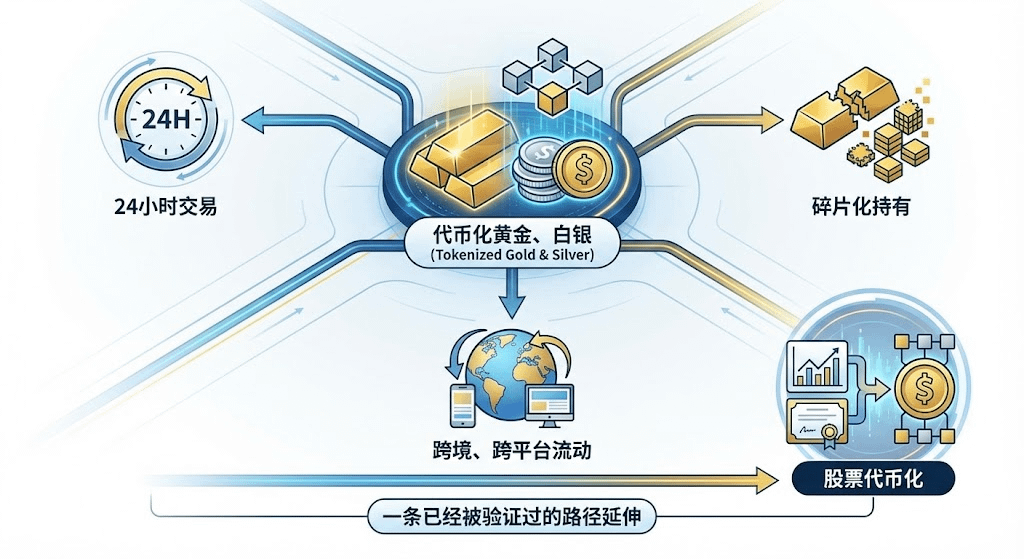
Recently, gold and silver surged, and during severe market fluctuations and declining risk appetite, what is often introduced on-chain first is not new narratives, but gold and silver, which are long-validated assets.
The significance of their tokenization is not to 'make assets sexier', but to solve several very realistic problems:
Can it be traded 24 hours?
Can it be fragmented?
Can it flow across borders and platforms?
Once these issues are resolved, the market will provide feedback in real money.
From this perspective, tokenizing stocks is not radical innovation, but an extension of a path that has already been validated.
Why TSLA? This is a very 'crypto-native' choice.
Binance's choice of TSLA is actually not surprising.
Tesla itself stands at multiple narrative intersections:
Technology
High Growth
High Volatility
Globally recognized to a high degree
More importantly, the 'understanding cost' in the crypto space is extremely low.
Even if you never trade U.S. stocks, you probably know about Musk, Tesla, and its volatility.
From the exchange's perspective, this is a very rational strategy:
First, choose the stocks that are easiest for crypto users to accept, to validate whether the model holds.
Once TSLA can run liquidity, risk control, and user participation smoothly, the subsequent path will become clear:
More U.S. stocks → indices → stock assets from different markets.
Why do crypto exchanges want to 'introduce stocks'?
Many people will ask:
"The exchange already has so many coins, why bother with stocks?"
The answer is actually very realistic.
For most active traders, the focus has long been more than just coin prices:
Federal Reserve
U.S. Tech Stocks
Macro Risks
Global Liquidity
But the reality is that these assets are fragmented across different systems:
Stocks are with brokers,
coins are on exchanges,
capital is repeatedly switched between different accounts.
What crypto exchanges are trying to do is:
decouple 'trading ability' from asset types.
As long as trading is efficient, settlement is fast, and risks are transparent,
it doesn't really matter whether the asset is a coin, a stock, or a commodity.
Looking at the trend: stock tokenization will not stop at 'trying it out'.
From a trend judgment perspective, I am personally optimistic.
The reason is not complicated:
First, exchanges naturally need more tradable assets to maintain activity.
Second, the obsession of the new generation of investors with the 'background' of assets is weakening.
Third, traditional finance is also moving closer to on-chain, researching 24/7 trading and on-chain settlement.
From this perspective,
it is not that crypto is eroding traditional finance, but that both sides are converging on the same efficiency curve.
Stock tokenization is more like a technological upgrade than a camp confrontation.
Conclusion: This is not 'the crypto circle rolling stocks', but the financial boundaries disappearing.
Back to the initial scene:
When TSLA appears on the Binance trading interface, what it truly represents is not the launch of a specific product.
But it is a signal:
The way assets are traded is breaking away from the original financial boundaries.
When stocks can be traded 24 hours like crypto assets,
when traditional assets can be split, combined, and flow across platforms,
the market's focus will no longer be 'which system it belongs to',
but: who can provide a more efficient trading experience.
From gold, silver, to TSLA,
This path has been walked step by step.
Next, more stock-like tokens will appear,
which is not an accident,
but a trend.