
In the current market where mature stablecoins like USDT and USDC dominate, what makes USD1 stand out?
My answer is: policy dividends + compliance advantages + ecological incentives.
1. Policy dividends: Stablecoin endorsed by the Trump family
Unique political advantages
White House-level endorsement: Crypto project directly supported by the Trump family
Policy-friendly environment: The current government has a positive attitude towards cryptocurrencies, and USD1 is a beneficiary of this policy
First-mover advantage in regulation: Integrated KYC/AML protocols from the outset, managed by the regulated U.S. trust company BitGo Trust
Comparing with other stablecoins:
USDT: long-term regulatory scrutiny, ongoing reserve transparency disputes
USDC: although compliant, lacks direct policy support
BUSD: issuance has been suspended by regulators
USD1: optimal policy environment, strongest compliance
Two, real monetary incentives: Binance $40 million airdrop
Holding means earning
Other stablecoins can only 'stabilize', USD1 allows you to 'stabilize + earn':
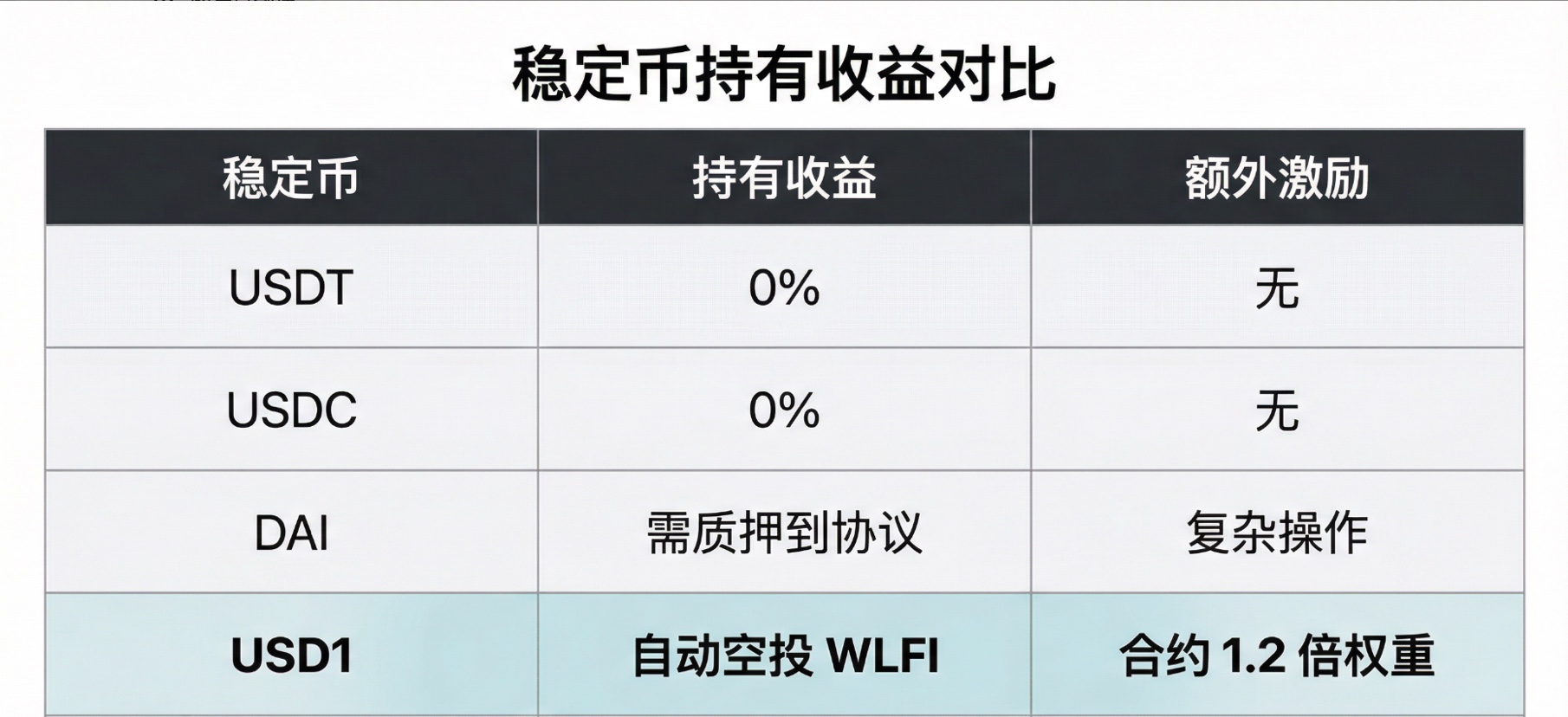
Binance airdrop details:
Total prize pool: $40 million WLFI tokens
Duration: 4 weeks (until February 20, 2026)
Participation threshold: zero threshold, just hold
Contract bonus: enjoy 1.2 times rewards by using USD1 as margin
Let's do the math:
Holding 10,000 USD1 = automatically participating in the weekly $10 million prize pool distribution
If used as contract margin = rewards calculated based on 12,000 USD1
Also allows contract trading to earn additional returns
Three, market validation: $4.75 billion market cap, surpassing PayPal PYUSD
Rapidly rising market position
Market cap ranking: has surpassed PayPal's PYUSD to become an important player in the stablecoin market
Sufficient liquidity: 24-hour trading volume $157 million
Price stability: 7-day fluctuation ±0.01%, standard stablecoin performance
Coverage of top exchanges
USD1 has been launched on all major CEXs:
Binance (USD1/USDT, USD1/USDC)
Coinbase (USD1/USD)
OKX (USD1/USDT)
Bybit (USD1/USDT)
Comparison: emerging stablecoins often take months or even years to gain support from major exchanges, USD1 has achieved full coverage in a short time, proving its market acceptance.
Four, innovative application scenarios: not just stability
Traditional stablecoins vs USD1
Traditional stablecoins:
Single function: only as a value storage and trading medium
Application scenarios: trading pairs, payment settlement
The innovative layout of USD1:
Satellite DeFi:
In collaboration with Spacecoin
USD1 as a payment and settlement tool for satellite networks
Serving remote areas with insufficient coverage from traditional banks
Global application scenarios
Crypto lending:
World Liberty Markets platform
USD1 as a lending settlement asset
Expanding DeFi application boundaries
Multi-chain deployment:
True full-chain coverage
Ethereum (mainnet)
Solana (high performance)
BSC (low cost)
Tron (Asian market)
Five, reserve transparency: institutional-level security standards
Reserve asset composition
100% fiat currency collateral: each USD1 is backed by 1 dollar in assets
High-quality assets: U.S. Treasury bonds + money market funds
Regular audits: independent third-party audits, high transparency
Issuer background
BitGo Trust Company: regulated U.S. trust company
Institutional-level management: professional asset custody and risk control
Compliance first: integrating KYC/AML protocols from inception
Comparison with USDT:
USDT reserves have long been opaque, previously questioned for insufficient reserves
USD1 has established a transparent audit mechanism from day one
Six, suitable for your scenario
Scenario one: stablecoin allocation
If you hold a large amount of stablecoin assets, USD1 offers:
The same stability (1:1 pegged to the dollar)
Higher security (compliance regulation + transparent reserves)
Additional earnings (airdrop incentives)
Scenario two: contract trading
If you are a contract trader, USD1 offers:
Stable margin assets
1.2 times airdrop weight bonus
Full support from major exchanges
Scenario three: long-term holding
If you are optimistic about cryptocurrencies but want to avoid volatility, USD1 offers:
Policy dividend (Trump family support)
Ecosystem expansion (satellite DeFi, lending platforms)
Market recognition (beyond PayPal PYUSD)
Seven, risk comparison: there is no perfect stablecoin
Risks of USD1
Centralization risk: holders are highly concentrated (top three addresses hold about 85%)
Political risk: association with the Trump family may bring policy changes
New project risks: compared to USDT/USDC, history is shorter
Risks of other stablecoins
USDT: reserve transparency disputes, regulatory uncertainties
USDC: affected by U.S. regulation, briefly de-pegged due to a banking crisis
DAI: algorithmic stablecoin mechanism is complex, collateral price volatility risk
BUSD: has been suspended by regulators, gradually exiting the market
Conclusion: every stablecoin has risks, USD1's risks mainly lie in centralization and political connections, but it has clear advantages in compliance and policy support.
Eight, data speaks: USD1 vs mainstream stablecoins
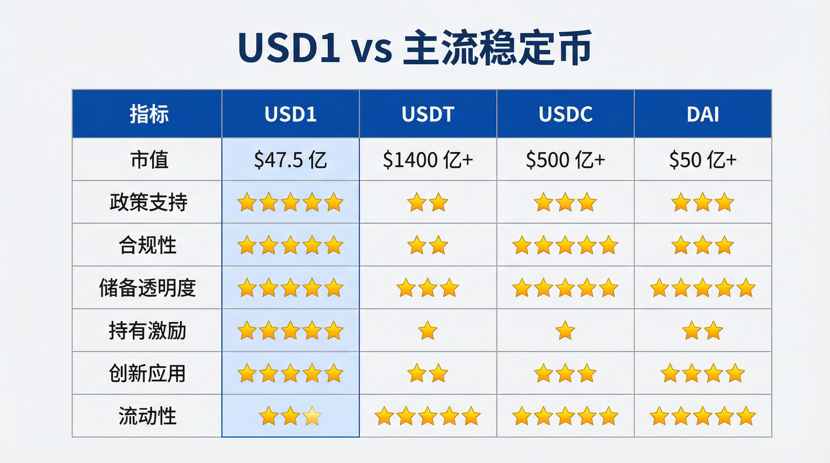
Summary: USD1's three core advantages
1. Policy advantage = long-term certainty
In a tightening regulatory environment, the compliance framework and political backing of USD1 provide a certainty that other stablecoins find difficult to replicate.
2. Incentive advantages = short-term profitability
$40 million airdrop + 1.2 times contract weight makes 'stablecoin' no longer just 'stable', but able to bring actual earnings.
3. Ecological advantages = future imagination space
Satellite DeFi, lending platforms, multi-chain deployment, USD1 is not just a stablecoin, but the core infrastructure of the World Liberty Financial ecosystem.
Final words: in the stablecoin market, USDT is the big brother, USDC is the compliance benchmark, while USD1 is a new species of policy dividend + innovative application + real monetary incentives.
Event countdown: less than 4 weeks until the $40 million airdrop ends, early participation means early benefits.
Data as of: 2026-01-25 | Author: Ice Cream War God