
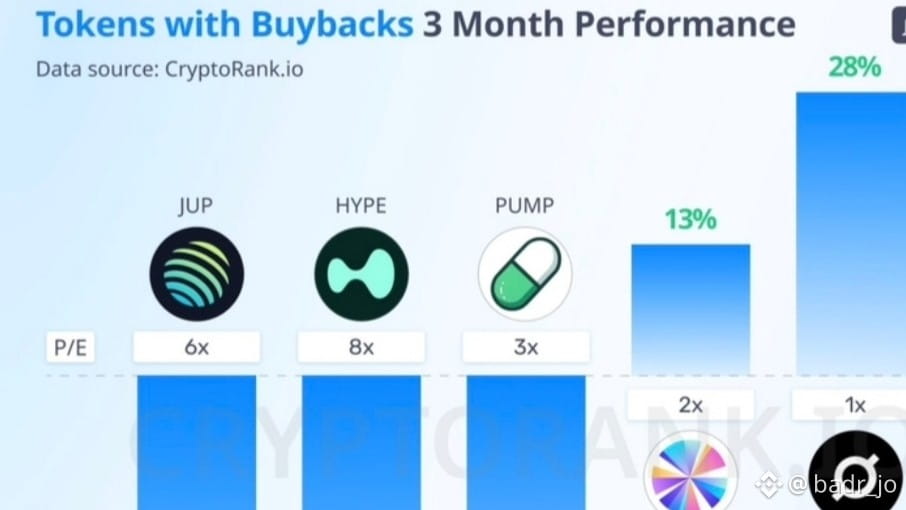
Token buybacks will not save your price — at least not in this market
For a long time, crypto believed that buybacks were the cleanest way to 'return value' to token holders.
The logic seemed perfect. A protocol attracts users. Users generate fees. The fees become revenue. The revenue is used to buy back tokens. A reduced supply drives up the price, which attracts more users, more activity, more fees, and even more buybacks. In a bull market, this inertia wheel not only works — it seems inevitable.
But once the market turns, this story begins to break down quickly.
Overall, we have seen tokens with aggressive buyback programs — even those trading at seemingly attractive valuations — fall just as hard as tokens without a buyback mechanism. The problem is not that buybacks are conceptually bad. The problem is that buybacks are completely at the mercy of market conditions.
When sentiment changes, users leave. Usage declines. Fees decrease. The buyback volume decreases with them. The buying pressure that everyone was counting on quietly disappears. At this point, buybacks cease to be a growth driver and begin to look more like a band-aid on a much deeper wound.
If you look at the protocols with the highest daily buyback value over the past few months, a clear pattern emerges. Most of them are still significantly down, with only a few exceptions. The presence of buybacks has not changed the direction — it has simply mitigated the impact.
The deeper problem lies in the real origin of buybacks. They are financed by revenues or cash capital, while the protocol's performance is closely tied to the broader market cycle. When conditions deteriorate, both sides of this equation weaken at the same time.
A good example is HYPE from Hyperliquid. The project itself is not lacking. The product-market fit is clear, the product is solid, and user growth has surprisingly held up well in a tough environment. Yet, the token is still down about 50% from its all-time high.
The reason is not a lack of buybacks. It’s the offer.
Every day, the market must absorb more than 200,000 HYPE tokens being unlocked. The buyback program only compensates for a fraction of this flow. If about a third of these unlocked tokens turn into real selling pressure, the buyback loses the battle against flows on its own — even before considering retail exits or trader positioning.
In situations like this, buybacks do not reverse price trends. At best, they slow down the decline. At worst, they silently drain cash while struggling against a wave of supply that is several times larger.
What is particularly revealing is that even some of the most aggressive buyback programs in the current market have failed to change the outcome. This raises an uncomfortable question: is buyback really a form of value accumulation, or has it become a comforting narrative that only works when liquidity is abundant?
If you are buying a token primarily because 'the project is doing buybacks,' it’s probably worth taking a moment to pause. Ask yourself where this buyback funding is actually coming from. Ask yourself if it is significant enough to meaningfully offset upcoming unlocks. And ask yourself if you are looking at a real capture of value — or just a nicely packaged story designed to trigger FOMO.
Sometimes, buybacks are not a solution. They are just a delay.
#Binance #wendy #Buyback $ASTER $BNB