

The stablecoin market is often described using surface-level metrics: total supply, daily transfer volume, or exchange liquidity. While these numbers are useful, they don’t explain why stablecoins are being used or how their usage is evolving. When you look deeper, a structural shift becomes clear and it helps explain #Plasma ’s current positioning.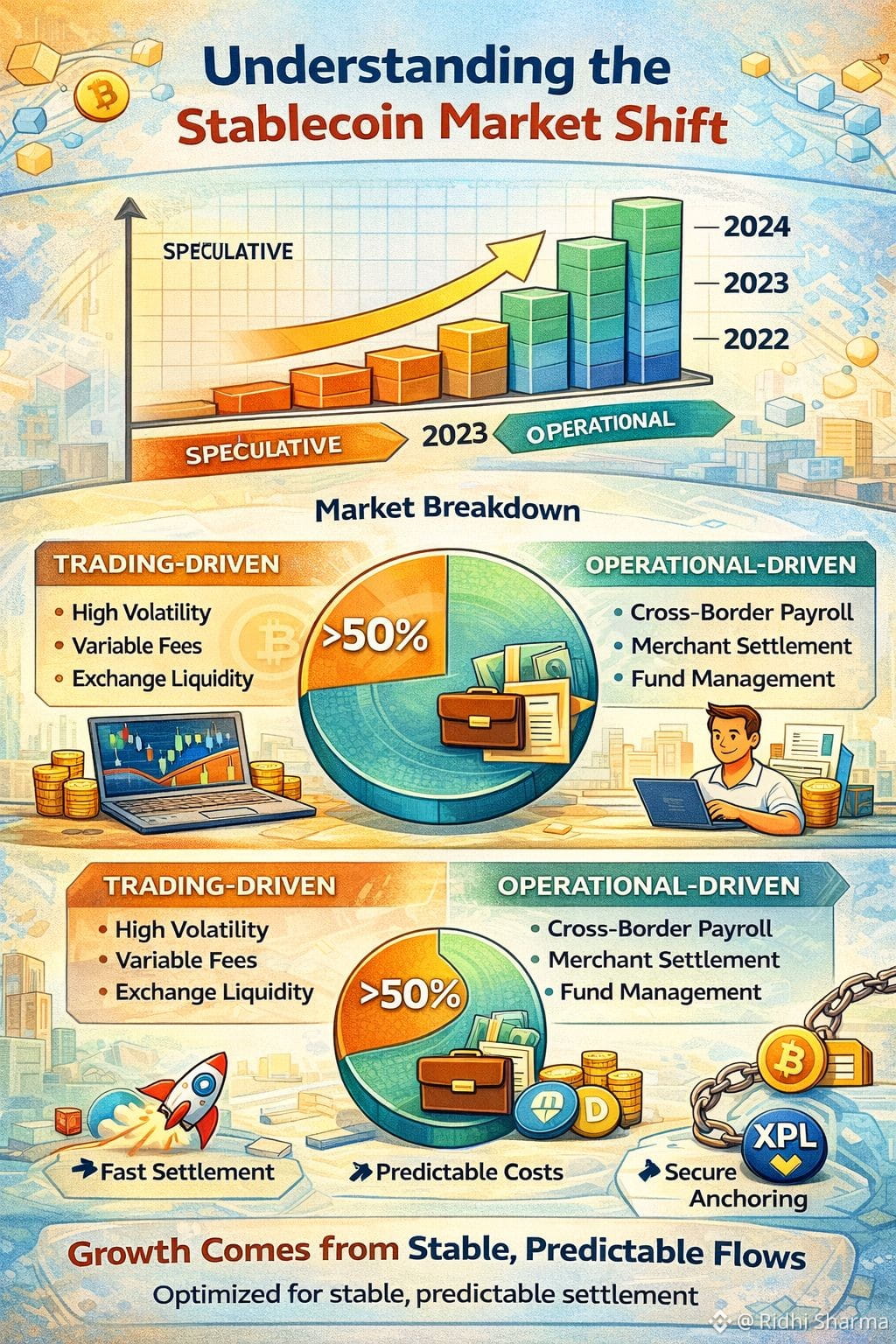
Stablecoin demand is increasingly coming from non-speculative flows.
Cross-border payroll, merchant settlement, platform treasury management, and internal fund movements now account for a growing share of stablecoin activity. These use cases behave very differently from trading. They are repetitive, time-sensitive, and cost-sensitive. They don’t tolerate uncertainty well.
#Plasma appears designed specifically for this segment of the market.
Let’s start with settlement behavior. In trading environments, delayed finality can be managed. In operational environments, it becomes a bottleneck. Businesses rely on clear balance states to trigger downstream actions: releasing goods, closing invoices, reconciling accounts. Plasma’s sub-second finality through PlasmaBFT directly supports this kind of activity.
This isn’t about speed for its own sake. It’s about synchronizing on-chain settlement with off-chain operations. When settlement lags, human and system processes stall. Plasma removes that lag by design.
Fee structure is another key signal of market awareness.
In speculative environments, users accept variable fees. In operational environments, variable fees create budgeting problems. Plasma’s stablecoin-first gas model aligns transaction costs with the way businesses already think about expenses. Fees become part of the transaction, not an external variable to manage.
This matters at scale. When stablecoin usage becomes repetitive, even small inefficiencies compound. Plasma’s fee logic reduces friction not once, but continuously.
Security anchoring to Bitcoin plays a different role when viewed through a market structure lens. Businesses and platforms evaluate infrastructure over long time horizons. They want assurances that settlement rules won’t change unexpectedly. Anchoring to Bitcoin provides an external reference point that reinforces long-term credibility.
Now consider $XPL within this evolving market.
Instead of being framed as a growth lever, XPL functions as a stability mechanism. Its role in validation and network security ties incentives to uptime, correctness, and continuity. This is particularly important when a network supports operational flows rather than opportunistic usage.
Markets punish instability in infrastructure layers. Plasma’s incentive structure appears designed to reduce that risk.
Another important aspect of this market shift is geographic. Stablecoin adoption is accelerating fastest in regions where traditional financial rails are expensive or slow. These users don’t want experimental systems they want dependable settlement. Plasma’s design choices map closely to those needs.
Educational distribution through platforms like entity["company","Binance","crypto exchange platform"] and Binance Square also fits this phase of the market. Education here is not about attracting speculators. It’s about helping users and builders understand where Plasma fits in the broader ecosystem.
When users understand that #Plasma is optimized for settlement flows rather than speculative activity, expectations align. That alignment reduces misuse, friction, and disappointment factors that often slow adoption.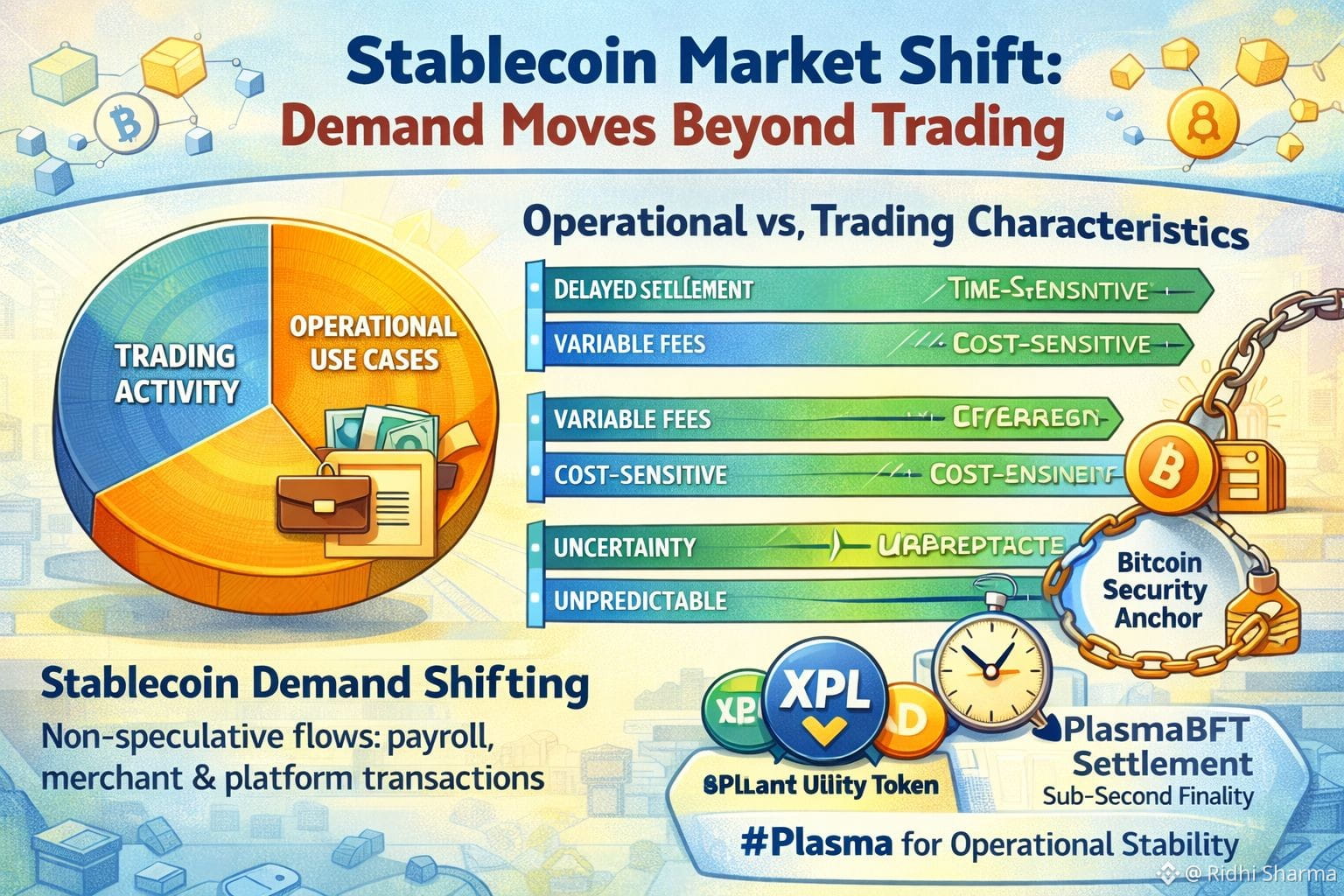
From a market perspective, Plasma isn’t trying to absorb all stablecoin activity. It’s targeting the segment that values predictability over optionality. That’s a smaller market today but it’s growing steadily as stablecoins integrate deeper into real economic processes.
The projects that succeed in this environment will not be the ones with the loudest narratives. They will be the ones whose infrastructure quietly supports daily financial movement without disruption.
Viewed through this lens, Plasma and $XPL look less like a bet on future trends and more like a response to current market structure. And systems built for how markets actually behave rather than how we wish they behaved tend to endure.
