
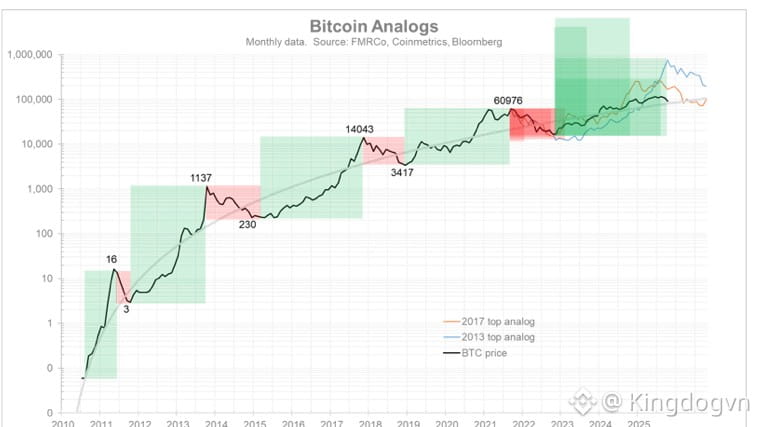
Yesterday and the morning of 31/1/2026, the Bitcoin (BTC) market is witnessing a significant price drop, with prices fluctuating around 82,000 - 88,000 USD, after reaching a high of about 96,000 - 126,000 USD in previous months. This correction is not merely a random decline but is viewed by many analysts as a 'liquidity sweep' – a process of sweeping liquidity – aimed at eliminating weak positions before initiating a new uptrend. In this article, we will analyze the current situation, the reasons behind the price drop, and the outlook for a stronger bull run in 2026.
The Concept of Liquidity Sweep and Its Role in the Crypto Market
Liquidity sweep, also known as 'liquidity sweeping', is a common phenomenon in financial markets, especially in crypto with high volatility. It involves a sharp decline in asset prices to reach lower support levels, triggering stop-loss orders from long-term investors and liquidating short positions. As a result, the market 'cleans up' weak positions, creating new liquidity and paving the way for recovery. In Bitcoin's history, liquidity sweeps often occur before major bull cycles, such as after halving or during corrections in a bull market.
According to data from exchanges, the recent price decline of BTC has led to over 4.5 billion USD in short positions being liquidated, with a potential target of 93,500 USD – where significant liquidity is concentrated. 2 Analysts like Mark Cullen from CoinGlass emphasize that hitting this level could trigger a rapid price increase as short positions are forced to close, driving prices higher.
Current Price Decline Situation of Bitcoin
Since the beginning of 2026, Bitcoin has experienced a strong sell-off, with prices dropping about 5-10% in just the last 24 hours, hitting a low of 81,000 USD. The main causes include:
Macroeconomic factors: The decision to keep interest rates unchanged by the Federal Reserve has reduced expectations for new capital inflows into the risk market. Additionally, geopolitical tensions in the Middle East and capital outflows from Bitcoin ETFs (over 140 million USD in the past week) have increased selling pressure.
On-chain data and derivatives market: The derivatives market shows caution, with indicators such as RSI falling below 50, confirming a downtrend. However, long-term indicators like realized cap suggest that new capital is still flowing into the network, indicating that this is just a correction in a bull market. 13 Furthermore, data from Glassnode indicates that the market is shifting focus to liquidity, with key support at 80,700 - 83,400 USD.
Impact from the halving cycle: 2026 is the third year after the 2024 halving, history shows this is often an 'off-year' with lower performance, but also a period of accumulation before a bull run. 10 Raoul Pal, a well-known expert, stated that this decline is just a correction in a prolonged bull market, with peak liquidity expected in mid to late 2026. 15
Posts on X (formerly Twitter) from traders like ProfitHusky also agree, predicting a final low sweep before the price rebounds to 100,000 USD+, marking the end of the bear market.
Outlook for a New Price Increase Cycle
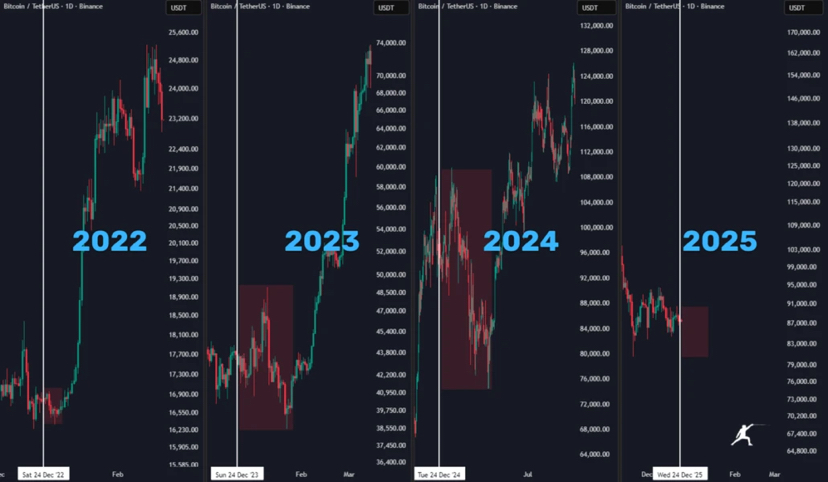
Although the current situation looks bleak, many signs suggest this is the foundation for a new bull cycle:
Global liquidity flow: From 1/1/2026, liquidity began to be pumped into the market after a tightening phase (QT) from 2022. Wyckoff Accumulation models indicate that a 'spring' phase may occur in mid-January 2026. 19
Price forecast: Analysts from Brave New Coin predict BTC could rebound to 97,000 USD after hitting the growth trendline. 4 Standard Chartered has revised its forecast to 150,000 USD by the end of 2026, removing the corporate buy factor. 0 Some even more optimistic forecasts target 185,500 USD in the first quarter of the year.
Comparison with previous cycles: Bitcoin is following a similar pattern to the years 2022-2025, where deep corrections led to strong growth. With traditional assets like gold and stocks reaching new peaks, BTC – currently 28% lower than ATH – has the potential to explode as liquidity increases. 17
However, risks still exist, such as the possibility of consecutive red candles forming on the Heikin-Ashi chart, which could signal a bear market if prolonged. 7 2 'LARGE'
Conclusion
The current price decline of Bitcoin may cause many investors to worry, but this is likely a necessary 'clearing' step to sweep liquidity and initiate a new uptrend. With favorable macro factors, new capital inflows, and positive on-chain data, 2026 promises to be a year of strong recovery. Investors should closely monitor key support levels and avoid making decisions based on emotions. As history has shown, the largest bull runs often start from the deepest corrections.