
On February 1, 2026 (which is today), Bitcoin's price fell to $78,359, with a daily decline of about 5.5%, and the fear and greed index dropped to the extreme fear range of 14 to 15.
Indeed, looking back at CZ's mention of the 'supercycle' a few weeks ago at this point feels quite jarring.
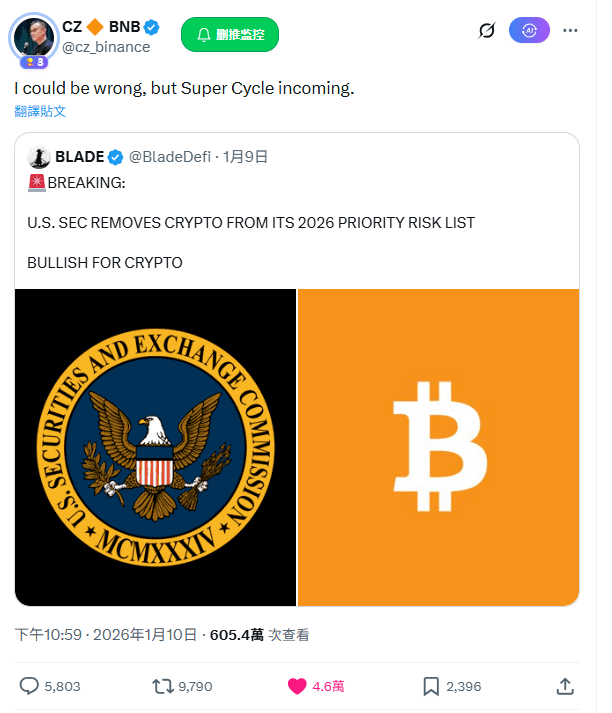
Moreover, because of this, on Twitter, in addition to criticism of his previous coin listing incident, many have also begun to specifically attack this matter.
The dissatisfaction in the market is not difficult to understand.
Price drops, sentiment cools, yet some talk about a supercycle, which sounds like speaking against the wind.
But if we temporarily remove the preset of 'calls,' returning to his complete statement at the Davos Forum on January 23, we find that this term oversimplifies things.

What is being discussed is that the market structure is changing.
More accurately, the Bitcoin market is already different from the past ten years.
Is the four-year cycle still valid?
For a long time, Bitcoin's price behavior has shown a highly consistent rhythm:
Expectations accumulate before halving, rise rapidly after halving, and then enter a deep retracement, with declines often reaching 70% or even 80%.
The core logic of this model lies in the impact brought by changes in miner supply.
By 2026, the focus of discussion begins to shift.
The market no longer only asks whether supply will decrease, but begins to focus on another question:
Has the nature of demand changed?
If demand primarily comes from capital with longer durations and different risk appetites, then the previously rapid collapse of cycles after peaks may itself be flattened.
The deep bear may not disappear, but its shape may no longer be the same.
What CZ really wanted to say at Davos
Original text:
Normally, Bitcoin follows 4-year cycles. But given how pro-crypto the U.S. is, and other countries following... I think we will break that 4-year cycle.
Bitcoin typically follows four-year cycles, but against the backdrop of U.S. policies clearly favoring crypto assets and other countries following suit, this four-year cycle may be broken.
The key to this statement lies in questioning existing patterns.
Therefore, he intentionally added a line that is often overlooked in the same interview:
If you look at a 5-10 year horizon, it's easy to predict... but for today or tomorrow, I can't predict.
If we extend the perspective to five or ten years, prediction becomes relatively easy;
But for today or tomorrow, no judgment can be given.
Dislocation of time scales
The source of controversy is actually quite simple.
Many investors interpret the 'supercycle' as an entry signal, even treating it as a commitment to price.
Once the market falls, sentiment naturally rebounds.
But what he talks about is the extension of time scales, not a specific market trend.
He describes changes in asset duration, not predictions about price movements in the first quarter of 2026.
When the analytical framework is treated as prophecy, disappointment is almost inevitable.
Observations on a data level:
Has the structure really changed?
Even if prices correct, the underlying structure is still worth observing.
During the period from 2025 to 2026, Bitcoin's annual new supply is approximately 166,000 units;
During the same period, institutional demand from ETFs and corporate buybacks absorbed over 700,000 units, with a clear gap between the two.
This does not mean that demand will only grow in one direction.
Taking ETFs as an example, there have recently been weekly net outflows, indicating that structural demand will still be affected by macro rates and risk preferences.
Valuation indicators also reflect this state.
As of February 1, 2026, the MVRV Z Score is approximately 1.41, at a historically relatively low level;
SOPR close to 1 indicates that chips are mainly changing hands near the cost line.
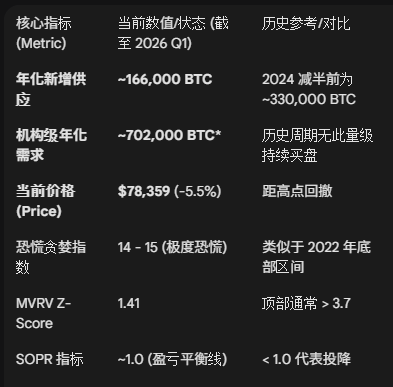
These data cannot tell us the reversal time, but they indicate that the current price already includes a considerable degree of risk discount.
If we regard the supercycle as a structure, rather than a market trend
Within this framework, the current decline itself is not enough to negate the discussion of the supercycle.
On the policy level, the U.S. shift in attitude towards crypto assets has indeed reduced the extreme regulatory risks.
This does not guarantee price increases but will affect the discount rates and holding times institutions are willing to accept.
The legislative process is still slow, and the supply-demand gap is not a one-way street.
Structural demand exists but will fluctuate with the macro environment.
Perhaps this road is long.
It may not necessarily come to our generation.
But I always feel that as a person in the crypto space
Having industry pride is a very happy thing.
Therefore, believe and embrace
Supercycle