
When most blockchains were racing to process more transactions per second, Vanar’s technical team was staring at a different problem entirely. Every blockchain promised decentralized ownership of digital assets, but that ownership rested on flimsy technical foundations. The NFT you purchased didn’t actually live on the blockchain—just a link pointing to some server somewhere that could vanish whenever the hosting company decided to shut down. I’m talking about billions of dollars worth of supposedly permanent digital property hanging by threads connecting to centralized storage that contradicted everything blockchain was meant to solve.
The April 2025 demonstration at Dubai’s Theatre of Digital Art wasn’t typical blockchain conference presentation. The venue itself was statement—360-degree projection walls transforming space into immersive visualization chamber where code became architecture. Over 120 venture investors, payment executives, and technology journalists watched as twenty-five megabytes of 4K video compressed into forty-seven characters, embedded directly into blockchain transaction, then reconstructed perfectly thirty seconds later. No external file storage. No brittle links to InterPlanetary File System servers. No dependence on Amazon Web Services or Google Cloud for the actual data. The file lived entirely within blockchain consensus layer where it belonged.
 Jawad Ashraf called it ending the industry’s “ownership illusion” and the description resonated because everyone in that room understood the uncomfortable truth. They’re building decentralized systems while depending on centralized infrastructure for the pieces that actually matter to users. That contradiction had persisted for years because solving it required rethinking blockchain architecture from storage layer upward rather than just optimizing transaction processing.
The Four-Stage Pipeline That Changes Everything
Neutron technology works through compression pipeline combining multiple techniques that individually would be impressive but together create capabilities impossible on traditional blockchains. The first stage uses AI-driven reconfiguration analyzing file structure to identify patterns, redundancies, and relationships that allow intelligent compression maintaining semantic meaning rather than just reducing file size. The system learns what information matters most and preserves that while abstracting less critical elements.
The second stage applies quantum-aware encoding preparing data for future security requirements. We’re seeing blockchain projects built today that will need to function decades from now when quantum computing threatens current cryptographic standards. Building quantum resistance into compression architecture means data stored now remains secure and accessible when computational capabilities advance beyond what classical encryption can withstand.
Third stage implements chain-native indexing creating searchable, queryable data structures directly within blockchain rather than requiring external databases. Every Neutron seed becomes active data that smart contracts and AI agents can interact with programmatically. Files don’t just sit passively waiting for retrieval—they participate in on-chain logic enabling applications impossible when data exists only externally.
Fourth stage ensures deterministic recovery guaranteeing perfect reconstruction. The five-hundred-to-one compression ratio means twenty-five megabyte files reduce to fifty kilobytes, but what makes this revolutionary is that decompression produces bit-perfect original without any loss. Traditional compression forces trade-offs between file size and quality. Neutron introduces third path where intelligent understanding of content enables massive size reduction while maintaining complete fidelity.
The demonstration’s timing was perfect because just fifteen days earlier on April fifteenth, AWS cloud outage disrupted major crypto exchanges including some of the largest platforms globally for twenty-three minutes. Users couldn’t access funds. Traders couldn’t execute orders. The entire promise of decentralized finance revealed its dependence on centralized cloud providers. Neutron eliminates that single point of failure by keeping everything within blockchain consensus itself.
Building Financial Infrastructure That Actually Understands Money
The February 2025 Worldpay partnership announcement connected dots between technical capability and practical application. Worldpay processes over 2.3 trillion dollars annually across 146 countries, handling more than fifty billion transactions connecting traditional finance to cryptocurrency exchanges. They’re not crypto-native company experimenting with blockchain—they’re established payment processor recognizing that financial infrastructure needs fundamental upgrade.
What attracted Worldpay wasn’t just Vanar’s transaction speed or low costs that other blockchains also promise. It becomes interesting when you consider what intelligent on-chain data storage enables for payment operations. When refunds, chargebacks, proof-of-delivery documents exist as immutable seeds directly within blockchain, the dispute resolution processes between merchants and financial institutions transform completely. Currently, payment disputes involve reconciling records across multiple systems where each party maintains separate truth. Putting authoritative documentation on-chain eliminates those reconciliation problems.
The PayFi concept extends beyond just processing payments on blockchain. They’re creating AI-enabled financial infrastructure where smart contracts can query transaction data, validate compliance requirements, execute complex treasury operations, and make intelligent decisions based on complete context rather than isolated transaction fragments. Traditional payment rails separate transaction execution from the data contextualizing those transactions. Vanar’s architecture makes data and execution inseparable.
BCW Group’s involvement provides technical services for transaction validation, ecosystem expansion, and use case development. Their enterprise-grade blockchain experience helps translate capability into deployments that meet regulatory compliance requirements, transaction integrity standards, and integration complexity that financial institutions demand. The partnership targets stablecoin transactions, digital asset settlements, and tools bridging blockchain and traditional banking systems.
The December 2025 Abu Dhabi Finance Week participation demonstrated how quickly this moves from concept to institutional conversations. Saiprasad Raut, Vanar’s Head of Payments Infrastructure, joined Worldpay representatives discussing “The Future of Money Flows” focusing on what it actually takes to support repeatable institution-grade money movement. The conversation acknowledged that while asset tokenization and on-chain experimentation advance rapidly, real adoption depends on payment execution, compliance automation, operational controls, and conversion between traditional and digital rails that most blockchain projects treat as afterthoughts.
Teaching Students Before They Build Tomorrow’s Economy
The Pakistan university roadshow represents strategic thinking about ecosystem development that extends beyond immediate user acquisition. Between October and November 2025, Vanar teams visited universities from Peshawar to Karachi including UET, NUST, FAST, LGU, UMT, Bahria University, and Comsats along with University of Peshawar. Each campus event featured interactive seminars, live product demonstrations, and student competitions focused on organizing research and exploring practical AI applications in academic work.
The program provided all students and faculty members at partner universities—not just event attendees—three months free access to myNeutron Pro subscription with exclusive discounts afterward. Early events drew hundreds of students curious about how AI memory could help manage coursework, improve development workflows, and enable more efficient group project collaboration. One student described spending the first ten minutes of every session just re-explaining research topics that AI tools had forgotten from previous conversations.
Irfan Khan, Vanar’s Head of Ecosystem, explained the long-term thinking: “Three years from now these students will be building the products and companies that define Pakistan’s tech sector. What they learn about AI today will help them improve their creativity and research.” The initiative follows earlier roadshow editions in Korea and Singapore with plans expanding to Turkey, Africa, and Malaysia. Partner universities gain recognition as official Neutron AI institutions receiving early product features, specialized training, and preferential licensing.
The broader context matters here. Chainalysis ranks Pakistan ninth worldwide for peer-to-peer crypto adoption. In May, the finance ministry earmarked two gigawatts of surplus electricity for Bitcoin mining and AI data centers converting idle generation capacity into catalyst for high-tech employment and foreign investment. Web3 Pak, the nation’s largest decentralized technology community, counts over seven thousand members across forty universities creating ready talent pipeline for future programs.
The July 2025 Web3 Leaders Fellowship graduation demonstrated complementary approach to ecosystem building. The four-month program delivered with Google Cloud support graduated eight startups spanning carbon credits trading, DeFi, and play-to-earn gaming. Founders received up to twenty-five thousand dollars in Google Cloud credits plus parallel twenty-five thousand dollar milestone-based grants from Vanar. Code reviews and product clinics from both Vanar and Google Cloud helped translate frontier ideas into functional products unveiled to investors and builders in Lahore.
The Five Layers That Make Applications Intelligent By Default
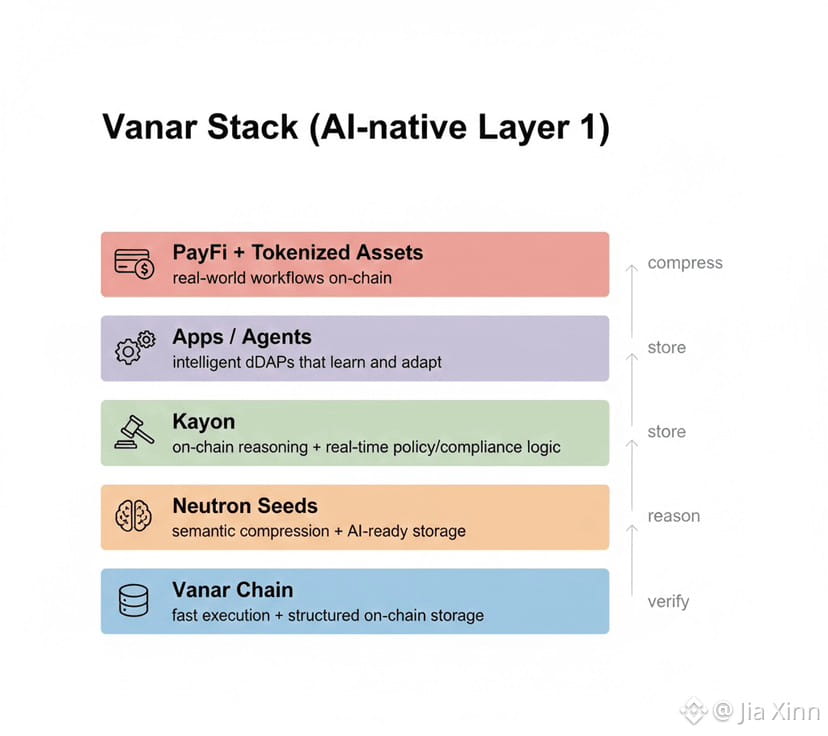
Vanar’s technical architecture stacks five integrated layers transforming Web3 applications from simple smart contracts into intelligent systems. The foundation layer is Vanar Chain itself—modular Layer 1 providing AI-native high throughput that secures entire stack. This isn’t generic blockchain optimized for transaction volume. If you look closely at the architecture, you’ll find design decisions optimizing for intelligent workloads rather than just processing speed.
Second layer is Neutron providing semantic memory and knowledge activation. Beyond compression capabilities already discussed, Neutron creates persistent memory layer enabling AI agents to maintain context across interactions. Traditional AI tools reset with every session forcing users to rebuild context manually. Neutron eliminates that friction through permanent cross-platform memory that survives platform switches, device changes, and service disruptions.
Third layer introduces Kayon—decentralized reasoning engine that analyzes data providing intelligent insights and predictions. This isn’t external AI service calling blockchain for data. Kayon embeds directly into validator nodes enabling smart contracts to query stored information, understand context and relationships, and execute logic based on comprehensive pattern analysis. It becomes possible to build applications where blockchain doesn’t just execute predetermined rules but adapts based on understanding data it processes.
Fourth layer brings Axon for task automation enabling intelligent agent-ready smart contracts. While specific launch dates haven’t been announced, Axon represents system where contracts don’t just respond to triggers but proactively manage complex workflows based on understanding desired outcomes rather than explicit instruction sets.
Fifth layer delivers Flows for industry-specific intelligent agents. These tools create automated logic-driven on-chain workflows customized for particular sectors whether finance, supply chain, healthcare, or other domains requiring specialized knowledge embedded into automation systems.
Together these five layers create infrastructure where intelligence isn’t added feature bolted onto blockchain as afterthought. Intelligence permeates entire stack from storage through execution to application logic. Developers building on Vanar inherit AI capabilities rather than having to integrate them separately.
Token Economics Designed For Decades Not Speculation Cycles
The VANRY token serves multiple functions creating utility that extends beyond just paying transaction fees. Maximum supply caps at 2.4 billion tokens with initial issuance followed by controlled release through block rewards over twenty years. Average inflation rate of 3.5 percent balances need for ongoing validator incentives against concerns about supply dilution. Years one and two show higher release rates accommodating developer ecosystem support, airdrops, and pre-minting staking rewards before settling into steadier long-term pattern.
Staking mechanisms let holders participate in network security while earning yields between eight and fifteen percent annually depending on lock-up duration. Minimum stake of one thousand VANRY tokens with periods ranging from thirty days to full year creates flexibility for different participant preferences. Validator nodes requiring one hundred thousand VANRY ensure network security without environmental impact of proof-of-work mining while maintaining decentralization through distributed validation.
Governance rights proportional to stake size give token holders influence over protocol upgrades and parameter changes. This aligns long-term holder interests with network development direction creating stakeholder base invested in sustainable growth rather than speculative trading. The November 2025 transition of myNeutron and other AI tools to subscription models introduces usage-based economics where product adoption drives token demand through subscription fees requiring VANRY purchases and burn mechanisms tied to actual utilization.
Every myNeutron user generating context, seeds, or sessions contributes to on-chain economic activity with bundles reinforcing market dynamics. If subscription model succeeds in converting free users to paying customers at meaningful scale, that creates deflationary pressure through burns and staking rewards making token value increasingly dependent on network productivity rather than speculation.
Where Capability Meets Commercial Reality Over Next Five Years
We’re seeing infrastructure mature from proving technical feasibility to demonstrating commercial viability. The Neutron compression works. The Kayon reasoning engine functions. The Worldpay partnership creates pathway to institutional adoption. The Pakistan education initiatives build developer pipeline. The subscription model tests whether users value products enough to pay for them. Each piece individually shows promise but success requires all pieces working together creating network effects.
Gaming beyond World of Dypians needs to prove infrastructure supports multiple successful titles rather than single breakout application. AI tooling requires developer adoption translating into applications leveraging Vanar’s unique capabilities in ways impossible elsewhere. Enterprise partnerships enabled by Google Cloud infrastructure need to materialize into business deployments rather than remaining mostly pilot programs. Token economics need to create alignment where network usage drives value rather than speculation determining price independent of actual adoption.
The technology solves real problems. Storage limitations and external dependencies plague blockchain applications across every sector. AI agents need persistent memory to function effectively. Payment infrastructure requires intelligent data handling for compliance and operations. Supply chains demand verifiable documentation existing on-chain rather than fragmented across systems. The applications are there if execution follows through.
Whether Vanar ultimately succeeds depends less on technical capability—which they’ve demonstrated—and more on commercial execution converting capability into adoption. The compressed files reconstructing perfectly from blockchain storage prove the technology works. The question remaining is whether enough developers, enterprises, and users choose Vanar’s solution over alternatives to create sustainable ecosystem where value compounds through network effects rather than requiring constant new user acquisition to maintain growth.
The roadmap centering on maturing AI-native stack while transitioning to sustainable revenue models suggests team understanding that impressive technology alone doesn’t guarantee success. They’re building for decades rather than speculation cycles. Whether markets reward that approach or whether they become interesting technology that never reaches critical mass for self-reinforcing adoption remains the defining question for Vanar’s next chapter. The infrastructure is ready. Now we watch whether the market is.