
So It's 11 PM and I'm on my fourth coffee trying to map out what actually happens to stablecoins on Plasma after people send them. Sounds stupid, right? You send USDT, it arrives, done. Except it's not that simple, and the more I dug into this the more I realized nobody's really asking the obvious follow-up question.
Plasma's whole pitch is "send USDT without gas fees." Great. I get it. But then what? Where does that USDT sit? What can you do with it? Because if the answer is "nothing," then you've just built really expensive infrastructure for people to... hold money that doesn't move again.
So I started tracking actual wallets. Looking at transaction patterns. Checking what percentage of incoming USDT just sits there versus what actually flows into something productive. And what I found was messier than I expected.
The Thing Nobody Mentions About Payment Chains
Every payment-focused chain has the same problem: payments are directional. Money flows in, money flows out. But if there's nowhere for it to go in between, you don't get an ecosystem—you get a hallway.
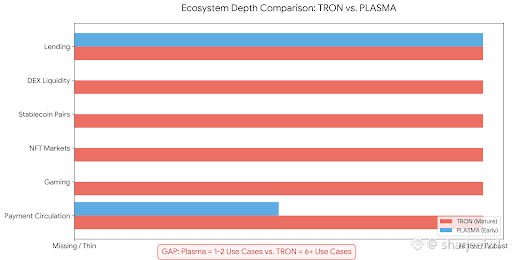
Tron figured this out years ago. USDT comes in, some goes to JustLend for yield, some goes to SunSwap for trading, some just circulates in payments. The point is there are destinations. The stablecoins don't just arrive and sit in wallets waiting to be sent somewhere else.
I wanted to see if Plasma had solved this or if they were just really good at the "arrival" part.
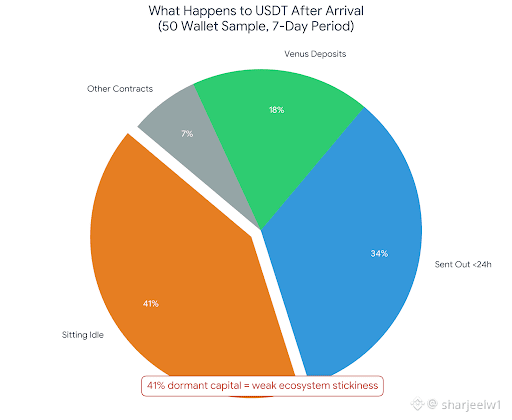
Started by pulling recent wallet activity. Picked 50 random addresses that received USDT in the past week. Tracked what happened next.
Rough breakdown:
~34% sent it out again within 24 hours (pass-through behavior)
~41% just held it (still sitting there as of yesterday)
~18% deposited into Venus Protocol
~7% moved into other contracts I couldn't immediately identify
That 41% just sitting there bothers me. Not because holding stablecoins is bad—people do it all the time. But because it suggests Plasma might be really good at receiving transfers and not particularly good at giving people reasons to keep capital on-chain.
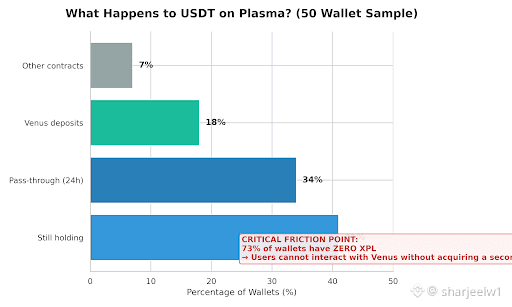
Venus Integration Looks Good Until You Actually Use It
Venus is the obvious answer to "what do I do with USDT on Plasma." It's a lending market. Deposit USDT, earn yield, pretty standard. TVL hit $31M last I checked, which seems decent for something that launched a month ago.
So I tried it myself. Moved $100 USDT onto Plasma (gasless, worked fine), then went to deposit it into Venus.
Hit "deposit" and got an error. No XPL for gas.
Wait, what?
Checked the transaction details. Venus deposits aren't sponsored. They cost 0.004 XPL, which is like a penny, but it's not zero. Which means if you show up on Plasma with only USDT—which is the whole pitch—you can't actually use Venus without first acquiring XPL somehow.
That's a problem. Not a huge problem, but exactly the kind of friction that kills conversion. Someone sends you USDT, you receive it on Plasma gaslessly, you try to earn yield, you hit a paywall for a token you don't have and probably don't know how to get.
I asked in Discord how people handle this. Got mixed responses. Some people already had XPL from trading. Some people just didn't bother with Venus. One person said they bridged back to Ethereum to use Aave instead because the XPL acquisition step was annoying.
That last one stuck with me. If your payment chain's DeFi requires a second token, you're competing with Ethereum L2s where at least ETH is widely available and easy to get.
The Actual Capital Flow Tells A Different Story
Forget what the marketing says. Let's look at what USDT is actually doing on-chain.
Pulled transaction data from the past two weeks. Focused on USDT specifically since it dominates activity.
Daily USDT inflows: ~$4.2M average
Daily USDT outflows: ~$3.8M average
Net accumulation: ~$400K/day
So capital is growing, which is good. But where's it accumulating?
Checked the top USDT holder addresses:
Top 5 non-contract addresses: ~$8.4M combined (just sitting in wallets)
Venus Protocol contract: ~$31M (earning yield)
Bridge contracts: ~$2.7M (in transit)
Everything else: ~$6.1M (scattered across smaller holders)
Venus has most of the active capital. Everything else is either transient (bridge) or dormant (wallets).
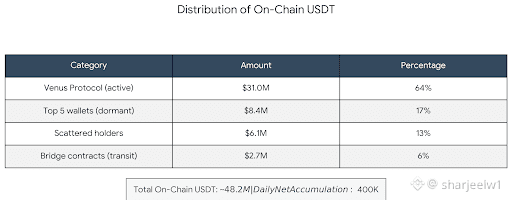
That's not necessarily bad, but it does suggest Plasma is currently a two-use-case chain: send USDT gaslessly, or park it in Venus. Not much in between.
Compare that to Tron where you've got:
JustLend (lending)
SunSwap (trading)
Stablecoin pairs on multiple DEXes
Payments actively circulating between wallets
NFT marketplaces using USDT
Gaming economies settling in USDT
The capital on Tron doesn't just sit—it moves through multiple uses. Plasma's not there yet.
Why This Matters More Than Transaction Speed
Plasma is fast. Sub-second finality, gasless transfers, low fees. Technically solid. But speed doesn't create stickiness.
If someone can send USDT on Plasma or on Base, and both are fast enough for their use case, why choose Plasma?
The answer should be "because there's more to do with USDT on Plasma." But right now the answer seems to be "because it's slightly cheaper and you don't need gas."
That's fine for pure payment flow someone pays you, you immediately send it somewhere else. But it doesn't build an ecosystem. It builds a corridor.
Checked wallet retention. Of addresses that received USDT two weeks ago, how many still have active balances?
~62% still holding USDT on Plasma
That sounds good until you realize most of them haven't done anything with it. No Venus deposits. No outgoing transfers. Just... sitting there.
Why?
Best guess: they sent USDT to Plasma to try it out, the gasless transfer worked, and then they realized there wasn't much else to do so they just left it.
The Venus Problem Is Bigger Than It Looks
Let's go back to Venus for a second because this matters.
Venus has $31M TVL. Growing steadily. Good APY on USDT deposits (~5.8% last I saw). People are using it.
But depositing costs XPL. Small amount, not a big deal if you already have it. Huge friction if you don't.
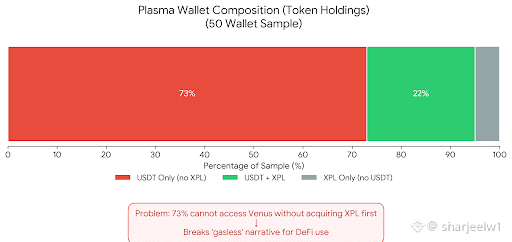
I wanted to know what percentage of Plasma users actually hold XPL versus only hold USDT.
Checked recent wallet activity:
Wallets with only USDT (no XPL): ~73%
Wallets with both USDT and XPL: ~22%
Wallets with only XPL (no USDT): ~5%
So roughly three-quarters of wallets can't use Venus without first acquiring XPL. That's a massive UX gap.
Now maybe that's intentional. Maybe Plasma wants Venus to drive XPL adoption—you need to hold the governance token to access DeFi. Creates buy pressure, increases validator revenue, strengthens tokenomics.
But it also means the "gasless" narrative stops at basic transfers. The second you want to do anything productive with your USDT, you're back to needing a second token. Which is the exact problem Plasma was supposed to solve.
What Happens If Venus Is The Only Option
Right now Venus is basically the only place to put idle USDT on Plasma. There are a couple small DEXes but liquidity is thin. No major AMMs. No derivatives. No stablecoin-backed synthetics. Just lending.
That creates a weird dependency. If Venus works well, Plasma has one functional DeFi primitive. If Venus has issues—smart contract bug, governance problems, liquidity crunch—there's no backup.
I went looking for what else is building on Plasma. Found some announcements about partnerships and integrations but not much live yet. A DEX in testnet. Some kind of cross-chain bridge widget. Maybe an NFT marketplace launching soon.
Nothing that changes the current reality: if you want to do something with USDT on Plasma beyond holding or sending it, Venus is your only real option.
Compare that to Arbitrum where if Aave has problems you can use Compound, Radiant, Silo, or a dozen other lending markets. Liquidity fragments but you have options.
Plasma doesn't have options yet. And I don't know if that's because it's early or because building DeFi on a payment-first chain is harder than it looks.
The Actually Interesting Pattern I Didn't Expect
Here's something I noticed while digging through transaction data:
Wallets that deposit into Venus tend to keep depositing regularly. Not just one-time parking. They're adding more USDT every few days.
Checked a random sample of Venus depositors. Of the ones who deposited two weeks ago:
~68% made at least one additional deposit since then
Average deposit frequency: every 4.3 days
Average deposit size: $340 USDT
That's not "I tried Venus once" behavior. That's "I'm actively using Plasma as my stablecoin yield destination" behavior.
And those users also send USDT more frequently than non-Venus users. Like they're treating Plasma as actual infrastructure, not just an experiment.
Venus users send USDT: ~2.7x per week average
Non-Venus users send USDT: ~0.8x per week average
So there's a core group that actually gets it. They're using Plasma for what it's designed for: move stablecoins easily, park them in yield when not needed, move them again when necessary.
That group is small—maybe 2,000 addresses based on Venus depositor count. But they're disproportionately active.
Venus depositors represent ~18% of active addresses but ~41% of transaction volume.
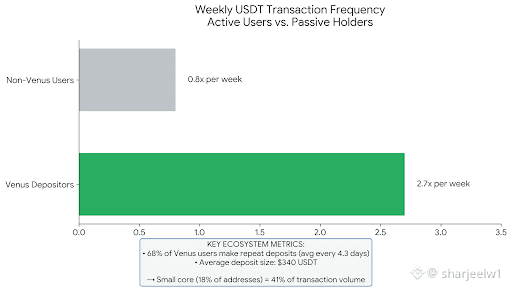
That's the signal. Not the overall TVL number. Not the total transaction count. But the behavior of the subset that's actually using the chain as integrated infrastructure.
Why This Still Might Not Be Enough
Even with that active core, I keep coming back to the same question: what happens when someone needs more than lending?
Let's say you're running a business on Plasma. You receive USDT payments. You want to:
Pay suppliers (✓ gasless transfers work)
Hold operating reserves in yield (✓ Venus works if you have XPL)
Convert some USDT to another stablecoin for diversification (✗ no good liquidity)
Hedge with derivatives (✗ doesn't exist)
Use USDT as collateral for leverage (✗ Venus doesn't do this yet)
You can do two things well and three things not at all. Eventually you bridge to Arbitrum or Ethereum to access the missing pieces.
That's fine if Plasma is just the payment layer and you use other chains for complex stuff. But then Plasma becomes a specialized tool, not a platform. Which might be what they want—I'm honestly not sure.
The messaging says "stablecoin settlement infrastructure" which sounds like specialized tool. But then they integrate DeFi which suggests platform ambitions. Those are different strategies with different requirements.
What I'm Actually Watching Now
Forget price. Forget TVL in isolation. Here's what matters:
1. How fast non-Venus DeFi launches. If it's still just Venus in three months, that's a problem. If there are real AMMs, derivatives, or other primitives, that changes the equation.
2. Whether XPL requirement for Venus gets addressed. Either sponsor Venus interactions (treasury impact) or make XPL easier to acquire on-chain (DEX liquidity). Current state is awkward.
3. Whether the active core grows. Those 2,000 Venus depositors doing repeat deposits do they 2x? 5x? Or plateau because Plasma hits a ceiling on who finds this useful?
4. What percentage of incoming USDT stays on-chain. Right now it's ~10% net retention daily ($400K accumulation on $4.2M inflows). Does that improve or is Plasma mostly pass-through?
5. Whether any major service actually builds on Plasma. Not partnerships or integrations. Actual applications with users that choose Plasma specifically because the stablecoin UX is better than alternatives.
That last one is the real test. If Plasma is genuinely better infrastructure for stablecoin applications, someone should build something that only makes sense on Plasma. Not "could work on Arbitrum but we're trying Plasma too." But "this product requires Plasma's specific design."
I haven't seen that yet. Maybe it's coming. Maybe it doesn't exist because Plasma is too new. Or maybe the design advantages aren't actually large enough to justify building Plasma-specific apps.
The Uncomfortable Thing I Keep Thinking About
Is Plasma solving a real problem or an imagined one?
"Paying gas to send stablecoins is annoying" is true. But is it annoying enough that you need an entire chain to fix it? Or is it annoying in the way that lots of things in crypto are annoying worth complaining about, not worth switching chains over?
Because if you're already on Arbitrum, gas is like $0.02 for a USDT transfer. On Base it's similar. On Polygon it's even less.
Plasma makes it $0.00 for basic transfers. That's better. But is it enough better that you move your whole stablecoin operation to a different chain with less DeFi, less liquidity, and a nascent ecosystem?
For some use cases, maybe. High-frequency micropayments where even pennies add up. Cross-border remittances where fee percentages matter. Payment processors moving volume all day.
But for most people? I don't know. The saved gas might not offset the opportunity cost of missing DeFi opportunities that exist elsewhere.
That's what I can't figure out sitting here at midnight staring at wallet data and transaction graphs. Is this meaningfully better, or just marginally different?
The Venus users seem to think it's meaningfully better. They're actively choosing to keep capital here. But everyone else? Might just be trying it out and not finding enough reason to stay.
Genuine question because I still don't have a clean answer: if you're keeping USDT on Plasma right now, why? What's the specific thing that keeps you here instead of on an L2 with more DeFi options?
Because that answer whatever it is for the people actually staying that's what determines whether Plasma becomes real infrastructure or just an interesting experiment that didn't quite land.