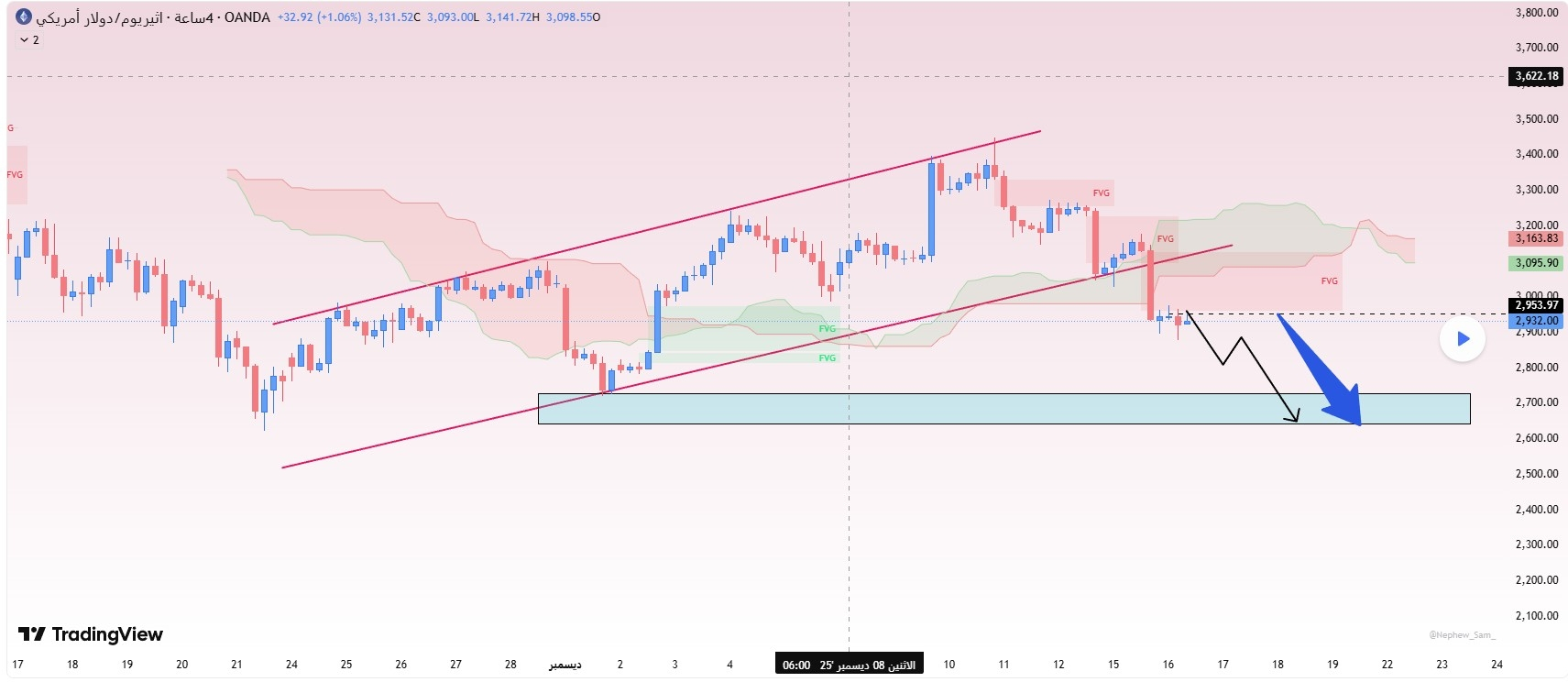
📊 Current market status (February 2026)
Ethereum is currently in a tough technical zone, having dropped in price from levels above $3,000 at the beginning of the year to around $2,240 (according to data from February 2, 2026). This decline of over 25% in a month has reinforced the bearish sentiment.
Key support and resistance levels:
Critical resistance: $3,000. Failure to reclaim this level opens the door to bearish expectations.
First support: $2,120. Breaking this level means the price enters the true "danger zone."
The distant psychological and technical support: $1,435. Analysts see it as the last stop before the possibility of a collapse towards $1,000.
⚠️ Why are some afraid it will reach $1,000?
Several factors may converge to push Ethereum towards this "catastrophic" scenario for investors:
Liquidations: The market is suffering from waves of forced liquidations of traders using high leverage, creating a snowball effect of selling that severely pressures the price.
Macroeconomic concerns: The return of global inflation fears or geopolitical tensions push investors to flee high-risk assets (like crypto) and turn to gold or cash.
Liquidity issues: Analysts note that market depth is currently low, making any large sell-off by "whales" lead to a massive price drop disproportionate to the selling volume.
Outflows from funds (ETFs): After the initial boom, Ethereum exchange-traded funds have seen outflows, temporarily weakening institutional confidence.
⚖️ The opposing view: Is $1,000 realistic?
Despite concerns, a large number of analysts believe that Ethereum reaching $1,000 requires a complete collapse of the financial system or a significant technical failure in the network, for the following reasons:
Staking: A large percentage of Ethereum is staked for security, reducing the available supply for sale and creating a solid price floor.
Optimistic forecasts: Major institutions like "Standard Chartered" and other analysts still expect Ethereum to return to levels of $4,000 - $7,000 before the end of 2026 once economic conditions stabilize.
The "Hope and Fear" zone: The NUPL indicator suggests that the market is currently in a state of fear, which historically precedes strong rebounds rather than continuous crashes.
📝 Summary
Reaching $1,000 is the "worst-case scenario" (Bear Case) that requires breaking historical support levels at $2,120 and then $1,435. Currently, the real battle is to stay above the $2,000 barrier to maintain the long-term bullish structure.
Alert: Cryptocurrency markets are highly volatile, and this report is an analysis of current data and should not be considered investment advice.
$BTC $ETH $BNB #MarketCorrection #USGovShutdown #USIranStandoff #WhoIsNextFedChair