

Recently, many first-level and novice friends have said they want to learn about contract trading, so I plan to release a few practical and simple trading tutorials. After organizing, I will put them into a teaching series. Those interested in trading can flip through them from time to time.
--- No fancy theories, just practical methods ---
1. The moving average is the market average cost over different time periods.
Short-term (e.g., MA21): Recent cost, reacts quickly, represents short-term sentiment.
Medium-term (e.g., MA55): Medium-term cost, the skeleton of the trend, the price often fluctuates around it.
Long-term (e.g., MA144): Long-term cost, the background of the trend, defines the major direction.
Moving average arrangements are the language of trends:
Bullish arrangement: Price > MA21 > MA55 > MA144. Only consider going long.
Bearish arrangement: Price < MA21 < MA55 < MA144. Only consider shorting.
Three-line entanglement: No trend, wait and see.
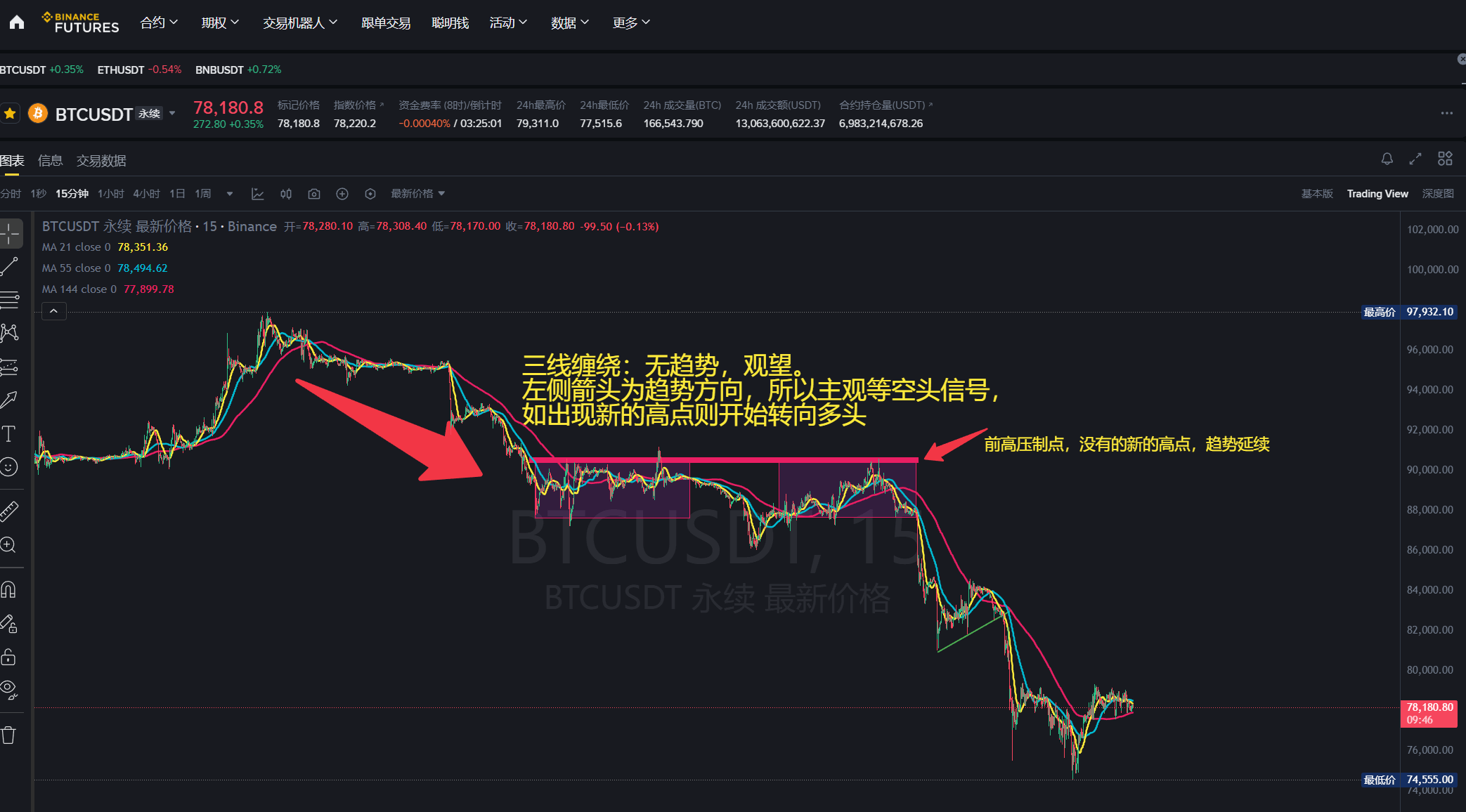
II. A complete moving average trading strategy (taking going long as an example)
Step 1: Trend filtering
Only trade when the 15-minute chart shows clear head arrangements on MA21, 55, and 144. If not satisfied, do not trade.
Step 2: Timing of entry
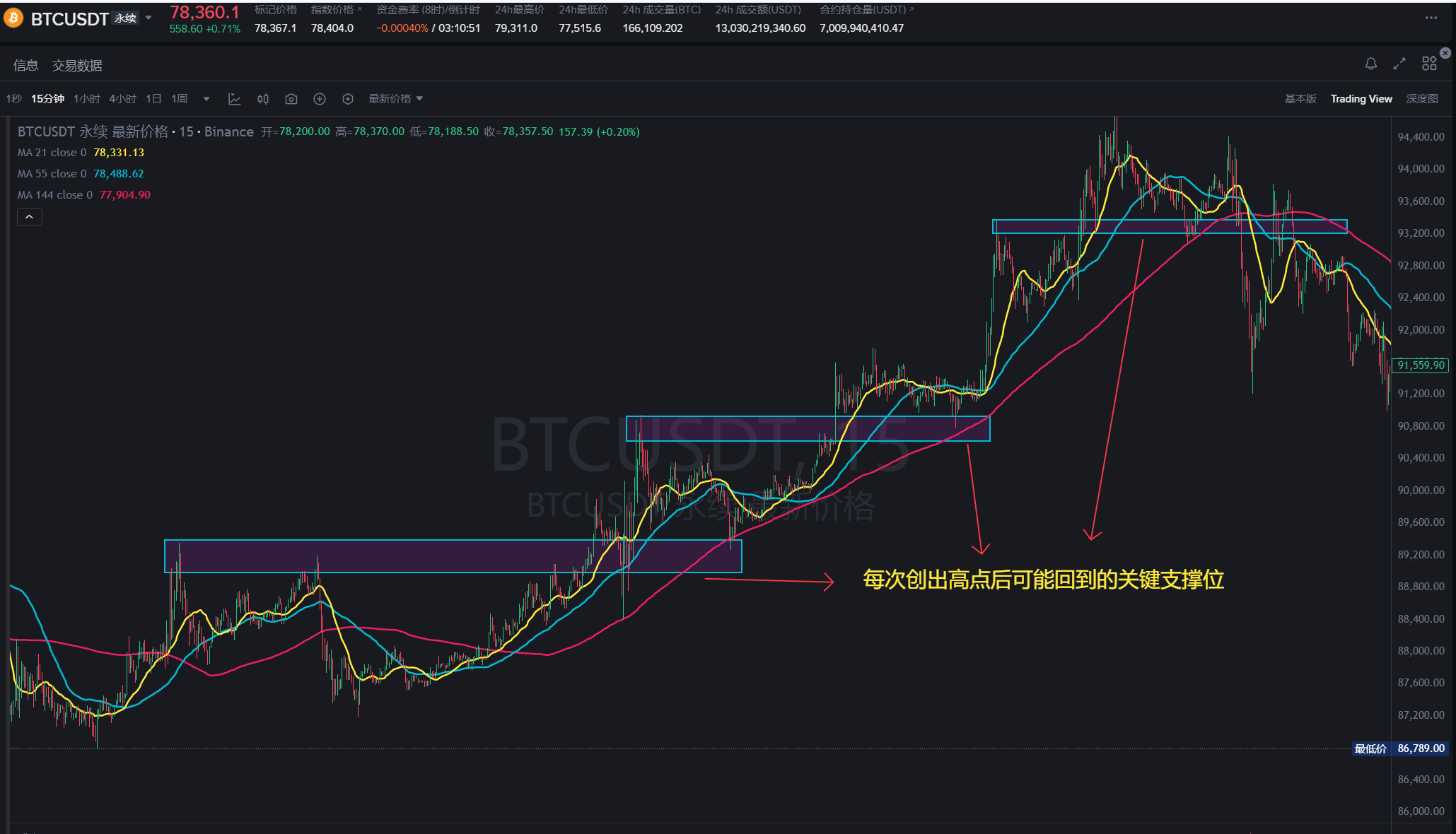
Wait for the price to retrace to near MA55 or MA144.
A bullish K-line combination (such as bullish engulfing or hammer) confirms as the signal K-line.
If the next K-line after the signal K-line closes as a trend K-line, enter at the close; if not, forgo this opportunity.
Step 3: Stop loss and take profit
Stop loss: Place below the lowest point of the signal K-line, or below MA144.
Take profit: Use a fixed risk-reward ratio of 1.5 times. Measure the distance from the entry point to the nearest previous high and set the take profit 1.5 times that distance above the entry point. Reduce the position by half when the risk-reward ratio reaches 1:1, and move the remaining position's stop loss to hold.
Step 4: Position management
Determine position based on loss: Maximum loss per trade should not exceed 1%-2% of total capital. Contract margin = Maximum expected loss amount / Stop loss points.
The core above is: only trade with the trend, enter at key levels, fixed risk-reward ratio, and determine position based on loss.
III. Three methods to solve the lag problem of moving averages
1. Combine large and small timeframes: The 15-minute chart determines the direction, and the 5-minute chart finds specific entry points.
2. Look for resonance areas: The probability of success is higher when the price simultaneously retraces to key static support levels (such as previous lows) and important moving averages (such as MA55).
3. K-line confirmation: Moving averages indicate position, K-line provides action signals. Don't act until you see the rabbit.
In fact, moving averages are used to follow trends and filter out noise. Accept their lag and leverage their stability.
Whether you make money or not does not depend on solving its lag, but on strict execution to sustain profits, trading discipline for long-term probabilistic advantages, and the rest is repetition. For more teaching content, please follow @黑手Garry .
Musing: This type of content may not have many people who can truly calm down and view it. The popular topics in the square are often those with trending memes or hot analyses. However, I still want to delve deeper into Binance Square, enriching my account as much as possible, as a way to give back to the friends who pay attention to me. I also hope more people can simply learn some trading techniques. Even if the final result is still a liquidation, at least through this process, you will know which aspect went wrong, whether it was a misjudgment of the trend, a faulty structural analysis, or whether there were issues with entry and exit signals and positions, or if the leverage was too high and the position was not managed well, etc.
I'll leave the promotion to you, hoping it can help more people improve a little bit @币安广场 .