
🛑 First, let's state the conclusion: This is an extremely rare 'first-level market anomaly' in the crypto space. In other words, your current entry cost is 70% cheaper than top venture capital firms like a16z.
In the first two episodes, we discussed the technology and cost advantages of @Walrus 🦭/acc . Today, we won't talk about abstract concepts; let's directly expose **the institutional cards**.
I received a valuation data set about Walrus, which shows that the current pre-market price is completely unreasonable. This is not a decline; this is giving away money.
1. Amazing price anomaly: Are retail investors cutting losses for institutions? (The Price Anomaly)
According to the white paper and financing report, let's calculate a sum:
$WAL Total Supply: 5 Billion (5,000,000,000 WAL)
Institutional Financing Valuation (FDV): Approximately $2 Billion
👉 Institutional/Private Placement Cost: $0.40 per unit
But what is happening in the market now?
The current pre-market/futures price is approximately between $0.09 - $0.13.
This means that if you buy now, your cost is only 1/4 of the institutional investors!
Usually, new tokens go live with retail investors taking over the high-priced chips from institutions, but $WAL has shown a rare 'backwardation'. When the price returns to the institutional cost line ($0.40), you will have already made a 300% profit.
2. Valuation Benchmark: How much upside potential is there?
To prove that $0.13 is severely undervalued, we will compare Walrus with other leaders in the same track:
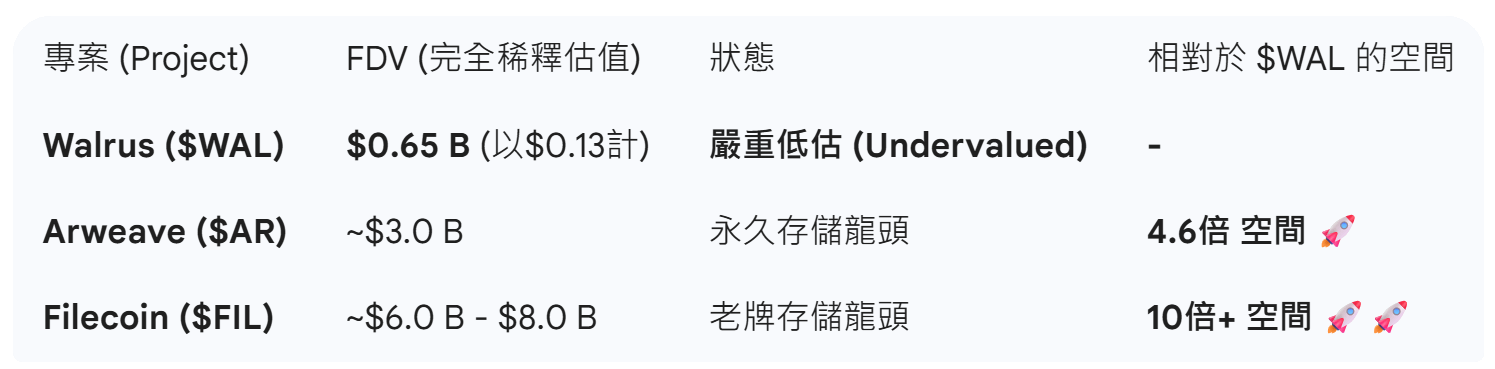
The logic is very simple:
Walrus has a more advanced 'Red Stuff' technology than Filecoin, at a cost 50 times lower, backed by explosive demand from the Sui ecosystem.
Even if it only reaches Arweave's market cap, the token price should be around $0.60; if it can challenge Filecoin, then it's a story above $1.20.
3. Chip Structure: Safe Entry Point (Supply Schedule)
You might be worried: "Will there be a massive unlocking and sell-off?"
Initial Circulation: Approximately 25% (1.25 Billion).
Source of Selling Pressure: Mainly from airdrops and testnet rewards.
Institutional Lock-up: Large amounts of tokens from early VCs and teams are long-term locked.
This indicates that the current selling pressure in the market mainly comes from retail investors who obtained tokens for free. After these retail investors polish off their chips, who will take over?
The answer is: Smart money clearly knows the cost is $0.40.
💡 Investment Insights: The Kingdom of Cheese's Decisions
Data does not lie. When you can buy at $0.13 for an infrastructure leader that an institution is willing to invest $0.40 in, this is a gift of the cycle.
Sui's game is about to launch, and AI's data needs to be stored.
Are you going to position yourself now while no one is asking, or wait until it rises back to the $0.40 institutional cost line to help lift the VC?
(Disclaimer: This article is based on financing data analysis and does not constitute investment advice. DYOR.)
📢 Next Episode Preview:
If $WAL is really that good, then who is using it?
Tomorrow (Day 4), I will reveal the list of ecological partners behind Walrus. Hidden within are several potential projects that have not yet issued tokens; interacting might just lead to an airdrop!
👇 Do you find this data analysis helpful? Please 'like' + 'share' so more people can see this hidden data!