📝 Hi, I am 10. When public chains enter the brutal elimination stage, Sui did not continue to internalize performance parameters but quietly shifted its strategy from providing speed to building a fertile ground for application growth.
In the autumn of 2024, the global top fighting event ONE Championship featured a droplet-shaped logo for the first time — Sui. This scene now seems like an accurate prophecy. The public blockchain arena itself is an octagonal cage without barriers, and the severe turbulence of 2025 has caused countless former star projects to fall silent and go to zero. Meanwhile, Sui has become one of the few remaining contestants still in the cage.
But its path to success is unique; it is not about being faster but thicker. Its story has shifted from a digital competition to how to transform the public chain from a technical testing ground into a platform that meets real demands.

👇👇👇
1. Current situation: still in the game, but the approach has changed.
Let's talk about the current situation first. Sui's TVL once peaked at 2 billion USD, with daily active wallets approaching 1.6 million, and processing over 50 million transactions in a single month. The numbers are good, but if you're focused on the coin price, you might feel confused, as it seems to not rise when it should and not fall too much when the market is bad.
This is the crux of the matter: is Sui worth continuing to pay attention to? My view is that if you only look at the price, you will indeed be conflicted. But if you look at what it is doing, you will find things becoming interesting.
In 2025, Sui did one thing: it shifted from desperately proving how fast it is to thinking about what exactly it can be used for. This change is worth more attention than any price fluctuation.
2. Sui Stack: a set of combinations.
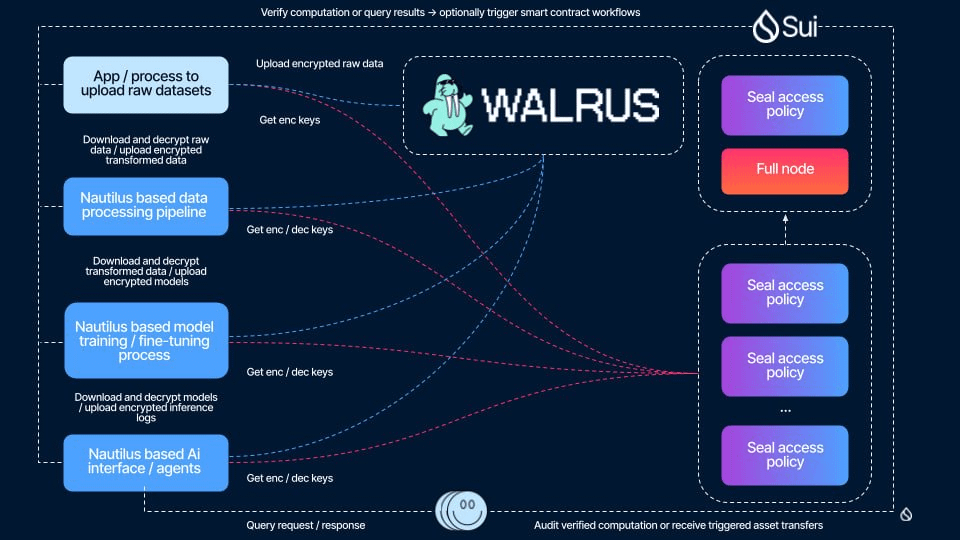
Sui has been frequently mentioning a term this year: Sui Stack. Simply put, it is no longer satisfied with just being the execution layer but aims to encompass the entire technology stack.
Let's break down this set of combinations:
▌ Storage Layer (Walrus) - In the past, if you wanted to create an NFT marketplace on Sui, you had to store images and videos elsewhere, like IPFS. That’s no longer necessary; Walrus is Sui's own storage layer. In just 8 months, it has stored 300TB of data, which, while not much compared to established storage projects, is commendable for a new component that is now up and running.
▌ Permission Control (Seal) - This feature is quite practical. Think about it, if you have some assets on-chain, who can see them? Who can use them? For how long? There used to be no standard answer, but now Sui has made permission control a native feature on the chain. This is also preparing for privacy transactions; if you want to transfer funds and only both parties know, you first need a reliable permission system, right?
▌ Off-chain Computation (Nautilus) - Not all computations are suitable for being placed on-chain; they're too expensive and slow. Nautilus allows some computations to run off-chain, with results verified back on-chain. It balances efficiency and security.
▌ These three components, together with the Sui mainnet, are what we now call Sui Stack. In simple terms, Sui wants developers to accomplish everything in one place, without having to piece things together.
Three, what impact does this have on us?
You might say: what do these technical details have to do with an ordinary user like me? The direct relationship is indeed not significant. You won’t rush to trade just because Sui introduced a new storage protocol tomorrow. But the indirect impact is actually quite profound:
First, the number of applications will increase. Developers find it easier, so they are willing to try. A small team of three to five people can also produce decent results. With more applications, we have more choices, and competition will improve the experience.
Second, the experience will become smoother. There is an order book project on Sui called DeepBook, and their developers said that there are now teams building margin trading front ends based on DeepBook without writing a single line of Move code. With a solid underlying foundation, building applications on top becomes much easier.
Third, institutions are more willing to come in. Traditional institutions like Grayscale and VanEck have laid out products on Sui this year. When they choose a chain, the integrity of the technology is a very important consideration. Institutions are not here for short-term speculation; they genuinely intend to play long-term.
So, regarding Sui Stack and these things, you don’t need to understand the technical details, but they will quietly affect what you can experience on this chain in the future and whether you enjoy it.

Four, how is it different from Ethereum and Solana?
At this point, you might ask: what is special about this approach compared to other public chains?
Ethereum follows an ecological division of labor model, doing the core layer itself while leaving storage, scaling, and oracles to ecosystem projects. The advantage is diversity; the downside is that integration can be troublesome, as you have to connect with multiple projects.
Solana adopts an all-encompassing model, stuffing everything into one chain in pursuit of extreme performance. The advantage is speed, which users can directly feel; the downside is that all the pressure is on the mainnet, which has historically gone down a few times.
Sui has chosen a middle path, developing core components itself but in a modular way. It is both an official product and maintains a certain degree of independence. It's a bit like a family business, where each has its role but are all connected by blood.
This approach bets on the developer experience, prioritizing who can enable everyone to create something usable in the least amount of time and with the least hassle.
5. In 2026, what battles will Sui fight?
At the end of 2025, Sui held a live stream where several core members discussed their plans for next year. I listened and extracted a few signals:
First, the experience really needs to improve. Aslan, the head of DeepBook, mentioned a very practical goal: I hope to be able to do what I can do on Robinhood on Sui DeFi as well. More specifically, Sui promises that in 2026, stablecoin transfers will be completely free, not subsidized, but a change in the protocol layer. If realized, transferring will cost nothing, which would be a strong selling point in payment scenarios.
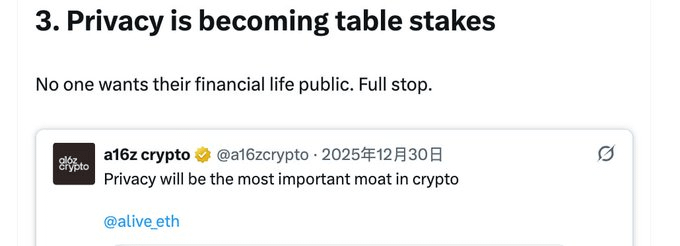
Second, privacy is coming. This is not a private function of a specific wallet but is natively supported by the entire chain for privacy transactions. The chief cryptographer shared a real example: in Dubai, someone wanted to donate but was afraid to use cryptocurrency because everyone could see his balance with each transfer. Doing so would cause problems here. Privacy is not just an added benefit in large-scale adoption; it's a necessity.
Third, technology needs to be encapsulated. CEO Evan repeatedly mentioned the concept of product-level protocols, meaning that the complexity of the technology should be hidden, allowing developers to build products at a higher level without needing to understand all the underlying principles.
6. Why am I still paying attention to Sui?
Finally, let me share my personal observation. One aspect of Sui that impresses me the most is the team behind it. Their chief cryptographer, Kostas, whom I met at an industry conference, really sits on the floor debugging a robotic dog, completely immersed in the technology. This kind of temperament is rare in the restless crypto circle.
In 2025, Sui is clearly transitioning from a chain for crypto users to a platform for real users. More and more applications are starting to downplay concepts like wallets and private keys, aiming to make users interact with blockchain applications as they would with ordinary apps.
If I had to summarize, I think Sui has already passed the stage of desperately proving itself and is now seriously considering how to be truly utilized. If this step is taken correctly, the road ahead can be long.
In the octagonal cage of public chains, Sui has found its own approach and rhythm. In 2025, it completed multiple technical accumulations, and in 2026, it will focus on refining user experience. Whether Sui can welcome its own spring still needs time to verify. However, from the current layout, it at least seems well prepared.