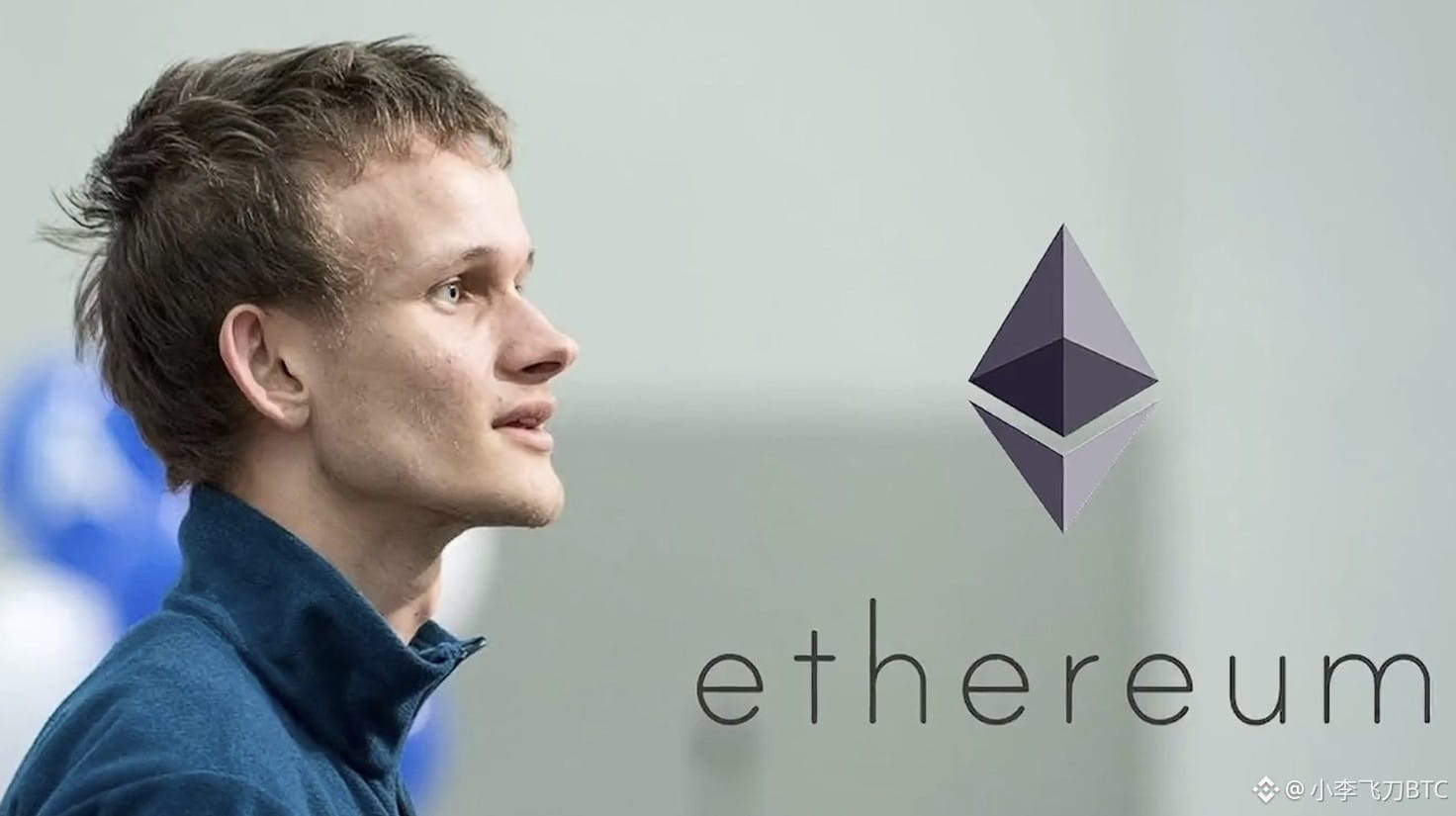
First of all, Vitalik Buterin is a genius, a technological geek idealist. What he truly cares about is whether the system is elegant, whether it is decentralized, and whether it is 'correct' in the long term. But the current dilemma is that when the spiritual core of an ecosystem is overly dominated by technological geeks, it easily heads in one direction - technical goals overshadowing user goals, and idealism overshadowing real-world needs.
'Ethereum is dead' does not mean that its chain is dead or that nodes are not running. On the contrary, its technology is still being upgraded and iterated. But the problem is: these things are increasingly detached from real people, real users, and the real market.
Ethereum's technology is impressive, and there is almost no dispute about this. Smart contracts, DeFi, NFTs, DAOs — the foundation of the entire Web3 world has basically developed around the Ethereum ecosystem. Its vision is also extremely grand — a decentralized, trustless, censorship-resistant global system. From the perspective of technological history, it will definitely be written into textbooks.
But the market is not a textbook, and users are not doctoral students.
What ordinary users want is never the 'most advanced technology,' but rather something that is cheap, stable, simple, and easy to use. However, in reality, Ethereum has gradually pushed itself toward the opposite. High and unpredictable gas fees, complex operational processes that require tutorial videos, and one explanation after another saying 'what you're using now is uncomfortable for a greater future.'
Later, even Ethereum itself realized that the mainnet could no longer support real use, so L2 became 'the only answer.' The problem is that L2 did not solve user issues but rather fragmented and outsourced the problems, then handed them over to users to digest themselves.
What is the current state of the Ethereum ecosystem?
The mainnet is like an aristocratic area, while L2 is like countless fragmented colonies. Arbitrum, Optimism, Base, zkSync, Starknet... each with different technical routes, inconsistent security models, and assets circulating between different L2s requiring cross-chain bridges, which are precisely the most accident-prone and fragile areas in the entire crypto world.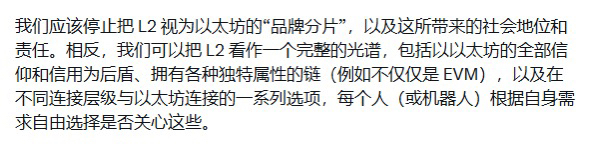
From the user's perspective, this is not scaling; this is an explosion of complexity.
You are not using a system; you are being forced to understand a whole set of modular architecture. Which chain is the money on, which bridge to use, is it safe, can it come back — all depends on your own research. Will truly large-scale users use such things? The answer has long been written in the data.
The deeper issue is that after Ethereum transitioned from PoW to PoS, the entire system's 'spiritual core' has undergone an irreversible change.
In the PoW era, ETH, at least in narrative, relied on computing power, costs, and constraints of the physical world to maintain security; while PoS essentially uses capital itself to determine power. Whoever has more ETH has greater discourse power, higher returns, and stronger control.
This step is packaged as 'environmentally friendly,' 'efficient,' and 'advanced,' but it also inevitably brings about a consequence: Ethereum is no longer a system open for competition with the external world, but a highly financialized structure with internal capital circulation.
When security relies on 'existing wealth,' and the source of income becomes 'holding the coin itself,' the system will naturally tend to maintain vested interests rather than serve new users. You will find that since PoS, Ethereum's friendliness towards ordinary users has not improved, but it has become increasingly friendly toward large funds, institutions, and staking service providers.
This is not a coincidence, but a decision made by design.
In this context, looking at the behavior of the Ethereum Foundation is even more thought-provoking.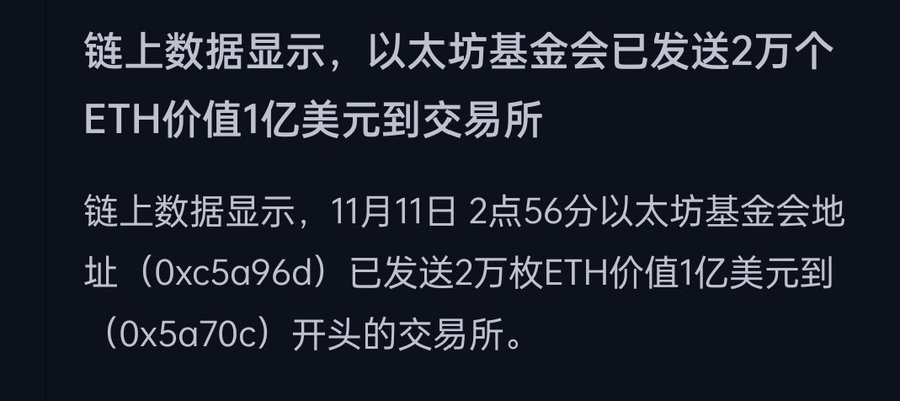

The Ethereum Foundation has long obtained funds by selling ETH and then invested these funds into so-called 'ecosystem construction.' It sounds very much like a Builder, but the reality is that many of the projects that have been invested in and supported ultimately either go unnoticed or die directly. Technical experiments continue, but real users have not appeared.
The problem is that the costs of these experiments are not borne by the foundation, but by the users of Ethereum in the entire market. ETH is continuously sold by the foundation, with selling pressure persisting, while holders are repeatedly told to 'believe in long-termism' and 'pay for technological ideals.'
As a result, the most brutal thing happened — those who truly bear the cost are the investors who genuinely believe in the Ethereum narrative. For example, Tom Lee, who has long publicly been bullish on crypto and Ethereum, and Li Hua, who supports Ethereum in China, along with countless people who build faith around ETH, go all-in, and even leverage themselves. Amid Ethereum's continuous decline, long-term underperformance, and dilution of its narrative, the risks of liquidation, psychological pressure, and asset losses have all genuinely fallen on them.
It has been observed that Ethereum has reached 2200u more than ten times within five years, and it will likely reach this position more times in the future...
The market never automatically rewards you for having advanced technology. The market only recognizes one thing: Is there real demand? Is there continuous usage? Are there users willing to stay? And today's Ethereum needs to constantly explain why it is not user-friendly, why it is complex, why it sells coins, and why the future will be better. This, in itself, already says it all.
So, when people say Ethereum is 'dead,' it doesn't mean it's really gone; it means that in a market sense, it has lost its vitality. It hasn't died technologically but has perished due to neglect of user needs, arrogance towards market signals, and excessive faith in capitalized pathways.
I was once a believer in Ethereum. I have a sentence to send to Vitalik: You have proven that you can design an extremely complex, elegant, and correct system, but if technology cannot be used on a large scale and with low barriers, it will ultimately become a relic for a few to pilgrimage to. Decentralization is not the goal; users are.
If Ethereum continues to exist only for technical coherence,
Then it may run forever.
But it will only serve as a great experiment.
And it's not a system that truly belongs to the real world.