
Having stayed in the blockchain industry for a long time, everyone tends to focus on those TPS data that easily reach tens of thousands.
To be honest, what really drives a true businessman crazy is not the speed of the internet, but the awkwardness of having to buy a ticket upon entering.
You want to transfer USDT to a friend, but the system tells you that you need to buy some native coins for gas fees first. It's like going to a restaurant to eat, and when it's time to pay, the owner says they don't accept cash and insists you go next door to the convenience store to exchange for two special coins.
Unless these friction points are removed, blockchain payments will forever remain just a digital game in exchanges and will not enter the daily life of groceries and essentials.
Remove the ticket: payments should look like payments
@Plasma 's core logic is straightforward: it aims to turn stablecoin payments from a trading tool into a real commercial settlement track.
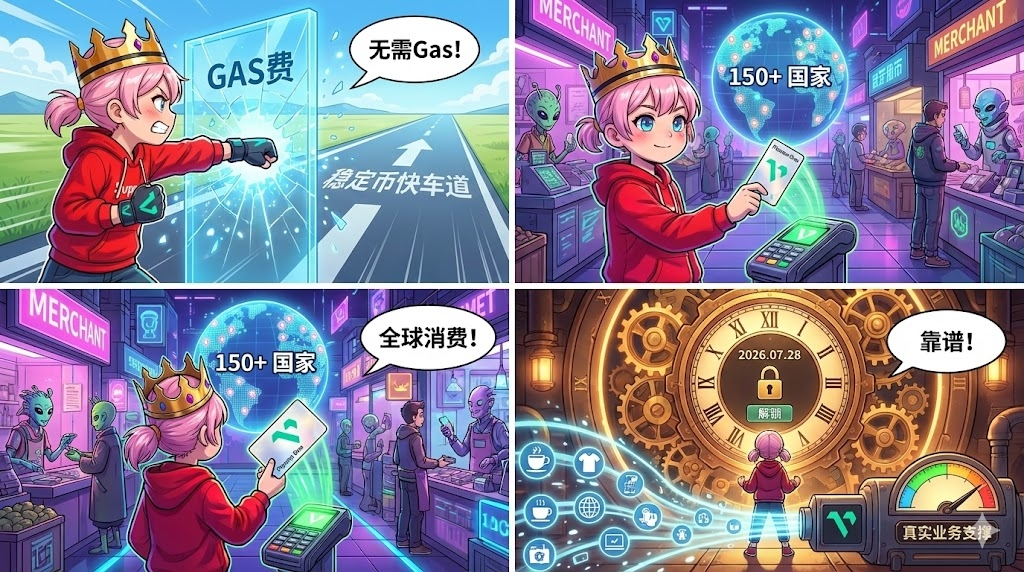
The way it solves problems reflects the thinking of a payment system. For the simplest stablecoin transfers, it follows a zero-fee path. Through the payment mechanism at the protocol layer, users can complete transfers just by holding stablecoins. This experience is actually very close to the traditional transfer we are accustomed to.
For more complex interactions, it does not blindly pursue free services; instead, by supporting custom gas assets, it has digested the cumbersome step of currency exchange at the system's core. In simple terms, it leaves the complexity to technology and the simplicity to users.
From settlement to finance: the three pieces of the Plasma puzzle
In specific landing scenarios, Plasma's layout is very clear, mainly focusing on three areas
High-frequency payments: zero-fee paths directly serve small remittances and daily transfers, addressing the most basic needs.
Commercial settlement: the highlight here is Plasma One. It enters the market in the form of new banks + cards, covering more than 150 countries and 150 million merchants, and offers attractive incentives such as direct consumption of balances and up to 4% cashback.
Capital gains: by being compatible with EVM, it brings mature lending and yield products in, allowing idle funds to achieve returns of over 10%, improving the utilization of capital.
Hard-core data: the red lines that cannot be ignored
When looking at projects, one cannot just look at the pie; one must look at the hard data on the books.
From the official perspective, the total amount of XPL tokens is set at 10 billion. There is a very critical time point: July 28, 2026. This is the complete unlocking date for American participants, and the arrival of this date will directly change the supply and demand rhythm of the secondary market.
And those enticing cashbacks and high yields, while they are the 'nuclear weapons' for attracting new users in the early stages, whether they can succeed in the end still depends on user retention.
Underlying logic: clarity behind the prosperity
Finally, we need to step back from the hustle and look at two hard-core judgment lines.
First, while the zero-fee path is good, it must have a very strong anti-abuse mechanism. If it cannot prevent scripted orders, the costs will ultimately rebound on normal users.
Secondly, there is the vitality of the tokens. When that unlocking window in 2026 arrives, can the real payment volume and fee consumption on-chain withstand the sudden increase in token supply? This is the key to determining whether Plasma is truly a settlement highway or just another castle in the air.

If these terms do not run smoothly, no matter how attractive the vision is, it is merely decoration. After all, the business world does not believe in miracles, only in clear accounts and well-defined contracts.
