On February 5, Thursday, the gold price$XAU is not a one-sided bull market replaying but rather a 'wide fluctuation after sharp rises and falls in 2020 + policy and central bank gold purchase-driven band repairs,' with the core being a range of 4400-5000 U.S. dollars/ounce (London gold) + 1080-1140 yuan/gram (domestic gold T+D) with oscillation + repeated testing of support + structural differentiation; do not bet on one side, controlling positions according to the rhythm is more stable.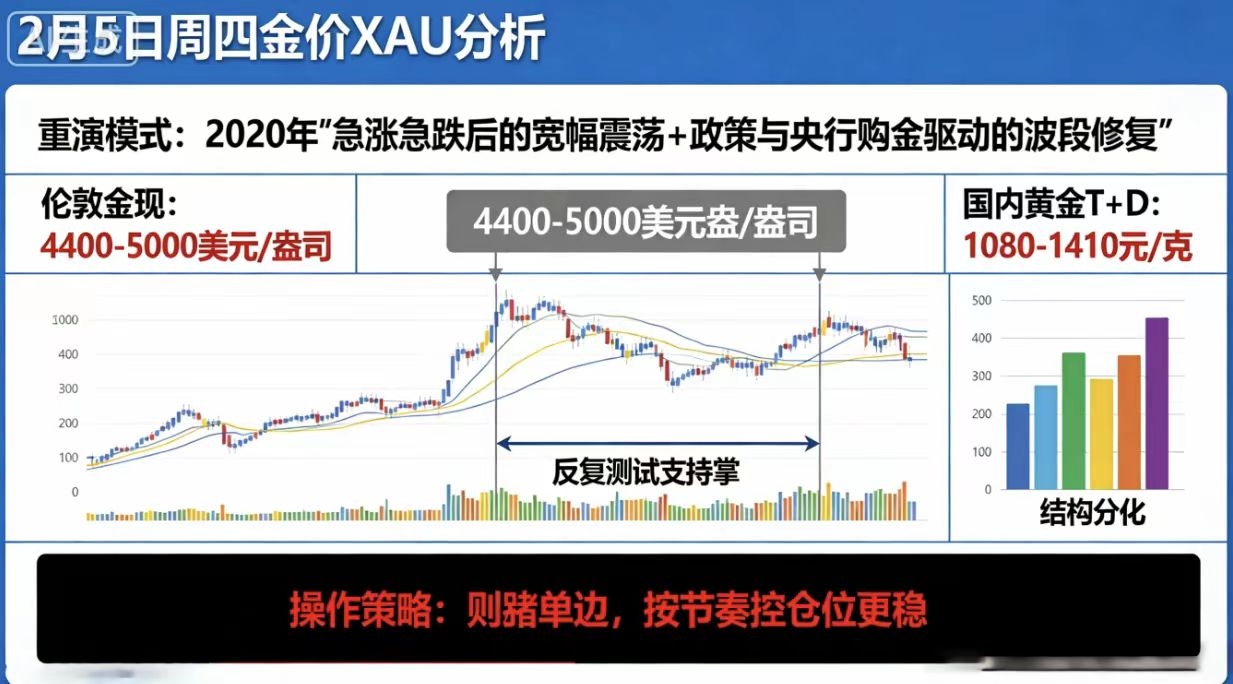
I will start with the real-time gold price on February 5, explaining the logic, rhythm, and responses of 'replaying history' in detail, providing practical information that can be directly used, without any fluff.
Today (February 5), let me give you an accurate number for the gold price to avoid confusion with prices of different categories:
- London gold early spot: 4920.89 U.S. dollars/ounce, down 25.35 U.S. dollars from the previous day, a decrease of 0.51%.
- Gold T+D: 1110.35 yuan/gram, down 19.05 yuan, a decrease of 1.69%.
- Shanghai Gold main contract: 1112.3 yuan/gram, down 8.64 yuan, a decrease of 0.77%.
- Investment gold bars: ICBC 1114.57 yuan/gram, CCB 1136.80 yuan/gram, BOC 1143.65 yuan/gram, overall in the range of 1114-1146 yuan/gram, slightly down from the previous day.
Let’s first talk about the historical market conditions that may replay this time. The gold trend in 2020 shares many similarities with the current situation, which veteran players should remember. In 2020, with the outbreak of the global pandemic, gold prices first fell and then rose, plummeting from around 1700 U.S. dollars in March to about 1450 U.S. dollars, and then surging to 2075 U.S. dollars driven by the Federal Reserve's interest rate cuts, global central bank easing, and a surge in safe-haven demand, resulting in a major recovery trend. The core characteristics at that time were wide fluctuations + policy-driven + central bank gold purchases supporting the market + phase of sharp rises and falls, which is highly similar to the current market environment.
Looking at the present, on January 29, London gold once soared to 5598.75 U.S. dollars/ounce, breaking the historical record, then plummeted over 9% on February 1, rebounded violently on February 3 with a single-day increase of over 6%, and slightly corrected on February 5. This 'roller coaster' trend is strikingly similar to the volatility rhythm after March 2020. The core driving factors are also quite similar: in 2020, it was U.S. Federal Reserve easing + central bank gold purchases + safe-haven demand; now, it is the continuation of a global central bank gold purchasing spree (the People's Bank of China has increased its holdings for 14 consecutive months, and by January 2026, global central bank gold purchases will reach 1200 tons), strong expectations for interest rate cuts by the Federal Reserve this year (the market expects 2-5 rate cuts), and ongoing geopolitical risks and economic uncertainties, all of which closely align with the supporting logic of 2020.
However, there are also differences. In 2020, global liquidity was extremely loose, with continuous inflows of new funds. Now, speculative funds are more volatile, with gold prices plummeting from above 5500 U.S. dollars and quickly rebounding. Short-term speculative sentiment is clearly dominant, making extreme market fluctuations of 'sharp rises and falls' easier to occur, while the rise in 2020 was relatively more stable. Additionally, there are divergences in global economic recovery expectations now, with some countries potentially tightening monetary policies, which could exert some pressure on gold prices, unlike the uniformly loose environment in 2020.
After discussing historical comparisons, the most concerning question is how gold prices will move next. Based on historical patterns and current market conditions, I will outline my short-term and medium-term predictions.
In the short term, from February 5 to 6, it is highly likely to maintain a wide fluctuation, with London gold in the range of 4800-5000 U.S. dollars/ounce and domestic gold T+D in the range of 1080-1120 yuan/gram. The morning of February 5 may continue a slight correction trend, testing the support levels of 4800 U.S. dollars and 1080 yuan. In the afternoon, with some bottom-fishing funds entering the market, there may be a slight rebound, with a probability of closing with a small negative or small positive candle at about 60%. On February 6, the fluctuations may be smaller, within the range of 4850-5000 U.S. dollars/ounce and 1090-1130 yuan/gram, with a heightened sentiment of cashing in before the holiday, likely resulting in a closing star pattern, with volatility within ±0.5%.
In terms of support levels, the strong support for London gold is at 4400-4600 U.S. dollars/ounce (previous low points + round numbers), and for domestic gold T+D, strong support is at 1060-1080 yuan/gram (20/30-day moving averages + previous transaction dense areas). In terms of resistance levels, the resistance for London gold is at 5000-5200 U.S. dollars/ounce, and for domestic gold T+D, the resistance is at 1120-1140 yuan/gram. A breakout requires a significant increase in volume and favorable fundamentals, which is currently difficult.
In the medium term, the probability of gold prices replaying the 'upward trend after fluctuations' of 2020 is relatively high, but it will not simply copy the large one-sided rise of that year; instead, it will show a pattern of wide fluctuations upwards. The core reasons are threefold: first, the long-term demand for gold purchases by global central banks is a 'ballast' for gold prices and will not change easily; second, once the Federal Reserve's rate-cutting cycle begins, a weaker U.S. dollar becomes a major trend, providing long-term support for gold prices; third, geopolitical and economic uncertainties are difficult to eliminate in the short term, and safe-haven demand will continue to exist. However, risks must be noted; short-term speculative funds are highly volatile, easily triggering gold price 'roller coasters,' and if the pace of the Federal Reserve's rate cuts does not meet expectations or if the global economy recovers more than expected, gold prices may undergo a phase of correction.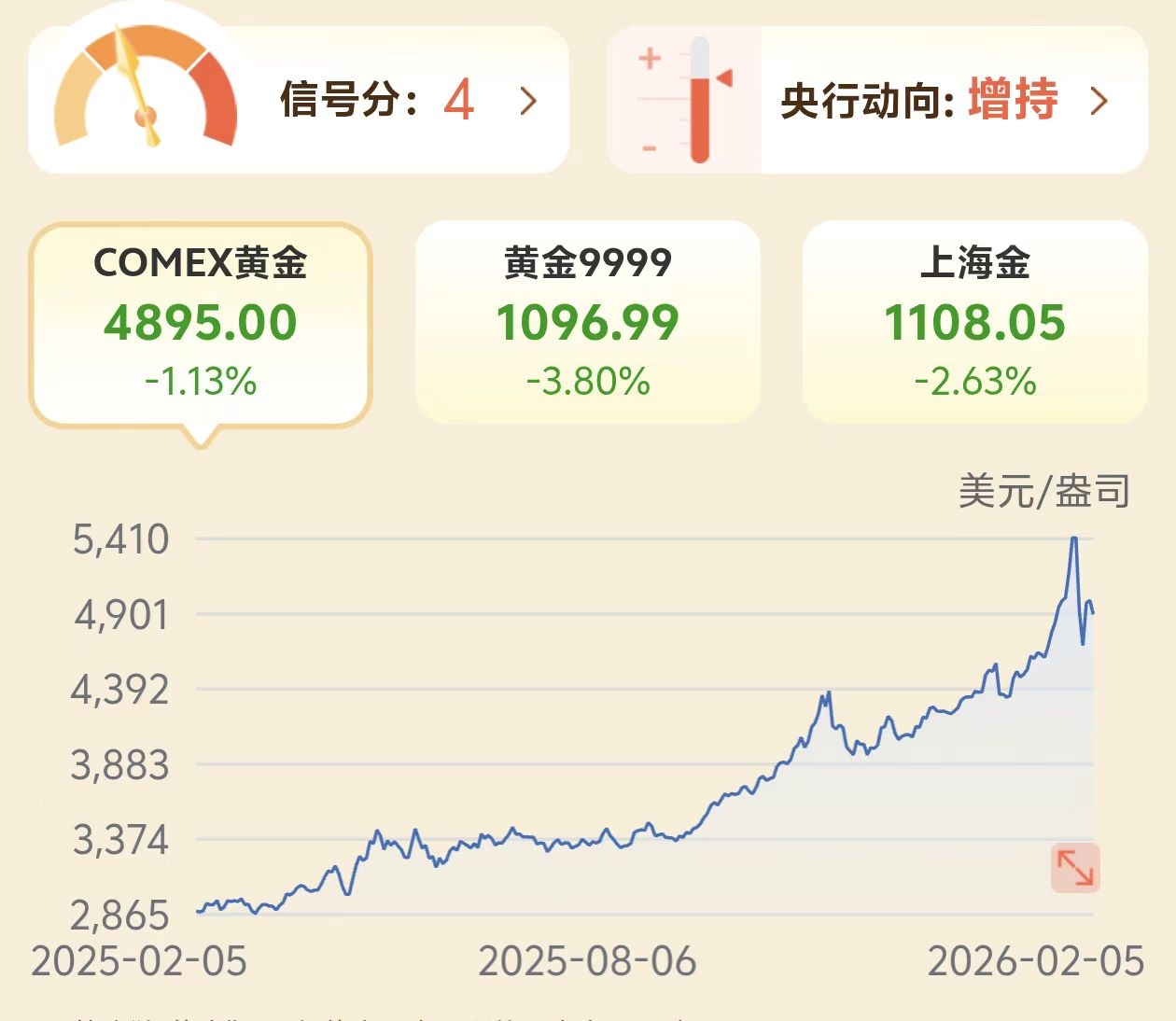
For ordinary investors, how should one respond reasonably to this 'replaying history' market? I will give you a few practical suggestions; this is not investment advice, just a personal experience sharing.
First, do not chase highs or bottom fish. Gold prices are currently volatile, and chasing highs can easily lead to being trapped, while bottom fishing might catch only partway up the hill. You can build positions in batches in the range of 4600-4800 U.S. dollars/ounce for London gold and 1060-1080 yuan/gram for domestic gold T+D, and reduce positions in batches in the range of 5000-5200 U.S. dollars/ounce and 1120-1140 yuan/gram, without betting on one-sided markets.
Secondly, distinguish between investment and consumption. If it’s for investment, prioritize choosing bank investment gold bars or gold ETFs, as these types have lower premiums and are closer to market prices, making them suitable for long-term holding. If buying jewelry, understand that its main value lies in decoration, with weaker investment attributes, higher brand premiums, and labor costs, and short-term fluctuations have limited impact on it; do not approach jewelry purchases with an investment mindset.
Finally, control your positions and hedge risks. Although gold is a safe-haven asset, it can also have significant short-term fluctuations. It is recommended to keep the proportion of gold assets in personal total assets within 10%-15%, and not to heavily bet on it. You can pair it with some low-risk assets like bonds or money market funds to reduce the overall portfolio volatility risk.
As a seasoned player who monitors the market daily, I summarize a few practical points based on the gold price movement on February 5. Today, the gold price slightly corrected, with London gold reported at 4920.89 U.S. dollars/ounce and domestic gold T+D reported at 1110.35 yuan/gram. This kind of fluctuation is normal, especially since the prior increase was too large, and the market needs to digest the profit-taking.
History is indeed repeating itself, but not simply copying. The present is a period of wide fluctuations, and controlling positions according to the rhythm is more important than betting on one side. Fluctuations are meant to build momentum for future trends; maintaining support levels and controlling risks is the long-term strategy. Investing involves risks; caution is required when entering the market. This article is purely for personal entertainment and should not be taken as investment advice.
Finally, let's talk about the above-mentioned golden line.$XAU , silver$XAG Stock perpetual contracts can still share a prize pool of 200,000 U.S. dollars, with the first ten thousand participants each having a share.