
There was a point where nothing I did in Pixels was technically wrong, but the outcome still felt off. Same time spent, same level of focus, no obvious mistakes. Yet the results didn’t carry the same weight as before. Not a sharp drop, just enough to make the session feel less productive than it should have been.
What made it harder to understand is that nothing signaled a change. No update, no adjustment, no visible limitation. If I looked only at the surface, everything was still working. But the longer I stayed in that same pattern, the clearer it became that something underneath had shifted.
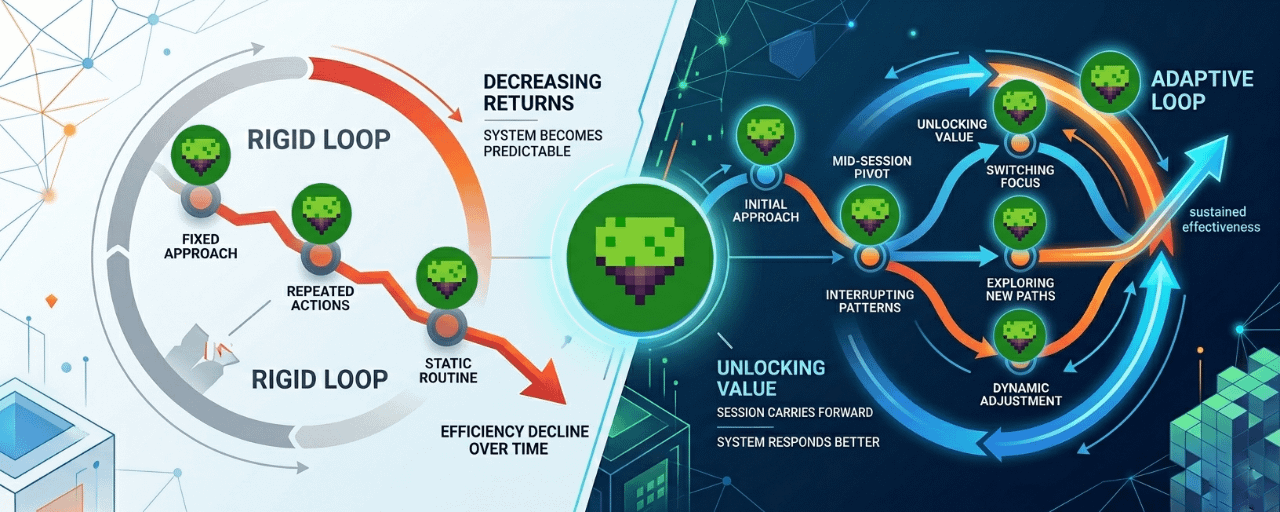
I started paying attention to how long I was staying in one approach. Not what I was doing, but how consistently I was repeating it. The more fixed my routine became, the less effective it felt over time. It didn’t break completely, it just stopped scaling with effort.
So I tried something simple. Instead of optimizing one path, I interrupted it earlier than usual. I changed direction mid-session, switched focus before reaching the usual stopping point, and avoided finishing loops the way I normally would. It didn’t feel efficient at first, but the difference showed up later.
What changed wasn’t the amount of $PIXEL earned in a single moment, but how the session carried forward. The next session felt less constrained, less predictable. It was as if the system responded better when I didn’t lock myself into one structure for too long.
That made me think differently about how value moves inside Pixels. It doesn’t seem tied strictly to isolated actions. It feels closer to how patterns evolve across sessions. When behavior becomes too stable, the outcome stabilizes as well, and not in a good way.
I’ve seen systems where repetition is the goal, where finding the best loop means you can rely on it indefinitely. Here it feels temporary. A loop works, then gradually loses its edge if nothing changes. Not because it’s removed, but because it stops being the best option.
That creates a different kind of pressure. Not to play more, but to stay aware of when something is no longer working as well as it used to. The system doesn’t force that realization, it lets you sit in inefficiency until you notice it yourself.
After a while, it becomes less about optimizing a single session and more about managing how your approach evolves over time. The difference is subtle, but once you see it, it’s hard to ignore.
I’m still testing how far this goes, but so far it doesn’t feel like a system you can solve once and repeat forever.