
@Plasma is a specialized Layer 1 blockchain designed around a narrow but increasingly important objective: enabling stablecoin transfers that are fast, inexpensive, and dependable. Rather than operating as a general purpose smart contract network, Plasma focuses on payments and settlement as its primary workload. It combines full Ethereum Virtual Machine EVM compatibility with rapid transaction finality and protocol level features tailored specifically to stablecoin usage.
This article provides a technical, non promotional overview of Plasma’s goals, the problems it seeks to address, and the architectural choices behind its design, with an emphasis on real world financial use cases.
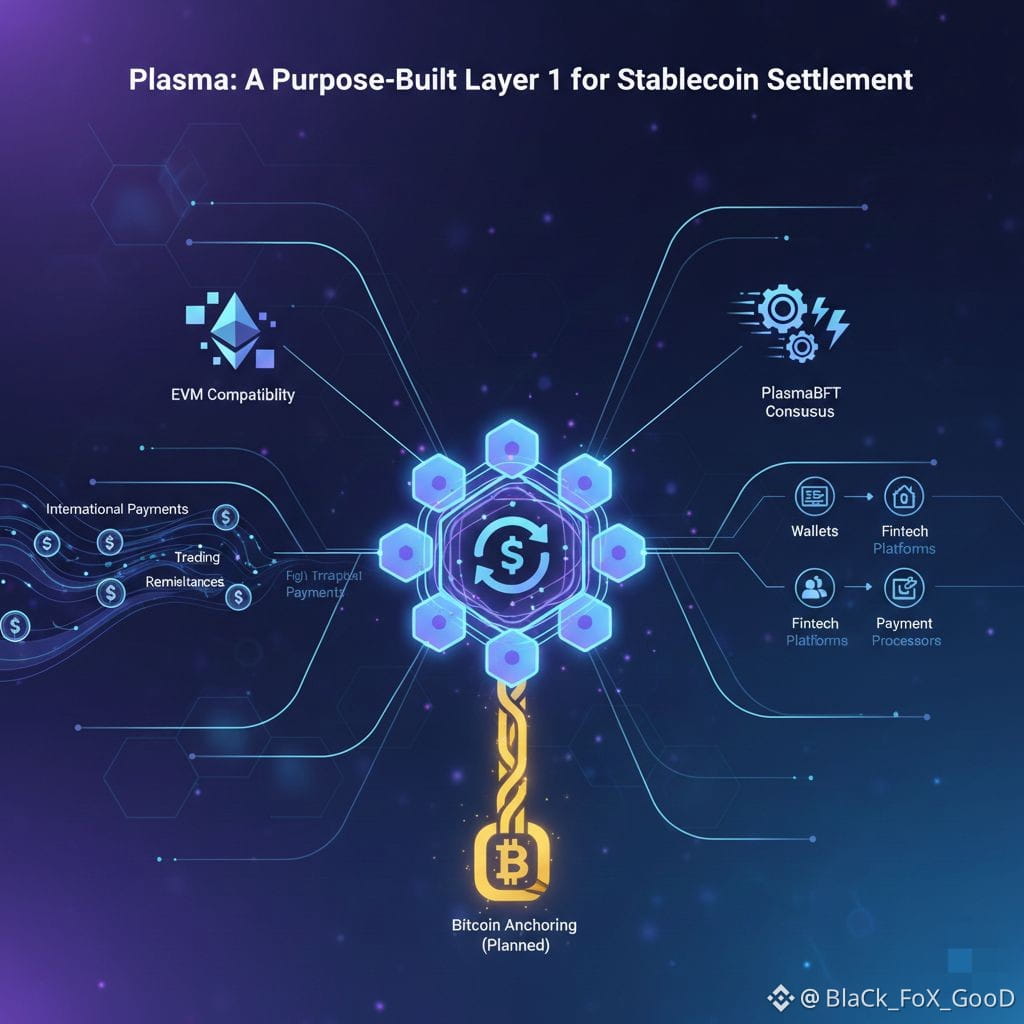
The Underlying Issue: Stablecoins on Non-Specialized Networks
#Plasma Stablecoins are among the most widely adopted blockchain based assets today. They underpin a broad range of activities, including:
International money transfers
Remittance services
Trading and treasury operations
On chain payroll and payments
Despite this widespread use, stablecoins typically operate on blockchains that were not built with payment settlement as a primary function. Most Layer 1 and Layer 2 networks prioritize general smart contract flexibility, which can introduce inefficiencies when used for high volume financial transfers.
This mismatch leads to several recurring challenges:
Variable transaction fees Costs fluctuate with congestion, complicating budgeting and pricing.
Delayed or probabilistic finality Transactions may require multiple confirmations before being considered irreversible.
Suboptimal payment experience Users often need to hold a native token solely to cover fees, even when transacting only in stablecoins.
Fragmented infrastructure Payments, custody, and financial applications are spread across multiple networks with different assumptions and guarantees.
For both individuals in regions with high stablecoin reliance and institutions managing large transaction volumes, these limitations translate into higher friction and operational overhead. Plasma is built on the premise that stablecoin settlement warrants infrastructure optimized specifically for that purpose.
Importance Within the Web3 Ecosystem
Stablecoins increasingly serve as the connective tissue between traditional finance and blockchain systems. They function as digital representations of fiat currency for users without reliable banking access and as settlement instruments for fintech platforms and payment processors.
As their role expands, the infrastructure supporting them must meet standards commonly associated with conventional financial systems:
Rapid confirmation times
Consistent and transparent fees
Clearly defined finality
Strong resistance to censorship
Blockchains that lack these properties struggle to support payment centric use cases at scale. Plasma addresses this gap by elevating stablecoins to a core protocol concern rather than treating them as just another application layer asset.
High Level System Design
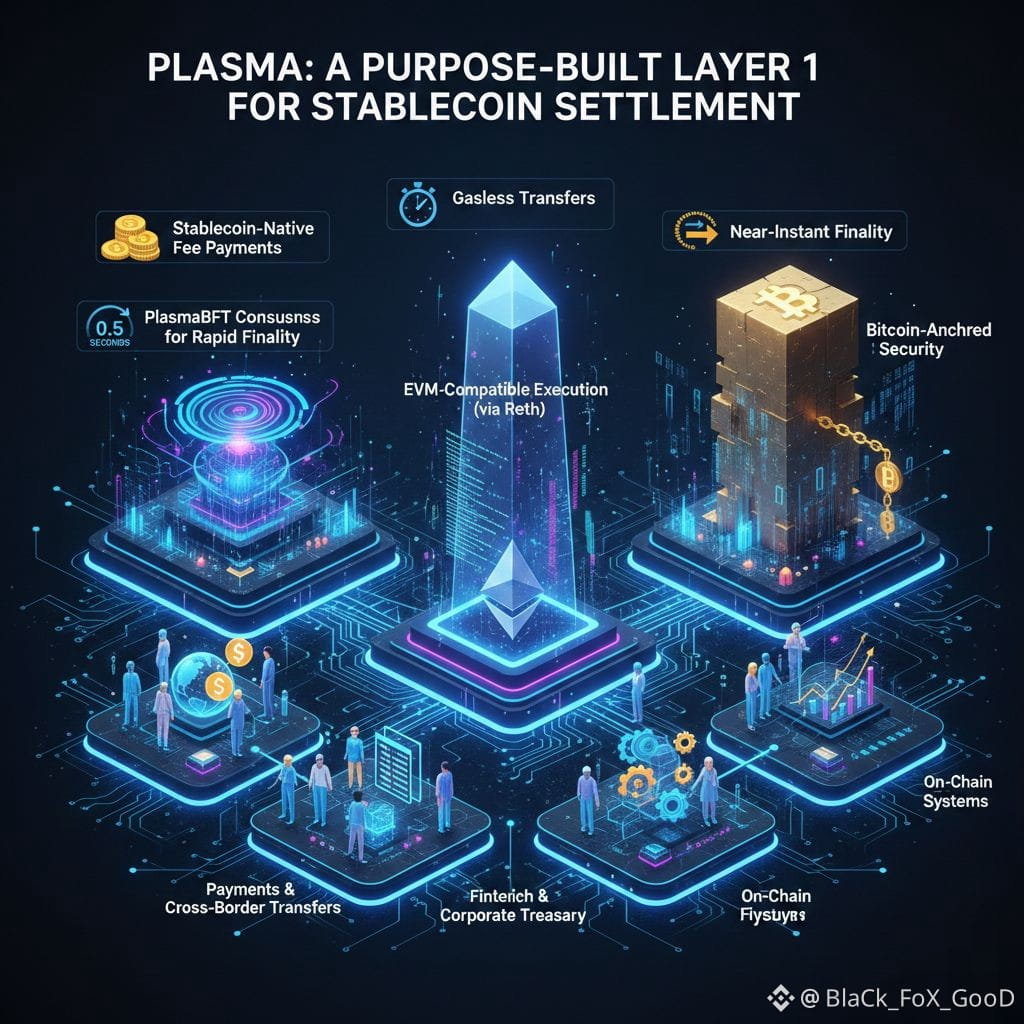
Plasma is structured around three foundational components:
EVM Compatible Execution via Reth
Plasma operates an Ethereum compatible runtime, enabling existing smart contracts, wallets, and developer tools to function with minimal modification. This lowers the barrier for developers migrating payment related applications.
PlasmaBFT Consensus for Rapid Finality
The network employs a Byzantine Fault Tolerant consensus mechanism that delivers sub second finality. Transactions reach a definitive state quickly, which is critical for merchant payments, payroll systems, and real time financial workflows.
Bitcoin Anchored Security Planned Architecture
Plasma is designed to periodically anchor network state to Bitcoin. This anchoring is intended to provide an external reference point for integrity and enhance censorship resistance by leveraging Bitcoin’s neutrality as a settlement layer.
Together, these elements form a Layer 1 optimized for low latency stablecoin movement while remaining interoperable with the Ethereum ecosystem.
Core Features and Functional Design
Stablecoin Native Fee Payments
#Plasma allows transaction fees to be paid directly in stablecoins. Users are not required to acquire or manage a separate gas token, reducing onboarding friction and simplifying payment flows.
Sponsored and Gasless Transfers
For certain transaction types, Plasma supports gasless transfers where applications or service providers cover fees on behalf of users. This model is particularly well suited for consumer facing products that aim to abstract blockchain complexity.
Near Instant Finality
Through PlasmaBFT, transactions can be finalized in under one second. This contrasts with probabilistic confirmation models and is essential for point-of-sale transactions and high-throughput payment environments.
Full Ethereum Compatibility
Developers can deploy Solidity based contracts and reuse existing infrastructure such as wallets, indexers, and analytics tools, enabling smoother integration with current Web3 systems.
Architectural Overview
Plasma follows a modular Layer 1 architecture:
Execution layer EVM compatible runtime powered by Reth
Consensus layer PlasmaBFT for fast and deterministic agreement
Settlement anchoring Periodic commitments to Bitcoin
Application layer Payment platforms, wallets, and financial services
This separation allows Plasma to optimize performance and fees for stablecoin settlement while remaining compatible with Ethereum based applications.
Application Areas and Use Cases
Payments and Cross Border Transfers
Fast finality and stablecoin denominated fees make Plasma suitable for remittances, merchant payments, and consumer wallets.
Fintech and Corporate Treasury
Organizations can process payroll, supplier payments, and internal transfers without exposure to volatile native tokens.
On Chain Financial Systems
Developers can build escrow, settlement, and credit systems that assume stable value assets at the base layer.
Emerging Markets
In regions where stablecoins are already widely used, Plasma can function as a lightweight settlement network for everyday transactions.
Developer and User Experience
For developers, Plasma maintains a familiar environment through Ethereum compatibility while offering different underlying guarantees namely faster finality and a payments-oriented fee model.
For users, many of Plasma’s advantages are subtle but impactful:
No requirement to manage multiple tokens
Faster transaction confirmation
More predictable and transparent costs
These changes reduce friction and make blockchain based payments feel closer to traditional digital finance systems.
Security, Reliability, and Trust Model
Plasma combines Byzantine Fault Tolerant consensus with Bitcoin anchoring to balance responsiveness and neutrality. BFT consensus enables rapid finality, while anchoring to Bitcoin is intended to provide an external checkpoint that strengthens resistance to censorship or validator collusion.
This hybrid approach reflects an attempt to deliver payment grade performance without relying entirely on a small, closed validator set.
Scalability and Ecosystem Integration
Because Plasma is EVM compatible, it can integrate with existing Ethereum tools and potentially interoperate with Layer 2 networks and bridges. Its specialization around stablecoin traffic allows it to scale around a well defined workload rather than attempting to optimize for all possible applications.
Cost Structure and Performance Goals
By simplifying the gas model and prioritizing stablecoin transfers, Plasma targets:
Lower transaction costs
Reduced user experience complexity
High throughput for payment heavy workloads
These properties are particularly relevant for businesses handling large volumes of small-value transactions.
Long Term Outlook and Challenges
Plasma operates in a competitive environment that includes general purpose Layer 1s, Ethereum Layer 2 solutions, and other payment focused blockchains. Its primary differentiation is treating stablecoins as native protocol elements rather than secondary applications.
Key challenges include
Expanding validator decentralization
Achieving adoption among wallets, fintechs, and payment providers
Competing with rapidly advancing Layer 2 payment solutions
Demonstrating the practical security benefits of Bitcoin anchoring in production
If successful, Plasma could reinforce the idea that specialized Layer 1 networks still have a meaningful role in Web3 particularly for financial infrastructure where reliability, cost predictability, and user experience are paramount.
Conclusion
Plasma represents a focused approach to blockchain architecture, prioritizing stablecoin settlement while maintaining compatibility with Ethereum’s development ecosystem and drawing on Bitcoin for external security anchoring.
Rather than aiming to support every possible application, Plasma targets a specific and growing demand: digital currency infrastructure optimized for payments. Its long term significance will depend on execution quality, ecosystem adoption, and how effectively it integrates into the broader crypto and financial landscape.
