

Every so often, a technology shift reaches a quiet turning point. Nothing flashy. No countdown. Just a subtle change that reroutes everything that follows. In blockchain, that moment is happening now. Not because of memes or price charts but because of stablecoins.
Digital dollars are doing the real work. They move billions each day while barely making noise. And right in the middle of that shift sits a new kind of blockchain. One that refuses to be all things to all people. Plasma exists for a single reason: to move stablecoins fast, cheaply, and without friction. Once that clicks, it becomes hard to see the future of money the same way again.
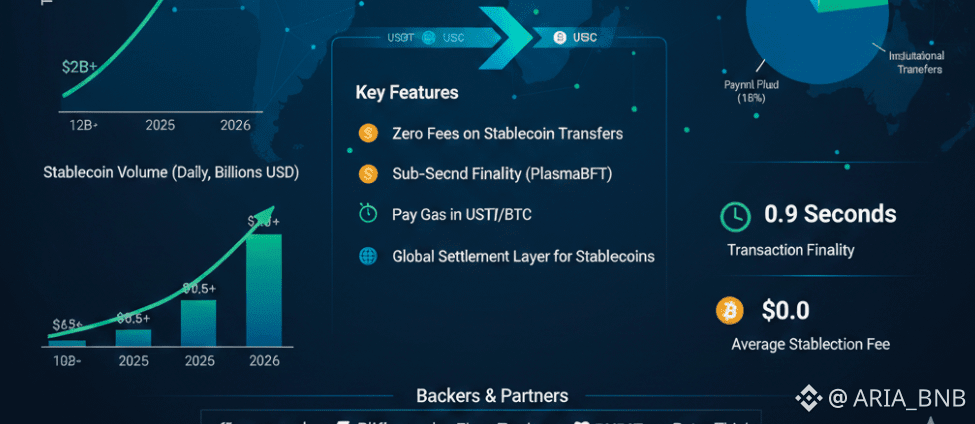
Plasma is not another Layer 1 chasing hype. It was designed with a narrow mission and that focus shows. This chain wants to be the global settlement layer for stablecoins. On Plasma, USDT is not just another token tucked inside contracts. It is a first-class primitive. The entire network is shaped around it.
Most blockchains had different priorities. Ethereum pushed programmability. Solana went after raw speed. Bitcoin locked in security above all else. None of them were built around a simple truth: people want to move dollars instantly, predictably, and cheaply across borders. Plasma took that truth seriously and built from there.
The result feels almost unreal in its simplicity. You can send USDT on Plasma and pay zero fees. Not low fees. Not discounted fees. Zero. The transfer feels like sending a text. PlasmaBFT finalizes transactions in under a second. No waiting. No stacking confirmations. No stalling when the network gets busy. It just settles. For anyone who has paid painful remittance fees to move money home, that alone is a breakthrough.

Speed and cost are only part of the story. The deeper trick is how Plasma connects worlds that were never meant to fit together. Its execution layer is fully EVM-compatible through Reth. Developers deploy smart contracts the same way they do on Ethereum using the same tools they already know. At the same time, Plasma anchors its state into Bitcoin. That means Ethereum-style flexibility backed by Bitcoin-level security. A hybrid most people assumed was theoretical until it showed up in production.
Then there is the gas model. It sounds minor until you use it. Most networks force you to hold a native token just to send anything. Even stablecoins. Plasma removes that friction. Fees can be paid in USDT or BTC. Basic stablecoin transfers cost nothing because the protocol covers them. Suddenly blockchain feels less like a system for specialists and more like normal digital money. Simple. Direct. Human.
The growth didn’t trickle in either. When Plasma’s mainnet beta launched in September 2025, over $2 billion in stablecoins arrived on day one. More than a hundred partner protocols were live immediately. The backers tell the same story. Framework. The USD₮ ecosystem from Bitfinex. Cumberland. Flow Traders. Bybit. Nomura. Early support from Paolo Ardoino and Peter Thiel. That kind of lineup only forms around infrastructure that matters.
Plasma is aiming well beyond crypto natives. It is targeting payments as a whole. Remittances. Merchant settlement. Treasury flows. Payroll. Institutional transfers. All the places where money still crawls through slow and expensive systems. If a business can settle instantly, pay nothing, use stablecoins, and anchor trust to Bitcoin, the question flips. Why wouldn’t they switch? Why wait days for wires when finality can arrive in a blink
The planned Bitcoin bridge in 2026 adds another layer. Instead of custodian-wrapped BTC, Plasma is building a trust-minimized path that brings real Bitcoin liquidity on-chain as pBTC. Bitcoin can then move with stablecoin speed. Add EVM smart contracts on top and BTC finally plugs into DeFi without the usual tradeoffs. Two financial universes opening their doors at once.
Plasma still has work ahead. Validator decentralization needs to deepen. Regulation will always loom over payments. Early momentum has to turn into lasting adoption. But the hardest pieces are already in place. The tech works. The liquidity is real. The backers are serious. Most importantly, the use case is obvious.
This does not feel like crypto built for speculation. It feels like infrastructure. Like the early internet before anyone realized what email or websites would become. Stablecoins have already proven their value. What they needed was a home built to handle scale, speed, and trust at once. Plasma wants to be that home.
