
After spending years around on-chain transactions, one thing has become pretty clear to me: in crypto, “security” and “freedom” often feel like they are pulling in opposite directions.
Anyone who has spent real time swapping tokens, approving contracts, or moving assets across chains probably knows this feeling. Every time you sign a transaction, there is always a little hesitation. And most of the security tools people rely on today still work after the damage is done. They can tell you what happened, but not always stop what is about to happen.
That is why Newton Mainnet Beta caught my attention.
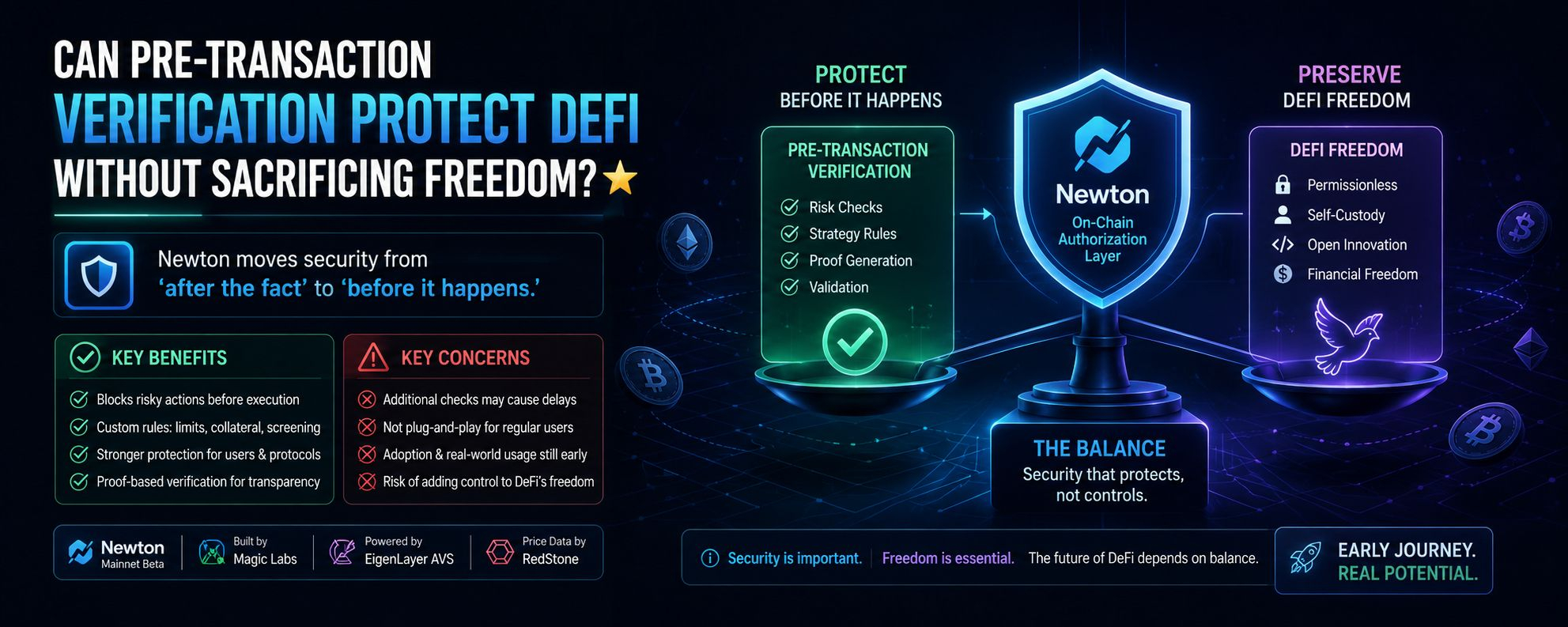
At its core, Newton is an on-chain authorization layer developed by Magic Labs and built on EigenLayer AVS. The idea is simple: before a transaction is finalized, it checks whether the action matches the rules you already set. If the verification passes, the transaction goes through with proof. If it does not, the transaction is blocked before settlement. In simple words, it tries to move security from “after the fact” to “before it happens.”
From a technical point of view, that is an interesting direction. With the VaultKit SDK, developers can set different rules like spending limits, collateral requirements, or screening for counterparties. The system also uses price data from RedStone to support its risk checks. On paper, this makes sense. Instead of waiting for something to go wrong and then reacting, why not stop risky behavior at the source?
But there are also some clear concerns, and they are not minor.
The first issue is performance.
Any system that adds extra checks before execution will naturally create some delay. Newton’s model depends on strategy execution, proof generation, and risk validation, which means every transaction has to pass through another layer. For normal transfers, that may be fine. But in high-frequency trading, arbitrage, or any time-sensitive situation, even a small delay can matter a lot. In crypto, speed is often part of the edge. If the risk-control layer slows things down too much, the trade-off becomes hard to ignore.
The second issue is usability.
The VaultKit SDK is clearly built for developers. That is not necessarily a bad thing, but it does mean that the average user will probably not be able to use it easily without understanding strategy setup, parameter configuration, and rule management. For experienced teams, that may be normal. For regular users, it may feel too technical and too complicated. A product like this may be powerful, but it is not yet something that feels truly plug-and-play.
The third issue is adoption and valuation logic.
Like many infrastructure projects, Newton’s real value will not come from the idea alone. It will depend on whether people actually build on it, integrate it, and use it in real workflows. Infrastructure without adoption can easily remain a story instead of becoming a business. A low valuation may look attractive, but it also reflects the market’s uncertainty about whether the product can move beyond the early narrative and become something widely used.
What makes Newton especially interesting, though, is the philosophical side of it.
The appeal of blockchain has always been tied to permissionlessness, self-custody, and less dependence on centralized approval. DeFi was supposed to create a financial system that works differently from traditional finance, not simply recreate the same approval-heavy structure on-chain. Newton’s model, however, introduces a layer of pre-authorization and rule-based control. From a security perspective, that is understandable. From a philosophy perspective, it raises a real question: if every transaction has to pass through a strategy engine before execution, how much of DeFi’s original spirit is still left?
To me, that is the real debate.
I do not think the pre-transaction verification model is wrong. In fact, I think it solves a real problem. It can reduce mistakes, block risky behavior early, and give users more control over how assets are used. That is a meaningful improvement. But at the same time, this kind of system is not something every user needs, and it is not the perfect fit for every use case. For some people, it may feel like protection. For others, it may feel like another layer of restriction.
So my view is simple: the direction is important, but the road is still early.
Newton may become an important part of DeFi infrastructure if it can lower the technical barrier, improve performance, and stay flexible enough for real users. But if it becomes too heavy, too slow, or too complicated, then it may remain a tool for a small group of advanced users rather than something the broader market actually uses.
For now, I see it as an interesting experiment with real potential, but also with real trade-offs.
The idea of protecting users before damage happens is strong. The challenge is making that protection useful without making DeFi feel less open, less fast, and less permissionless.
That balance will decide whether this model becomes widely adopted or stays a niche concept.
This is only my personal research perspective, and I may still be wrong. DYOR and manage your own risk carefully.
What do you think — can pre-transaction verification become mainstream without losing DeFi’s free spirit?
