The internet is powered by content delivery networks but everything changes with decentralization. Walrus becomes the first storage facility created to be optimized to global media distribution-blobs in strategic locations among the operators to sub-100ms access globally. Platforms prevent renting out centralized infrastructure and begin to own their economics of delivery.
Video platforms receive direct benefit. The long feature films are just stored as a bundle that has precision encoding which they are placed within the operators close to major population centers. The contracts enable warm caches, which are temporary doubling of the replication factors of popular titles during the peak viewing hours. Consumers have the streaming quality of conventional CDNs, with creators setting the terms of distribution themselves.
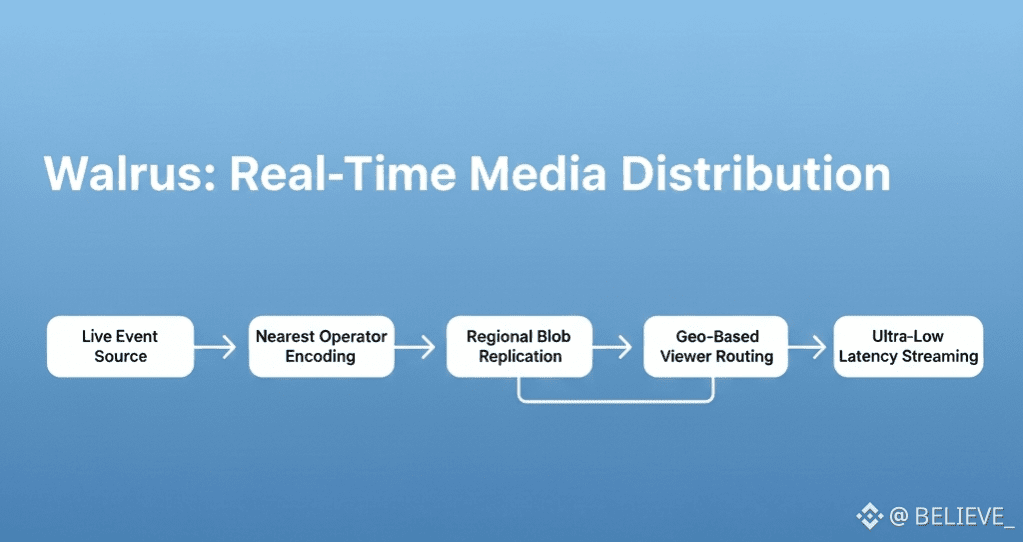
Broadcasters of live events go even Farther. Gaming tournaments, concerts, conferences, etc. are being streamed into real-time blobs. Encoding tasks are given to the operators who are nearest to venues. Worldwide viewers query using geographic paths; in Tokyo, a viewer is served out of Asia-Pacific nodes, in Europe a viewer is served out of local operators. Latency is 73 times lower than conventional alternatives that are decentralized.
 Lecture archive is efficiently scaled on educational platforms. Video series of several weeks within a semester are packaged into unities in university classes. Students all over the world get the same quality irrespective of the place. Access controls are built into contracts, which is free where the actors are enrolled students and teir-1 for non-students, external viewers. Institutions can achieve a saving of 89 percent on distribution expenses and still offer homogenized experience.
Specialisation of operators speeds up about optimisation of delivery. Pools where the CDN has been given special attention are known as edge infrastructure pools - operators co-locate with ISPs, place specialized retrieval caching available. Top performers receive commissions of 1.6; 68% of queries in media the world over. The competitive advantage turns into the geographic performance; Singapore nodes deliver 41 percent faster performance to Southeast Asia in comparison to the general pools.
The importance of token coordination is based on distribution velocity. Contracts to deliver Freight give higher premiums to operators with strong latency SLAs (less than 120ms worldwide is equal to 1.3x base rewards). The platforms stake WAL to nominate the preferred geographic clusters. The governance presents bandwidth bounties; operators increasing edge presence have retroactive protocol emissions granting.
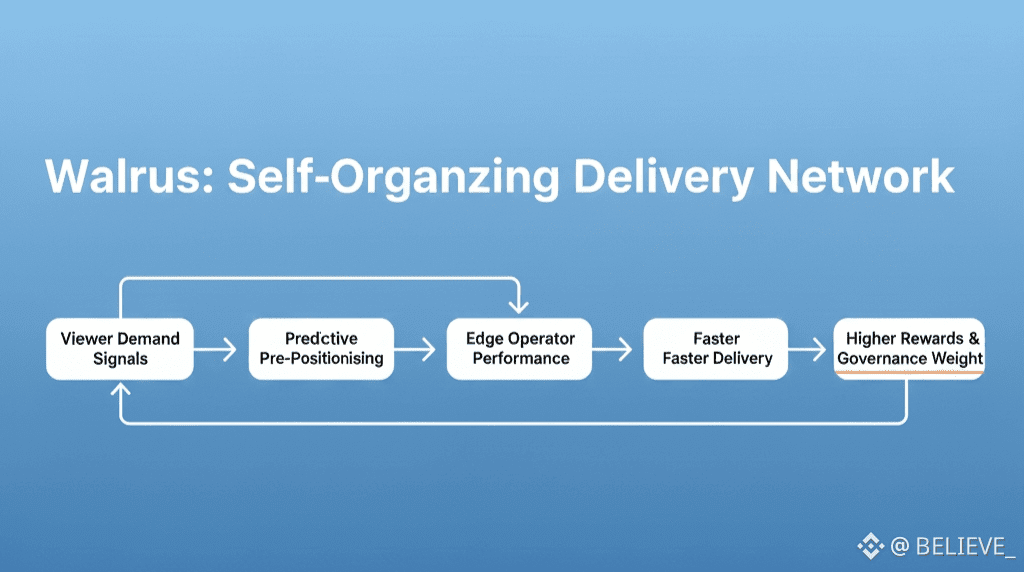
Optimization is elaborate between query patterns. Social media has been pre-warming popular videos 24 hours before the date of release. The process of concentration of viewers is tracked by use of contracts, which dynamically relocate the replication among the regions. Redundancy further goes to 8x on-demand during international occasions, and scales back down methodically when demand starts exposing usual levels. No intervention of man.
High-value streams are secured by privacy controls. This is done by encrypted slivers so that operators can not assemble complete video payloads. Granular analytics are not revealed to rights holders who use zero-knowledge proofs to verify the count of views. Scans of piracy detection are done across streams and not per stream. Security is a distributional property.
Cross-platform standards are a natural occurrence. Sony Playstation 4 streams read the same Walrus blobs, producing the same quality. Producers gain the advantage of being universal, no platform lock-in. Viewers can enjoy some level of mobility; subscriptions can easily be moved. Infrastructure commoditises and the control of the creators gains strength.
They are performance measures which lead to inexorable improvement. In nine months global average latency plummeted to 287ms down to 89ms. 99.97% refinements of auto-slashing are triggered. Top operators are delivered 450TB each day. Savings in bandwidth: optimization to compression saves 23% of monthly expenditures.
Staking indicates the need in delivery in order of size. CDN pools are 410 WAL delegation operator minimum, 180 standard lockups. APYs resolve into 26% -reduced yield, greater certainty. Infrastructure capital is a lead time phenomenon that the capacity is built prior to revenue. The votes of governance give priority to geographic expansion.
Speedy edge computing integration. Smart contracts cause compute tasks to run close to storage transcoding pipelines against blobs, removing two network-hops. Sites incorporate captions, characterize responses, base thumbnails without servers. Delivery pipes are also made fully programmable.
Decentralized delivery is best in disaster situations. The failure of regional ISPs is automatically rerouted by other non-affected operators. Media are available all over the world despite localized infrastructure failure. Advertisements do not disappear during cloud vendor outages; viewers do not lose access. It gets to be the state of resilience.
Viral distribution attains an algorithmic perfection. The predictions of machine learning models are used to predict content trajectories based on initial indicators, pre-position successful blobs based on the best operators. Popularity is financed by creators: virality economics is captured. There is no need to have capacity planning teams because the network is self-organizing.
Multi-resolution streaming acquires accuracy. All levels of quality are found in the single blobs; the viewer devices will search the best resolution on their own. Bandwidth optimizes to connection quality without buffering. Tasks: The effectiveness of storage increased intelligent tiering 34% g. Delivery is totally context-consistent with viewers.
Walrus considers the distribution of content to be a programmable infrastructure. Blobs are received in the form of raw media, and are eliminated as assets worldwide. Operators focus on regional performance. The governance of the system is an allocation of proposals by the number of bytes sent using the global network. The network finds that real delivery scale requires edge intelligence, but not storage capacity, looking forward to demand patterns no central planner can understand.