I’ll be honest I didn’t always look at blockchain projects the way I do now.
For a long time, my thinking was simple. If the technology sounded advanced, the narrative felt big, and the token had enough attention, I assumed everything else would fall into place. In my mind, building something innovative was already halfway to success. Creation and adoption felt almost interchangeable.
But that belief didn’t survive reality.
I kept watching the same cycle repeat. Strong protocols would launch, partnerships would be announced, listings would happen, liquidity would flow inand then usage would quietly disappear. Not because the system was broken, but because the world didn’t know what to do with it.
That’s when something shifted for me.
Most systems don’t fail at design they fail at integration.
They fail after they’re built.
Since then, one question has shaped how I think: what happens after creation? Does the system keep moving through the economy like something useful, or does it become static like a machine with no environment to operate in?
That shift is exactly why Sign Protocol started to stand out to me.
At first, it looked like familiar territory. Evidence layer, schemas, attestations, zero-knowledge proofs it sounded like another “future of identity” narrative. But when I slowed down and really thought about it, I realized it was aiming at a different layer entirely.
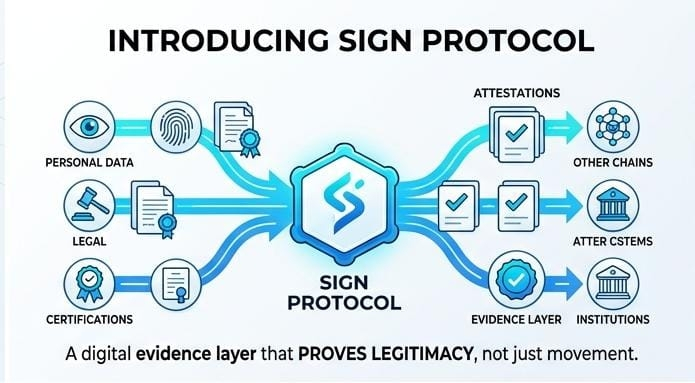
Sign isn’t trying to compete with blockchains in the usual way. It’s not just recording transactions. It’s trying to standardize the reason behind digital actions.
And that’s a different category.
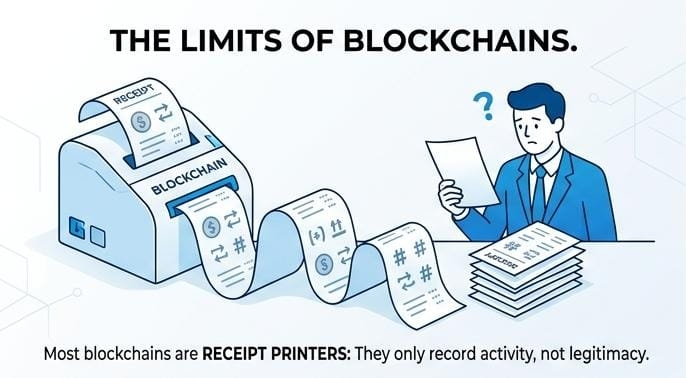
Most blockchains function like receipt printers. They record that something happened assets moved, value changed hands. But a receipt doesn’t tell you if the transaction was legitimate, if the participants were authorized, or if the outcome should be recognized outside the system.
Sign is trying to build something closer to a digital evidence layer a system that proves legitimacy, not just activity.
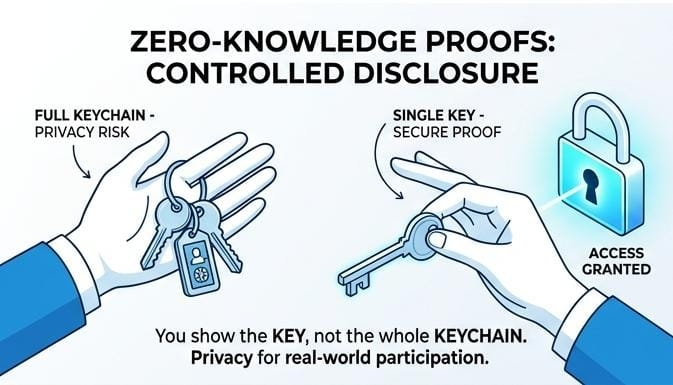
That’s where zero-knowledge proofs stop being abstract and start becoming practical. It’s the ability to prove something without exposing everything. You show the key, not the whole keychain.
This isn’t privacy for the sake of privacy. It’s privacy as a requirement for real-world participation.
Because the real world doesn’t operate on full transparency.
It operates on controlled disclosure.
Once I saw it that way, the idea of an evidence layer made more sense. If blockchains are highways that move value, then Sign is trying to build the paperwork system that makes that movement legitimate the permits, licenses, and certifications that allow real activity to flow.
That’s when the evaluation changed for me.
The question stopped being “is this a good product?” and became “can this become infrastructure?”
Because infrastructure isn’t something you use once.
It’s something you rely on without thinking.
Electricity. Shipping containers. Barcode systems. They’re not exciting, but everything depends on them.
So the real test isn’t technical it’s structural.
Does the system enable interactions that feel natural? Not forced, not incentive-driven, not dependent on hype.
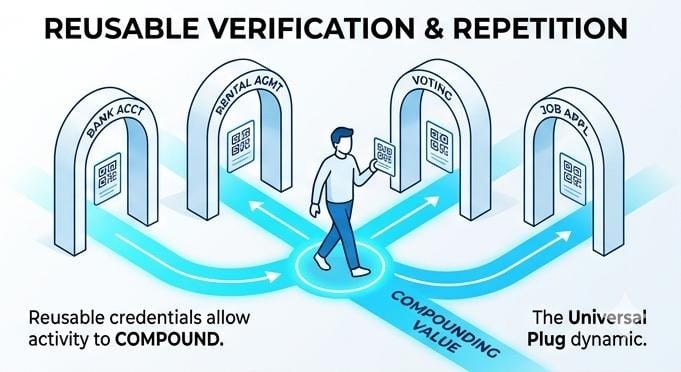
Sign’s model based on attestations and schemas makes something important possible: reusable verification. A proof created today can be used tomorrow, somewhere else, without being rebuilt.
That’s how systems scale.
Because once outputs become reusable, activity starts compounding. One credential can unlock multiple interactions. One proof can support many agreements.
That’s where network effects actually come from not marketing, but repetition.
It’s like a universal plug. The plug itself isn’t exciting, but once enough systems support it, it becomes essential. The value isn’t in the plug it’s in the compatibility it creates.
That’s the dynamic Sign is aiming for.
And from a market perspective, the positioning makes sense. The narrative aligns with where things are heading: digital identity, compliance, privacy, and proof-based systems. Multi-chain deployment also reflects reality users move toward efficiency, not ideology.
But positioning isn’t maturity.
Maturity shows up when usage continues without incentives. When activity remains consistent even when attention fades. When the system becomes routine.
And that’s where the real tension begins.
Because even if the technology is flawless, the world doesn’t run on cryptography alone.
It runs on law, politics, and recognition.
A zero-knowledge proof can verify something perfectly but it only matters if someone with authority accepts it. A smart contract can execute flawlessly but if institutions don’t recognize it, it doesn’t carry weight outside the system.
That’s something I used to underestimate.
I thought mathematical truth would be enough
It isn’t.
Governments don’t trust systems just because they’re decentralized. They trust systems they can control or at least hold accountable. Institutions don’t adopt tools because they’re elegant. They adopt them when disputes can be resolved and responsibility is clear.
And decentralization removes a key element they rely on: a single accountable party.
That’s why so many institutional systems remain permissioned.
Not because permissionless systems don’t work but because permissioned systems offer accountability.
So when I look at Sign, I don’t just see a technical challenge.
I see an adoption challenge.
The real question isn’t whether it can create evidence.
It’s whether that evidence will be recognized outside crypto.
Because the biggest risk isn’t competition.
It’s irrelevance.
The risk is building something powerful that never fully connects to real economic activity.
Because the world doesn’t reward what can be built.
It rewards what gets embedded.
That’s why everything comes back to one idea: what happens after creation?
If attestations keep circulating, keep being reused, and keep becoming inputs for other systems, then this becomes infrastructure.
But if activity only spikes during campaigns, then it’s just another temporary wave.
The difference is simple.
One-time usage is noise.
Repeated usage is gravity.
So now, I don’t watch hype.
I watch continuity.
Is activity consistent or event-driven?
Is participation expanding or concentrated?
Are people using it because they need to—or because they’re being incentivized?
Because potential is everywhere in crypto.
Sustained adoption is rare.
And in the end, the real question is simple:
Do people have a reason to keep using this system over time?
Not once. Not for rewards. But repeatedly because it becomes part of how they operate.
That’s the difference between a product and infrastructure.
And that’s the real test.
Not whether Sign can build an evidence layer but whether the evidence it creates becomes a living asset in the economy. Something that doesn’t just exist, but continues to circulate, compound, and create value long after the excitement fades.