
I've lost money on trading bots before. Not a lot. But enough to want to understand why.
The answer was always the same. The bot made a decision. The decision was wrong. That's all the information you got. No reasoning. No explanation. Just a number that moved in the wrong direction and silence where an answer should have been.
That bothered me more than the loss itself.
There's something uncomfortable about trusting a system you can't read. Not because you need to understand every calculation — but because when something goes wrong, you have no way to know if it was a bad market or a bad decision. That distinction matters. A bad market is noise. A bad decision is a flaw you need to find.
Most trading systems are built to hide that difference.
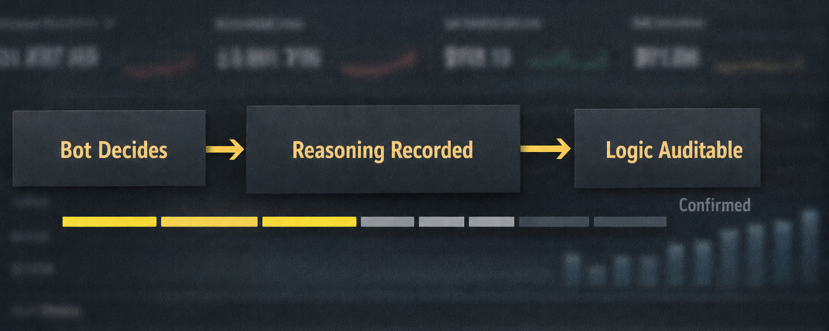
That's what made me stop when I started reading about what OpenLedger is doing with its trading agent. The claim is specific: every step of the agent's reasoning gets recorded on-chain. Not just the final trade. The thinking behind it.
I don't know exactly what that looks like in practice. Whether "reasoning" means a full decision tree or something simpler. Whether the record is actually readable by a person or just verifiable by another system. Those details matter and I haven't seen them answered clearly yet.
But the direction is interesting.
Because the problem with black-box trading isn't just transparency for its own sake. It's that without visibility into reasoning, you can't improve the system. You can't tell if the agent is learning or just getting lucky. You can't distinguish a strategy from a pattern that happens to work for now.
If the reasoning is recorded — really recorded, not just logged — then something changes. You can look back at a decision and ask whether it made sense given what the agent knew at the time. You can audit not just outcomes but logic. Crypto doesn't usually ask that question.
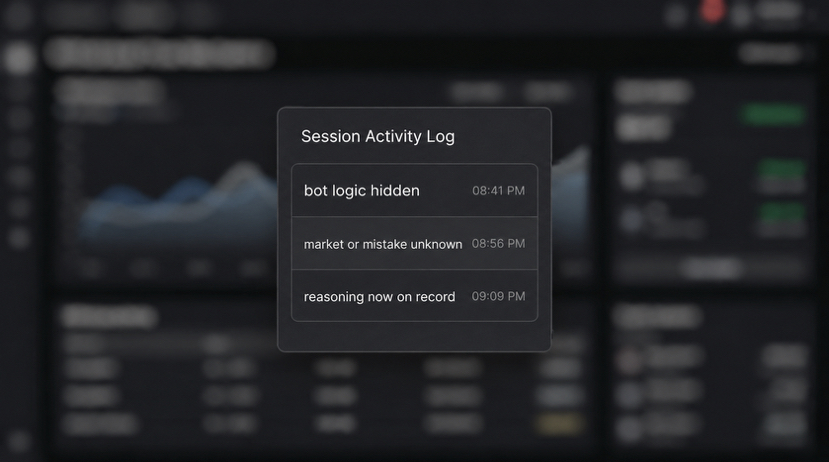
OpenLedger's integration with Theoriq adds another layer. The record isn't just internal — it's meant to be checked by someone outside the project. By someone with no reason to protect a bad decision.
That's the part I keep coming back to.
Not whether the agent makes good trades. Any bot can have a good month. The question is whether you can tell, after the fact, why it made the trades it did. And whether that record is honest enough to be useful when it matters most — when the trade was wrong.
It works if the on-chain reasoning is specific enough to be meaningful and accessible enough that someone outside the project can actually read it. It fails if the record becomes a technical artifact that satisfies auditors but tells traders nothing.
I'm not sure which one this will be.
But it's the first time I've seen the question asked seriously in a trading context. Even before there's a clear answer.
