
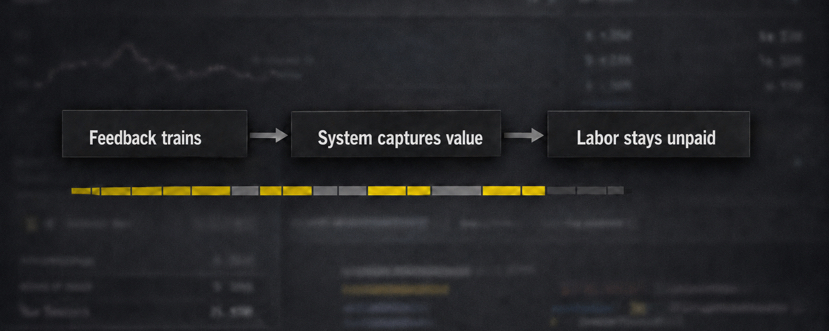
Thumbs up. Thumbs down. Sometimes a short note. "This missed the point." "Too confident about something it shouldn't be confident about." Then submit. Then the page refreshes and it's gone.
I never tracked how many times I did this. Hundreds, probably. Maybe more. It became automatic — like correcting a typo in a document that isn't yours. You do it because it bothers you not to. You do it because the next version will be slightly better and that feels like enough reason. And then I came across OpenLedger asking exactly that question: if this is labor, why does nothing move in your direction when you do it?
Except lately I started thinking about what "enough reason" actually means. Because every time I rated a response, I was doing something. I was making a judgment that required context, experience, taste. I was telling the model something it couldn't figure out on its own. That's labor. The quiet kind — no desk, no paper trail. Just a thumb pointing up or down. I never once thought to call it work.
The premise isn't complicated. If your feedback improves a model, and that model earns money from every query it answers, then something should move in your direction. As a calculation, not a thank-you. Every inference that draws on a model you helped shape — a small share flows back automatically, recorded on-chain. Not dependent on anyone deciding you deserved it.
I kept rereading that part. Not because it sounds revolutionary. Because it sounds obvious. And the fact that it doesn't exist anywhere else — that's the part that stayed with me.
That said. I've watched enough projects describe clean mechanisms that dissolve under real conditions. The math sounds right until you ask: who calculates how much my specific thumbs-down contributed to this specific improvement? How granular does attribution actually get? Is there a minimum threshold before anything clears? These aren't edge cases. They're the whole thing.
The premise survives if the link between feedback and reward is traceable and real — not a general pool distributed equally to everyone who ever clicked something. It becomes noise if the numbers are technically correct but practically invisible. A payout of $0.0003 per month is still a payout. It's also meaningless.
What I keep coming back to is simpler than the mechanics. All those ratings I submitted over the years — they went somewhere. They changed something. The model that exists today is partly shaped by people like me who never thought of themselves as contributors. We just thought we were helping.
Maybe that distinction was always the problem. Maybe "helping" is what you call labor when you've decided it has no price. OpenLedger at least names it differently. Whether that changes anything in practice — I genuinely don't know yet.
I'm not sure what it would feel like to rate a response and know it was recorded. Know it counted. Know that somewhere in the chain, my judgment left a trace that didn't disappear when the page refreshed.
Probably not that different from what I do now. But maybe slightly less like holding a door for a room I'll never enter.
