
I've been thinking about this for a while.
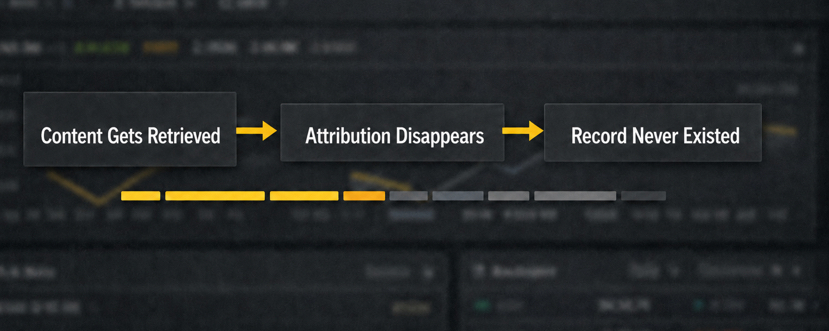
Someone built a Q&A tool using documentation I wrote. Not copied — built on. The tool answered questions the way I would answer them, used the structure I developed, the edge cases I spent time on. The tool got good reviews. My name appeared nowhere in how it worked.
There's a name for what happened. RAG — retrieval-augmented generation. The model doesn't know the answers. It pulls relevant documents, generates a response based on them. My documentation was probably retrieved dozens of times. And OpenLedger has a specific question about that process: when your content gets retrieved, does anything record that it was yours?
I want to be careful here. I don't think anyone did anything wrong. The documentation was public. The person who built the tool probably never thought about where the clarity came from. That's not malice. That's just how building works. You use what's available and don't trace every layer back to its source.
But that's exactly what bothers me. The system had no mechanism to trace it. Not because someone chose not to — because nothing was ever designed to record that connection. My contribution existed. The value it created existed. The link between them was never written down anywhere.
RAG Attribution is OpenLedger's attempt to change that. When a model retrieves your content to answer a question, that retrieval gets recorded. Your file isn't just sitting in an index somewhere — the system logs that it was pulled, that it contributed to a specific answer. That's the part I keep returning to. Not that the record exists, but that it's tied to a specific event: this query, this specific moment when your file actually mattered. Most systems don't even try to capture that. They store the file and forget the context in which it was used.
I genuinely don't know if that works at scale. Thousands of documents, millions of queries — the attribution graph gets complicated fast. And I don't know if the current implementation handles real complexity or just the clean cases.

It works if the logging is granular enough to mean something. Not just "your file was in the index" but "your file was retrieved, weighted, used for this answer."
It fails if attribution becomes a label nobody reads. If "attributed" ends up meaning the same thing as "mentioned in the documentation" — technically recorded, practically gone.
Most of the value flowing through AI systems started somewhere. Someone spent time making something clear that wasn't clear before. That origin usually disappears long before the value shows up on the other end.
What OpenLedger is trying to preserve sounds simple.
I'm not sure it is.
The tool got good reviews.
I still wonder if there's a version of this where that matters to anyone but me.
