
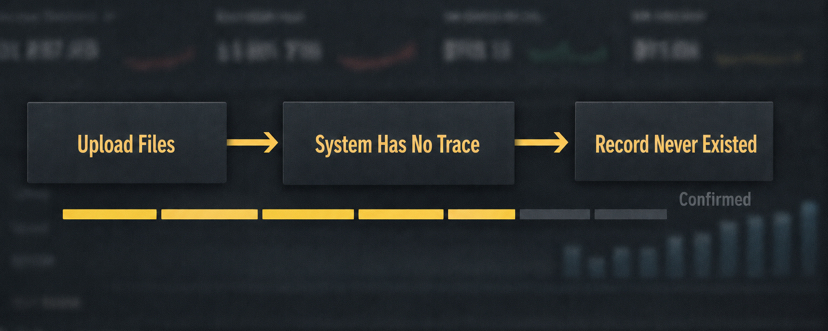
I uploaded a folder of files to a platform once and couldn't find them afterward. Not because access was revoked. Because the interface gave me no way to see where they went after processing. I spent months building documentation for a consulting project, careful work, the kind that takes real domain knowledge. When the contract ended, I asked where my contributions lived. Support said they were "part of the project history." No export function. No path back. That was the end of the answer.
That phrase stayed with me. "Part of the project history." It's technically true. It's also a way of saying it's ours now, not yours. And the system had no language for the difference between those two things.
Most platforms are built around input, not tracing. You contribute something, the system absorbs it, something happens downstream. The path between what you gave and what came next isn't hidden. It just doesn't exist as something you can follow.
That's the part I keep coming back to when I look at OpenLedger's on-chain audit trail. Every data contribution logged permanently. Not maintained by the platform. Not dependent on someone deciding to keep a record. Just there. I don't know if it works the way it sounds. But the framing is different from what I usually see.
A log someone maintains versus a record that exists independently. That's where I keep getting stuck. A log can be deleted. Or never started. Or quietly not updated after a certain point. A record on-chain is a different kind of thing. Whether that difference is meaningful in practice depends entirely on how the system is actually built. And I haven't seen it work end to end.
But a record existing isn't the same as a record mattering. OpenLedger's audit trail tells you what happened. It doesn't tell you what to do about it. And most people who contributed knowledge or time to a system don't have the resources or the leverage to act on a record even if it's perfectly preserved. Knowing something happened and being able to do anything about it are two separate problems.
Traceability and accountability are not the same thing. A hash on a chain proves something existed. It doesn't prove what it was worth, how it was used, or what happened downstream. Those are different questions. And I'm not sure the infrastructure that answers the first one automatically answers the rest.
OpenLedger keeps surfacing for me around the same problem. The distance between "your contribution is recorded" and "your contribution is traceable in a way that creates accountability" can be enormous.
The question I can't shake — if a record exists but nobody has a reason to read it, does the traceability actually change anything? Or does it just make the invisibility feel more official?
I'm not sure. But I keep thinking about the difference.
