
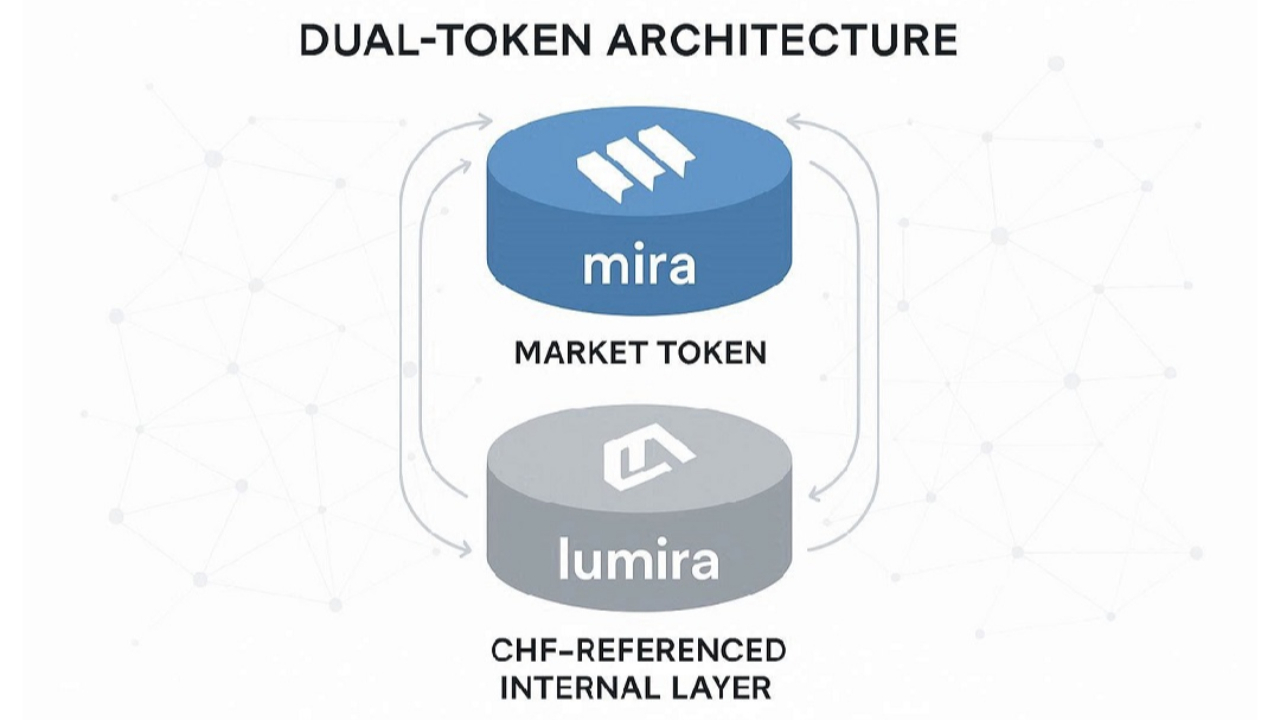

Most Web3 ecosystems operate under a single-token architecture. One asset carries governance, speculation, utility, and sometimes even stability expectations.
Mira Network takes a different route.
Instead of concentrating all economic pressure into one token, it separates functions between two: MIRA and Lumira.
At first glance, this may look like a complexity layer. But structurally, it attempts to solve a recurring problem in token economies: volatility versus usability.
Understanding this dual design is essential before forming any opinion about its long-term sustainability.
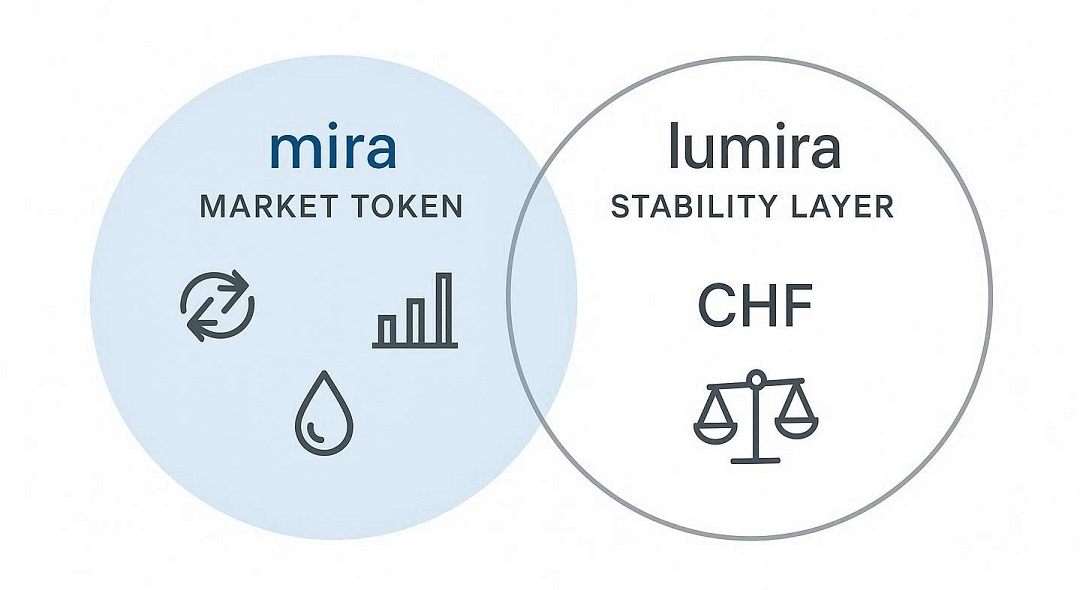
The Role of MIRA: Market-Facing Asset
MIRA functions as the primary market token. It is the asset connected to exchange liquidity, valuation dynamics, and broader investor perception.
Like most Web3 tokens, it is exposed to:
Market speculation.
Price volatility.
Supply-demand pressure.
Trading cycles.
This makes it a capital-facing instrument.
But capital-facing tokens often struggle when also expected to behave like stable mediums of exchange inside the ecosystem.
That tension is precisely what the second token attempts to address.
The Role of Lumira: Internal Stability Mechanism
Lumira is described as being referenced to CHF value logic.
This does not automatically mean it behaves like a fully collateralized stablecoin. The distinction matters.
Rather than positioning Lumira as a classic USDT-style stable asset, it appears designed to operate as a reference-based internal economic layer — particularly for ecosystem interactions such as services, transactions, or mining-related mechanics.
By separating:
Volatile external token (MIRA)
Reference-based internal unit (Lumira)
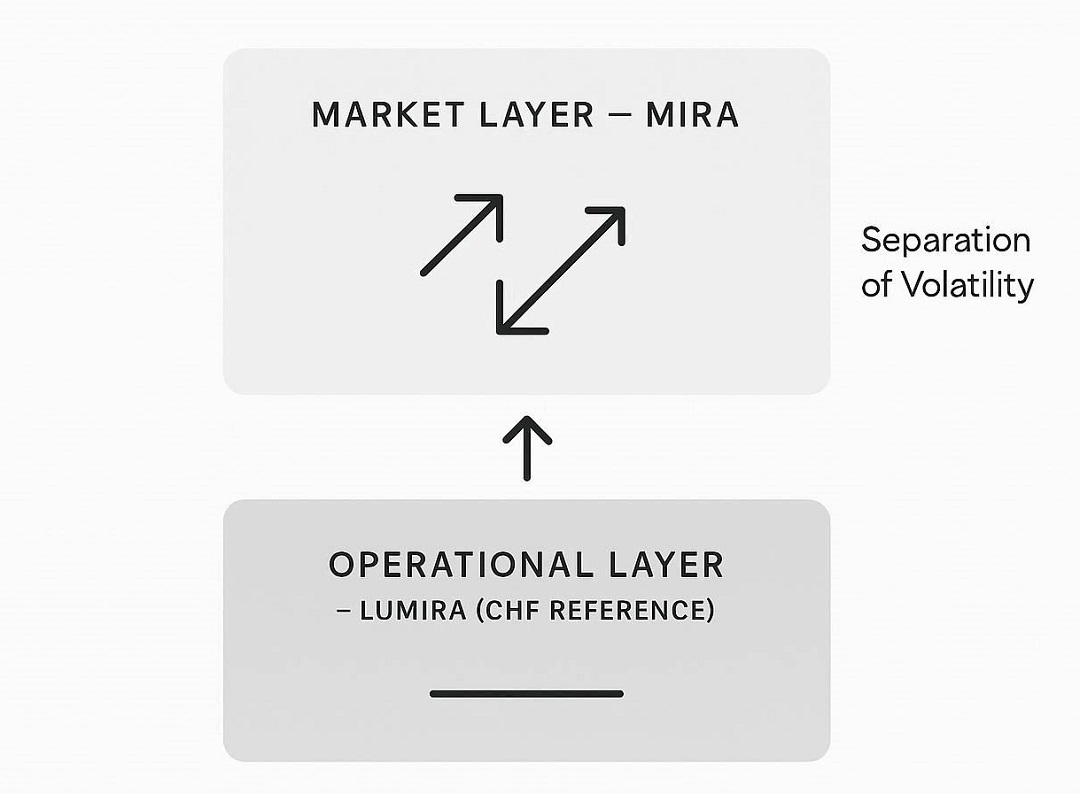
the ecosystem attempts to isolate user activity from direct exposure to market swings.
Conceptually, this is closer to a two-layer economic architecture than a simple token split.
Why This Split Exists
Single-token systems face structural friction:
If the token rises sharply, services become expensive.
If the token falls sharply, confidence erodes.
A dual-token system tries to compartmentalize these pressures.
MIRA can fluctuate with market cycles.
Lumira can serve as a predictable internal metric.
The idea is not to eliminate volatility — it is to prevent volatility from destabilizing core operations.
That design choice suggests Mira Network is thinking in macro-structural terms rather than purely speculative ones.
Structural Advantages — and Open Questions
Potential advantages:
Reduced operational instability.
Clear economic role differentiation.
Lower systemic pressure on one asset.
However, execution remains critical.
Dual-token systems can fail if:
Conversion mechanics are unclear.
Incentives between tokens are misaligned.
Demand concentrates only on one side.
The sustainability of Mira’s model will depend on how efficiently value flows between MIRA and Lumira without creating imbalance.
Design is one thing.
Economic behavior is another.
Conclusion
The dual-token model is not inherently superior. But it is structurally intentional.
By separating market volatility from internal economic logic, Mira Network introduces a layered framework that attempts to balance speculation with usability.
Whether this balance holds over time will depend on adoption depth, transparency, and economic discipline.
But from an architectural perspective, the split between MIRA and Lumira is not cosmetic — it is foundational.
And foundational decisions are where long-term outcomes are usually determined.