Most people think trading is about finding the next entry.
It’s not.
It’s about knowing when to close. 💭
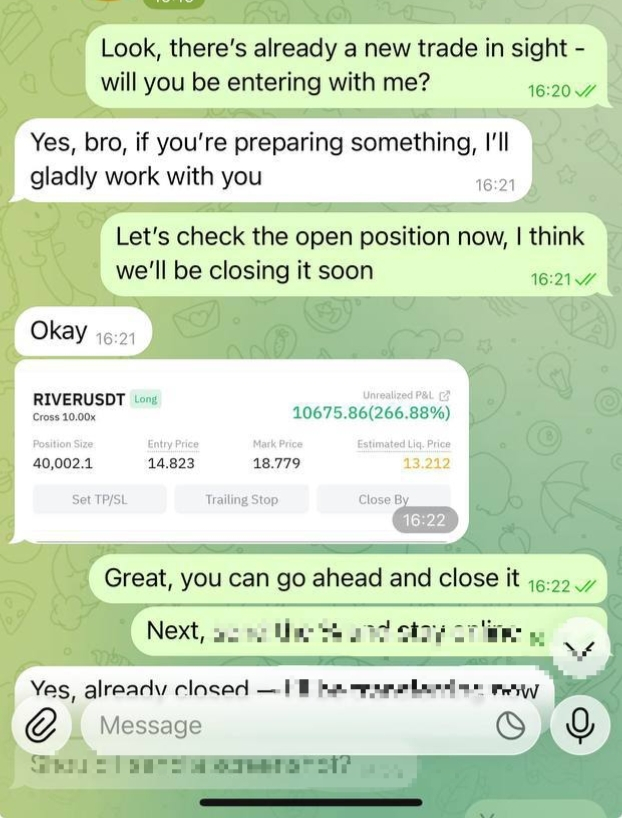
Look at this situation carefully. There’s excitement about a new trade forming, but instead of jumping immediately, the focus shifts to something far more important — the open position.
“Let’s check the open position now, I think we’ll be closing it soon.”
That sentence right there separates gamblers from traders.
While everyone online is obsessed with posting pictures of entries, calling new signals, and chasing the next pump… professionals are asking a different question:
👉 What do I do with the trade I’m already in?
The position was in strong profit. The numbers looked beautiful. Unrealized P&L showing massive percentage gains. This is where most traders lose control — not in losses, but in profit.
Because profit creates greed.
Greed whispers:
“Hold a little longer.”
“It can go higher.”
“What if this is the big breakout?”
“Don’t close yet.”
And just like that, a winning trade turns into stress.
But discipline says something else:
Protect capital.
Secure gains.
Respect the plan.
Execute without emotion.
Notice something powerful here — there was no hesitation.
“Great, you can go ahead and close it.”
No drama. No overthinking. No emotional attachment.
Just execution. 🎯
This is what real trading looks like behind the scenes. Calm decisions. Clear communication. Structured moves.
Not hype. Not flexing. Not chasing.
Let me tell you something most people won’t admit:
It’s harder to close a winning trade than to open one.
Anyone can press “Buy.” Few can press “Close” when the numbers are glowing green.
Because closing means accepting the result. Closing means discipline. Closing means you trust your system more than your emotions.
And that is power.
There’s another deep lesson here…
Before jumping into the next opportunity, the previous one was handled properly. This prevents overlapping emotions. It prevents revenge trading. It prevents overexposure.
Too many traders stack positions without closing properly. They keep adding trades because they feel “on fire.” Then one sudden reversal wipes out days of gains.
Momentum in the market is good. Momentum in emotions is dangerous.
Read that again.
Professional mindset: 1️⃣ Manage the open trade. 2️⃣ Lock profits when conditions say so. 3️⃣ Reset mentally. 4️⃣ Then evaluate the next setup.
Step by step. No rush. No ego.
The market will always create new opportunities. There is never “the last trade.” But there is such a thing as destroying your discipline.
And once discipline breaks, capital follows.
Another thing to understand:
Unrealized profit is not yours.
It’s just a number on the screen until you close the position.
The market doesn’t care how much you were up. It only cares where you exit.
So instead of chasing entries all day, start mastering exits.
Instead of flexing percentages, start building consistency.
Instead of asking, “What’s the next trade?” Ask, “Did I manage this one perfectly?”
Because trading is not about being right once. It’s about surviving long enough to compound.
Calm traders last. Emotional traders disappear.
When you see smooth execution like this — checking position, confirming profit, closing cleanly, preparing for next move — that’s structure.
Structure builds confidence. Confidence builds consistency. Consistency builds growth.
And growth beats hype every single time. 🚀
Train your mind to think like this: Not “How much can I make?” But “How well can I manage?”
That shift alone changes everything.
Stay sharp. Stay disciplined. And remember…
The best traders aren’t the loudest. They’re the most controlled.
#USCitizensMiddleEastEvacuation