
Il a gagné 100 millions de dollars en une seule semaine—en dollars de 1929. Il était le "Loup de Wall Street" original, l'inspiration pour le plus grand livre de trading jamais écrit, et un homme qui a battu le marché si souvent que les courtiers l'ont banni juste pour avoir mis les pieds dans leurs bureaux.
Mais Jesse Livermore est mort avec une balle dans la tête dans un vestiaire d'hôtel, laissant une note de suicide qui disait : "Ma vie a été un échec."
C'est l'histoire de sa lutte. Une histoire de génie, de cupidité et des démons qui détruisent un trader de l'intérieur. 🧵👇
🌱 Le fuyard : Un garçon contre le monde (1877-1892)
Jesse Lauriston Livermore est né en 1877 dans une famille agricole pauvre à Shrewsbury, Massachusetts. Son père était un homme sévère qui l'a retiré de l'école à 14 ans, lui remettant une charrue et lui disant que l'agriculture était son avenir.
Mais Jesse était différent. Il s'était appris à lire et à écrire à l'âge de trois ans et demi. Il détestait la ferme.
Avec seulement 5 dollars de sa mère, il s'est enfui de chez lui.
Il est arrivé à Boston et a réussi à obtenir un emploi chez Paine Webber en tant que "garçon de tableau" — un gamin qui notait les prix des actions sur un tableau noir pour 5 dollars par semaine. C'était sa première salle de classe.
🎯 Les Bucket Shops : Première expérience du sang (1892-1900)
Livermore n'a pas seulement noté des chiffres ; il les a ressentis. Il a remarqué des motifs dans la façon dont les prix bougeaient.
À 15 ans, il a emporté ses 5 dollars d'économies dans un "bucket shop" à proximité — un endroit de jeux déguisé en courtage où vous pariez sur les prix des actions sans réellement posséder l'action.
Son premier trade était de 5 actions de Chicago, Burlington et Quincy Railroad. Il a gagné 3,12 dollars.
Il n'a jamais regardé en arrière.
· À 16 ans, il gagnait 200 dollars par semaine (plus de 10 fois son salaire).
· À 20 ans, il avait accumulé 10 000 dollars de bénéfices de trading.
Il était trop bon. Les bucket shops l'ont banni. Il mettait des déguisements — chapeaux, fausses barbes — pour revenir. Ils l'ont banni à nouveau. Boston était fini pour lui.
La lutte commence : Il avait maîtrisé le "jeu", mais il était désormais un homme marqué. Il devait passer à la cour des grands : Wall Street.
🗽 New York : La première réalité (1901-1906)
Livermore a déménagé à New York à 23 ans, confiant qu'il allait escroquer le véritable marché boursier de la même manière.
Il a échoué. Misérablement.
Dans les bucket shops, vous pariez contre la maison. À New York, vous pariez contre le tape, qui était retardé de 30 à 40 minutes. Il a perdu l'ensemble de son capital de 10 000 dollars en quelques jours.
Il a plus tard écrit : "J'étais tellement sûr de mon système. Mais au moment où je suis arrivé à New York, mon système a cessé de fonctionner. J'étais un joueur qui ne comprenait pas la mécanique."
Il a dû emprunter 2 000 dollars à un ami et retourner discrètement à St. Louis pour trader dans des bucket shops juste pour reconstruire son capital. C'était sa première grande faillite, mais pas la dernière.
🏦 Le gros coup : La panique de 1907 (âge 30)
Livermore a reconstruit. Il a appris la mécanique.
En 1906, il a fait quelque chose qui semblait insensé. Pendant qu'il était en vacances à Palm Beach, il a eu un "pressentiment" et a vendu à découvert l'Union Pacific Railroad. Le lendemain, le tremblement de terre de San Francisco a frappé. Le marché s'est effondré. Il a gagné 250 000 dollars du jour au lendemain.
Mais son chef-d'œuvre était la panique de 1907.
Il a vu que le marché était surendetté. Il a commencé à vendre à découvert de manière agressive.
En un seul jour d'octobre 1907, il était à 1 million de dollars de bénéfice.
Au pic de la panique, le légendaire banquier J.P. Morgan lui-même a envoyé un mot à Livermore : Arrêtez de vendre, ou tout le système s'effondrera.
Livermore était d'accord. Il a couvert ses positions courtes et a commencé à acheter. Le marché s'est redressé.
Il avait 30 ans. Il valait 3 millions de dollars et possédait un yacht.
Mais la lutte n'était pas terminée. Il était invincible. Ou du moins, il le pensait.
💔 La chute : Écouter les "conseils" (1908-1915)
En 1908, un célèbre trader de coton nommé Teddy Price s'est approché de lui. Price avait un "coup sûr" sur le coton.
Livermore, l'homme qui n'a jamais pris de conseils, a brisé sa propre règle.
Il a misé tout sur le coton sur les conseils de Price. Pendant ce temps, Price vendait secrètement ses propres avoirs.
Le coton s'est effondré. Livermore a perdu sa fortune entière. En 1915, il était en faillite pour la deuxième fois, avec des dettes de plus de 2 millions de dollars.
Il a plus tard réfléchi : "Cela m'a coûté des millions de dollars de réaliser qu'un autre ennemi dangereux pour un trader est la personnalité magnétique d'un individu persuasif et talentueux."
Il était brisé. Il a dû vendre son yacht. Les courtiers ne voulaient pas lui prêter.
Le retour (1915)
Dans l'un des trades les plus célèbres de l'histoire, un ami lui a donné une chance : 500 actions de Bethlehem Steel.
Livermore a attendu. Il a observé. Pendant six semaines, il n'a rien fait.
Enfin, le prix a explosé. Il a acheté. Il a conservé. Il a pyramidé.
En 1917, il n'avait pas seulement remboursé ses **2 millions de dollars de dettes** (avec intérêts), mais il avait aussi acheté une obligation de la Liberté de 1 million de dollars.
👑 La couronne : Le krach de 1929 (âge 52)
Les années folles. Tout le monde était riche. Tout le monde achetait des actions sur marge.
Livermore était suspect. Il a vu la pourriture. Début 1929, il a commencé à construire une position courte massive — si massive qu'il a utilisé plus de 100 courtiers différents pour cacher ses traces.
Sur le papier, il était en baisse de 6 millions de dollars au printemps. Le marché continuait de monter. La pression était immense.
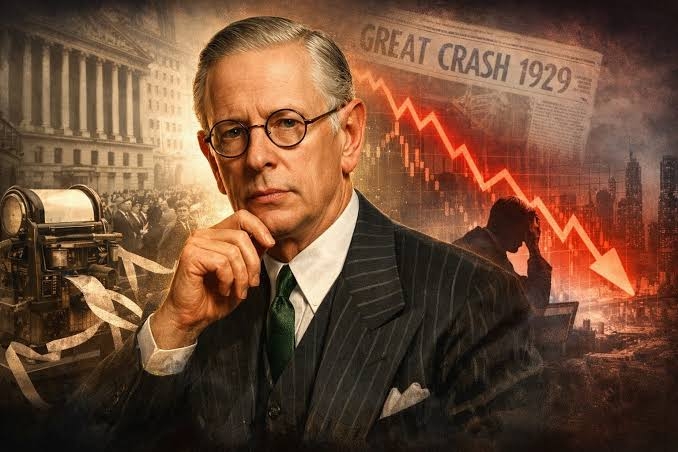
Puis est venu le jeudi noir (24 oct.) et le mardi noir (29 oct. 1929).
Le marché s'est effondré.
Lorsque la poussière s'est déposée, Jesse Livermore avait net environ 100 millions de dollars. Ajusté pour l'inflation, cela équivaut à plusieurs milliards de dollars aujourd'hui. Il contrôlait 1 % du PIB total des États-Unis dans son compte de trading.
Il était le "Grand ours de Wall Street." Il était une légende vivante.
🌑 La longue nuit : La lutte intérieure (1930-1940)
Mais l'argent ne l'a pas réparé.
La vie personnelle s'effondre :
· Sa deuxième femme, Dorothy, une fille de Ziegfeld qu'il aimait profondément, l'a divorcé en 1932, prenant un règlement de 10 millions de dollars.
· En 1935, son ex-femme a tiré sur son fils aîné, Jesse Jr. (qui a survécu).
· Il s'est marié une troisième fois, mais la joie était partie.
Changements dans le monde professionnel :
La SEC a été formée. De nouvelles règles ont rendu le style de trading "far west" qu'il maîtrisait beaucoup plus difficile.
Les marchés changent :
Il a perdu son rythme. Il a plus tard admis qu'il ne pouvait pas s'adapter au nouvel environnement réglementaire. En 1934, il a déposé le bilan pour la troisième fois. Actifs : 184 000 dollars. Passifs : 2,5 millions de dollars.
Le titre de Time Magazine disait simplement : "Affaires : Quatrième essai."
Il n'était pas ruiné dans le sens d'être pauvre — il avait des fonds fiduciaires pour sa famille. Mais il était spirituellement en faillite. Il avait perdu son but.
🔫 Le dernier trade : 28 novembre 1940
À 17h30 le jour de Thanksgiving, Jesse Livermore est entré dans le vestiaire de l'hôtel Sherry-Netherland à Manhattan.
Il s'est assis. Il a sorti un pistolet automatique Colt.
Il a écrit une lettre de 8 pages à sa femme, Harriet. La note finale disait :
"Je ne peux pas m'en empêcher. Les choses ont été mauvaises pour moi. Je suis fatigué de me battre. Cela ne sert à rien. C'est le seul moyen de sortir. Je ne suis pas digne de votre amour. Je suis un échec. Je suis vraiment désolé."
Il a mis le pistolet sur sa tête et a appuyé sur la gâchette. Il avait 63 ans.
Son fils s'est également suicidé plus tard. Son petit-fils aussi.
📖 L'héritage : Ce que Livermore nous enseigne
Jesse Livermore n'était pas un échec. C'était un génie qui a documenté la psychologie du trading mieux que quiconque dans l'histoire. Son livre, Reminiscences of a Stock Operator, est toujours une lecture obligatoire à Wall Street et sur les parquets de trading crypto aujourd'hui.
Sa lutte nous enseigne les lois immuables du jeu :
1. "Ce n'était jamais ma réflexion qui a fait le gros argent. C'était ma patience." (Laissez les gagnants courir)
2. "Les pertes ne m'embêtent jamais après les avoir prises. Je les oublie du jour au lendemain. Mais se tromper — ne pas prendre la perte — c'est ce qui nuit à l'âme et au portefeuille." (Coupez rapidement les pertes)
3. "Il y a un temps pour aller long, un temps pour aller court, et un temps pour aller à la pêche." (Patience)
4. "Les principaux ennemis du spéculateur viennent toujours de l'intérieur." (La bataille est psychologique)
💡 La connexion crypto
L'histoire de Livermore n'est pas une histoire ancienne. Elle se déroule en ce moment sur Binance Futures.
Chaque fois que vous :
· Moyenne descendante sur une altcoin perdante en espérant qu'elle "revienne" (c'est l'erreur fatale de Livermore).
· Prendre un conseil d'un influenceur sans faire vos propres recherches (c'est Teddy Price).
· Refuser de couper une perte parce que vous "croyez dans le projet" (c'est l'espoir qui tue votre compte).
Vous revivez la lutte de Jesse Livermore.
Il a maîtrisé le marché, mais il ne s'est jamais maîtrisé lui-même.
Jesse Livermore était-il un exemple d'avertissement ou une inspiration ? Pensez-vous qu'un trader aujourd'hui peut éviter son destin ? Laissez vos pensées ci-dessous. 👇
\u003ct-256/\u003e \u003ct-258/\u003e\u003ct-259/\u003e\u003ct-260/\u003e \u003ct-262/\u003e