
The Fabric network is a decentralized infrastructure for coordinating robotics and AI workloads across devices and services. It is built to operate as a neutral marketplace where participants exchange verifiable work, data, and compute. The networks economic mechanisms are designed to prioritize operational reliability and safety. ROBO tokens do not confer ownership in any entity or asset, nor do they represent equity, debt, or any form of investment contract.
ROBO is a utility token used exclusively to pay on-network fees and to post operational bonds. It initially launched as an ERC20 token on Ethereum mainnet to support a phased rollout and onchain interoperability. Over time, ROBO may migrate to serve as the native coin of the Fabric Layer1 blockchain.
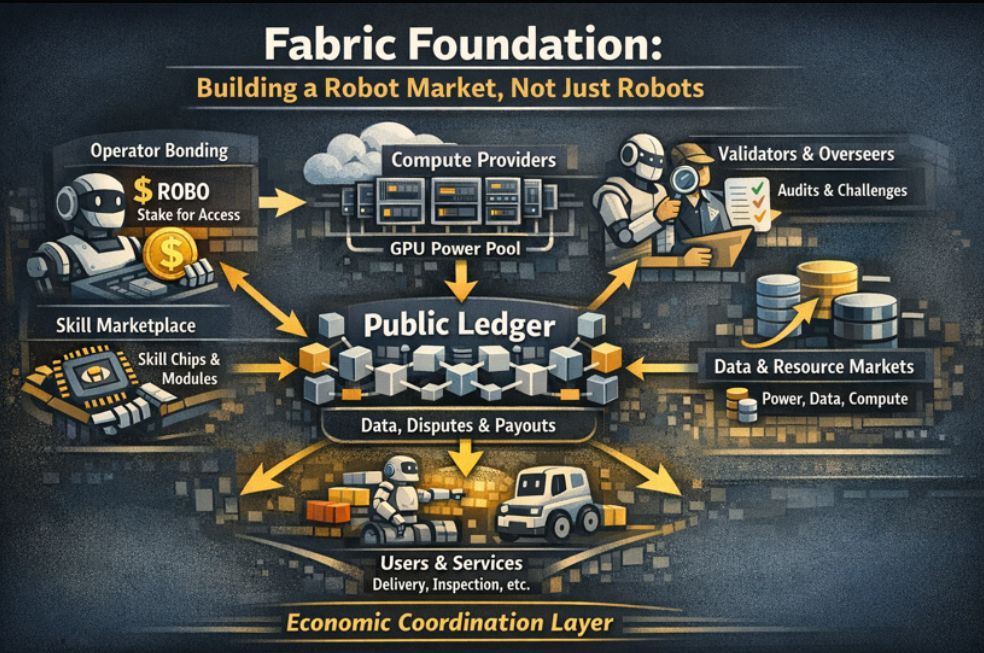
Token Utility Overview
ROBO serves six distinct operational functions within the Fabric network, each designed to align participant incentives with network health and create sustainable demand for the token:
1. Access and Work Bonds: Robot operators stake ROBO as refundable performance bonds to register hardware and provide services. These bonds act as economic security deposits that deter fraud and ensure service quality. Bond requirements scale with declared capacity, creating token demand proportional to network throughput.
2. Transaction Settlement: ROBO is used to pay networknative fees for services such as data exchange, compute tasks, and API calls. For user convenience, offchain or stablevalue payments may be converted onchain into ROBO to complete settlement. Quoted prices for services may be expressed in fiat terms for predictability; ROBO is not backed by or redeemable for fiat or any other asset.
3. Delegation and Reputation: Token holders may delegate ROBO to augment operator bonds, increasing their capacity to accept high-value tasks. Delegation serves as a market-based reputation signal and requires active operator selection. Delegators share in slash risk, aligning incentives while enabling capital-efficient scaling of network capacity.
4. Governance Signaling: Token holders may time-lock ROBO to obtain voting weight on protocol parameters and improvement proposals. Longer lock periods confer greater voting power, rewarding long-term alignment. Governance rights are procedural and do not convey control over legal entities or treasury assets beyond protocol-specified rules.
5. Crowdsourced Ownership: The protocol enables a crowdsourced process for the genesis and activation of robot hardware through ROBO-denominated participation units. Participants contribute tokens solely to access protocol functionality and coordinate network initialization. These units are used solely to coordinate participation, access protocol functionality, and support network initialization parameters related to robot deployment. Participation does not represent ownership of robot hardware, fractionalized interests, revenue rights, or economic claims, and ROBO is not backed by, locked to, or redeemable against any underlying physical assets or productive capacity of the network. Participation in crowd sourced robot genesis does not constitute an investment of money, does not create any expectation of profit derived from the efforts of others, and does not satisfy the elements of an investment contract under the Howey Test or equivalent tests applied in other jurisdictions.
6. Token-Based Rewards: Tokens may be distributed as protocol level incentives designed to support network participation, usage, and operational efficiency. Any such distributions are discretionary, non-guaranteed, and contingent upon active participation and verified contribution to network operations. Such incentives do not represent any ownership interest, profit sharing right, or expectation of financial return. These incentives are non-investment in nature, do not constitute consideration for an investment contract,
and do not involve an expectation of profit derived from the efforts of others. Recipients must actively participate in network operations to receive any incentives.
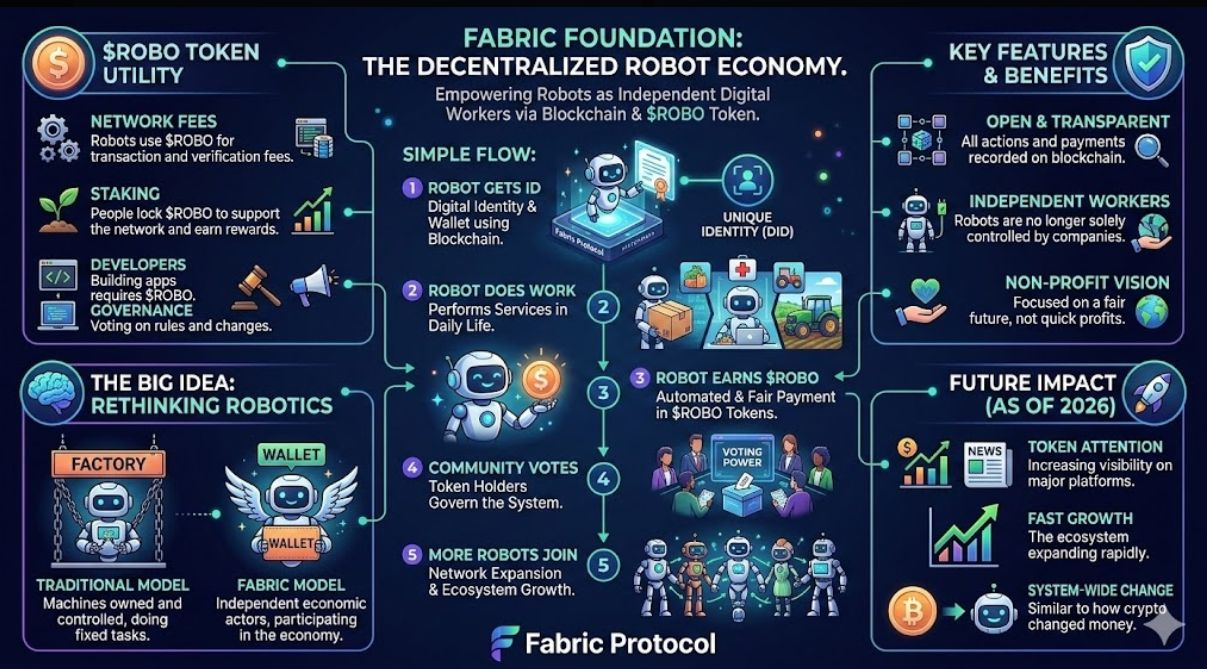
These mechanisms create structural token demand that scales with network utilization, operator capacity, and governance participation. Unlike speculative token models, ROBO utility derives directly from operational requirements of a functioning robotics network. The following subsections formalize each mechanism mathematically and analyze equilibrium properties.
#ROBO @Fabric Foundation $ROBO
