

A few years ago I held a token that looked unstoppable. Wallet growth was exploding, volume was huge, and every dashboard screenshot on crypto Twitter made it feel like adoption was inevitable. The chart looked healthy, the community was loud, and every metric people love to share was pointing up. Then the incentives faded. Liquidity mining ended, rewards slowed down, and within a couple months the network turned into a ghost town. The wallets were still technically there, but the activity had vanished. That cycle burned something into my brain: most crypto metrics look great during the hype phase, but very few systems survive the moment when incentives fade.
That experience is the lens I’m using when I look at projects like Fabric and the idea they call the Security Reservoir. Strip away the marketing language and the concept is actually pretty simple. If robots or autonomous systems are going to perform work in a decentralized network, the system needs some way to verify that work and punish bad actors. Fabric tries to solve this by forcing operators to lock collateral in the form of $ROBO tokens before they can participate. The locked pool of collateral becomes what they call the Security Reservoir. If a robot operator submits fraudulent results or fails service requirements, the protocol can slash the bond. In other words, robots don’t just produce output, they post economic receipts.
The interesting part of this model is that it tries to connect real work to token demand. Operators who want to deploy robots or services need to lock tokens proportional to the capacity they claim to provide. That means the more useful machines become inside the network, the larger the bonded pool of tokens becomes. The design attempts to turn infrastructure usage into structural demand instead of relying purely on speculation. The whitepaper describes this as a system where token demand scales with network throughput because bonds grow alongside productive capacity. It’s an elegant idea on paper because it tries to tie economics directly to verifiable activity rather than narrative momentum.
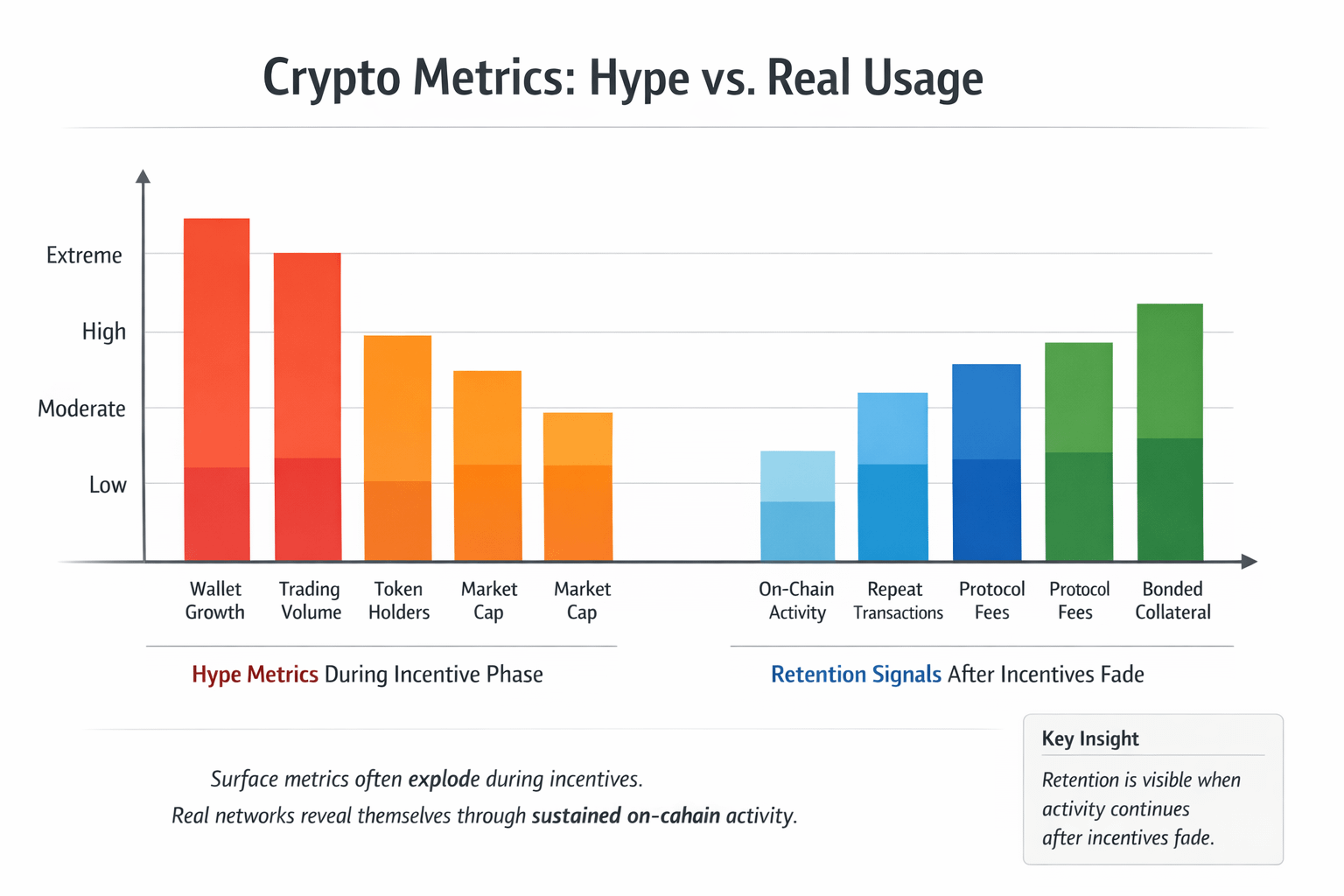
But this is where the retention problem shows up again. In crypto, surface metrics can be deeply misleading. Holder counts go up during airdrops. Volume spikes during speculation cycles. Market cap looks impressive when liquidity is thin. None of those numbers tell you whether a network produces real, repeatable usage once the incentives fade. The real question is always the same. After the hype phase ends, does anything keep happening on-chain? If the only activity was farming rewards, the system slowly empties out once the rewards shrink.
Fabric’s bet is that verifiable robotic work can create that kind of durable usage. In theory, if robots are performing useful tasks, completing jobs, and getting verified through the protocol, the activity should continue even when the market is quiet. That would create what every infrastructure protocol needs: boring, repeatable baseline activity. Not flashy spikes, but consistent usage. In crypto markets, boring usage is actually the most bullish signal you can find.
Looking at the current data gives some context for where things stand today. As of March 2026, public dashboards and market trackers like CoinMarketCap show the $ROBO oken circulating within its early discovery phase, with a total supply structure designed to distribute tokens gradually over time. On-chain explorers such as BaseScan show steady transfer activity but nothing close to the scale you would expect from a mature machine economy yet. That’s normal for an early-stage protocol, but it means investors are still trading more on thesis than on proven adoption. The token economics allocate supply across investors, ecosystem incentives, community distribution, and development reserves, which suggests the network still relies heavily on early growth incentives.
There are also real risks here that traders shouldn’t ignore. Verifying physical or robotic work is fundamentally harder than verifying digital transactions. Latency and operational complexity can slow systems down if the verification process becomes too heavy. Governance could concentrate if early token holders accumulate too much influence over protocol parameters. And like many infrastructure tokens, there is always the possibility that speculation dominates the token economy before real utility has time to develop. Fragmentation is another risk, because robotics hardware ecosystems are diverse and integrating many different systems into one network is not a trivial problem.
So when I evaluate something like Fabric, I try to ignore the flashy metrics and focus on boring signals. I want to see fee-paying activity that repeats week after week. I want to see tasks being executed on-chain even when the market is quiet. I want to see the bonded collateral inside the Security Reservoir grow gradually over time, because that would imply more operators are actually using the network. Quiet weeks are often the most revealing moments. If on-chain activity continues during slow market periods, it usually means the system has something real underneath the speculation.
For me personally, this falls into the category of an engineering bet rather than a narrative trade. The architecture is interesting and the incentive model tries to solve the retention problem in a thoughtful way. But the market will eventually demand evidence of verifiable usage rather than theoretical design. If the protocol starts generating steady on-chain activity tied to real work, that’s when the thesis becomes much stronger.
So I’m curious how others are looking at it. What kind of on-chain signal would convince you that this system is actually producing real usage? And what boring metric do you watch to decide whether a network survives after the incentives fade?
@Fabric Foundation $ROBO #CryptoAnalysis #ROBO #DePIN #Aİ #BinanceSquare