

There is a quiet kind of embarrassment that happens when you trust a system a little too quickly.
Not a dramatic failure. Nothing catastrophic. Just a moment where you confidently repeat something you assumed was reliable, only to discover later that the foundation beneath it was thinner than expected. The mistake isn’t loud. It doesn’t break anything immediately. But it leaves a subtle feeling behind — the realization that confidence and reliability are not the same thing.
That small discomfort has become increasingly common in a world shaped by automation, algorithms, and machine decision-making. Systems today can move quickly, produce convincing outputs, and coordinate enormous amounts of data. Yet speed and sophistication often mask a quieter structural problem: intelligence alone does not guarantee responsibility.
Machines can generate answers, coordinate actions, and optimize decisions, but without clear mechanisms for accountability, those actions exist in a strange middle space — powerful, yet difficult to verify. And when machines begin interacting with the physical world, through robotics or autonomous agents, the cost of misplaced trust grows heavier.
This is the tension Fabric Protocol is responding to.
Fabric Protocol is not built around the idea that machines simply need to become smarter. Instead, it begins from a more disciplined observation: intelligence without verifiability eventually produces uncertainty. The goal, then, is not to create more capable machines, but to create a structure where their behavior can be coordinated, recorded, and evaluated with clarity.
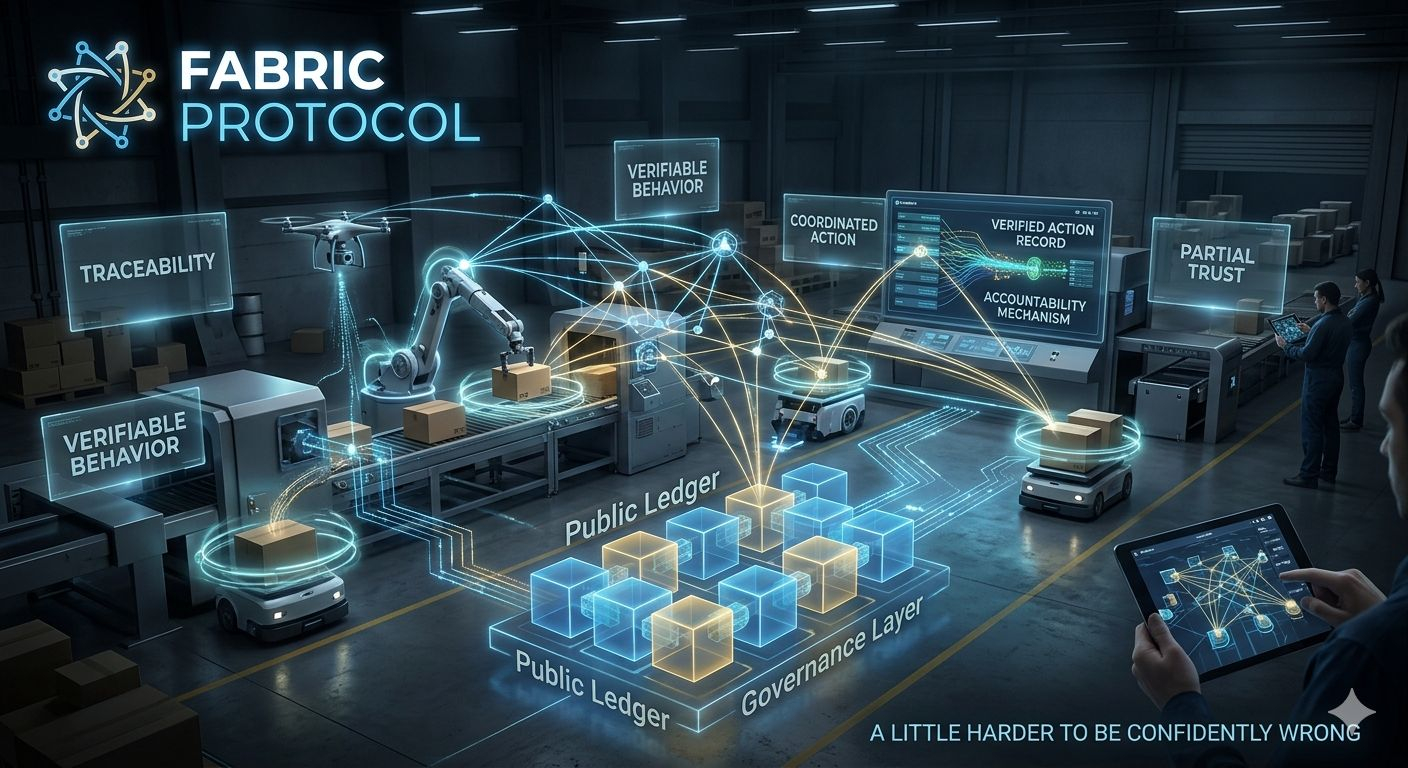
The network provides a shared environment where robotic systems, agents, and their governing logic can evolve together under visible rules. Actions are not treated as isolated outputs but as events that belong to a wider system of responsibility. By coordinating data, computation, and governance through a public ledger, Fabric Protocol introduces something that has often been missing from autonomous systems — traceability.
What matters here is not the technology itself, but the behavioral shift it encourages.
When actions are visible and decisions leave a record, participants become more careful. Builders structure their systems with clearer assumptions. Operators pay closer attention to how machines behave over time rather than simply celebrating impressive demonstrations. The environment subtly encourages discipline, because shortcuts become easier to see.
In that sense, the protocol doesn’t simply organize machines. It also reshapes the people building and managing them.
Fabric Protocol also recognizes something important: complete certainty is unrealistic. No infrastructure can eliminate every error or guarantee perfect machine behavior. Real systems will always contain ambiguity, unexpected conditions, and imperfect judgment.
Instead of promising perfection, the design leans toward something more practical — partial trust.
Partial trust means systems can be used while still being questioned. It means decisions are supported by records rather than assumptions. It allows organizations to move forward with robotics and autonomous agents without pretending that uncertainty has disappeared.
In many ways, this approach shifts the conversation away from spectacle. The goal is not impressive demonstrations of intelligence, but safer long-term operation in messy real environments. Factories, logistics networks, urban infrastructure, and collaborative robotics all require something deeper than clever algorithms. They require boundaries, oversight, and systems that can absorb mistakes without hiding them.
Fabric Protocol begins to address that layer of infrastructure.
It offers a place where machines, data, and governance can evolve together with clearer accountability. Not as a grand solution, but as a structure that reduces friction where trust and automation intersect.
The future this points toward is not dramatic. Machines will still make mistakes. Systems will still need supervision. Humans will still carry responsibility for the environments they create.
But the hope is that decisions become easier to trace, claims easier to support, and collaboration between humans and machines slightly less fragile.
Not perfect.
Just a little harder to be confidently wrong.
#ROBO @Fabric Foundation $ROBO
