
When people first hear about @FabricFND and $ROBO, the conversation usually drifts toward the obvious things — AI, robots, tokens, market activity. But the part that keeps sticking in my mind is something quieter: what happens when machines start making decisions that carry real economic weight?
Most systems today treat machines like tools. A robot performs a task, a program runs a process, and humans remain the ones who hold the responsibility. But as systems become more autonomous, that simple model starts to crack. If a machine can make choices, spend resources, or interact with other systems, the real problem is not intelligence — it’s accountability. Someone needs to know what happened, why it happened, and who carries the consequence when something goes wrong.
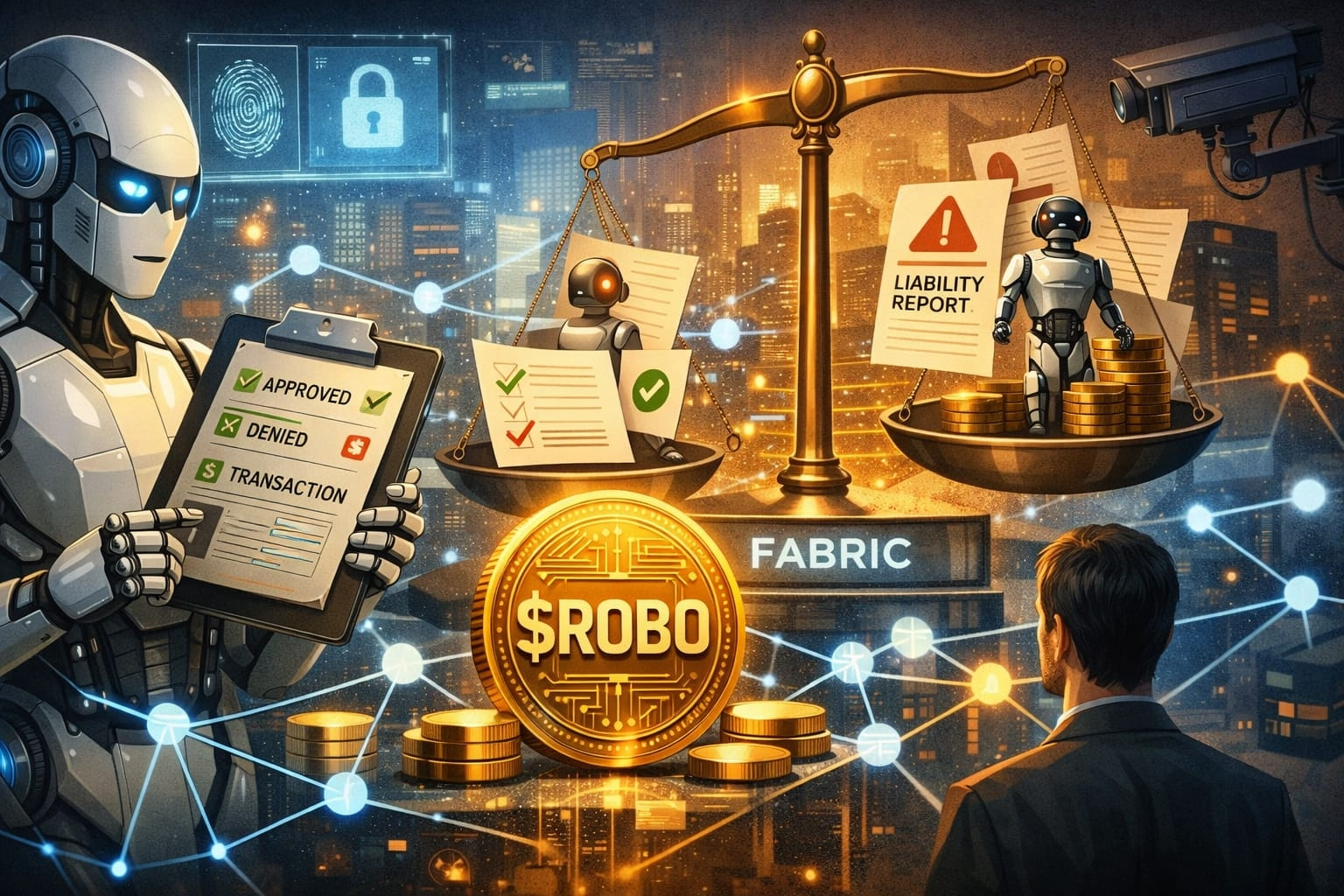
That’s the angle where starts to feel more interesting to me. Instead of focusing on robots as impressive hardware or clever algorithms, Fabric seems to be approaching them as participants in an economy. Not people, obviously, but entities that still need identity, rules, and a way to transact within a system that others can understand. It’s a bit like the difference between a car driving on an empty field versus a car entering a city. The machine might function perfectly in both places, but only one environment requires traffic lights, lanes, and shared rules.
A lot of observers misunderstand projects like @FabricFND because they expect something immediately visible. In crypto and tech, attention usually goes to whatever looks dramatic or fast-moving. Infrastructure rarely looks exciting in the early stages. But infrastructure is often where the real long-term value sits, because it quietly determines how everything else can grow.
What’s interesting about the growing attention around is that the market naturally focuses on the token itself, while the deeper idea sits underneath it. The question isn’t simply whether the asset trades well or gains attention. The more important question is whether networks like this can make machine activity understandable and structured enough for humans to trust it.
There’s also a strange human contradiction here. People say they want autonomous systems, but the moment those systems start doing things independently, everyone suddenly wants transparency and control. We like the idea of intelligent machines until their actions create real consequences. Then we start asking who approved it, who paid for it, and who is responsible for the outcome.
That tension is exactly why frameworks like the one around $ROBO feel worth watching. Not because robots are trendy, but because once machines start interacting economically, the absence of rules becomes impossible to ignore.
Eventually every system that grows large enough has to answer the same quiet question: not whether machines can act, but whether their actions can be understood and held accountable inside a shared economy.