

I've been wrapping my head around Mira Network lately, and it's one of those projects that just clicks—especially now in early 2026 when AI's flaws are impossible to ignore anymore. You have these powerhouse models churning out answers with total confidence, only to trip over hallucinations or sneaky biases that make them a no-go for anything serious, like medical advice or financial calls.
Mira changes the game by breaking down those outputs into simple, checkable claims, then running them through a decentralized swarm of verifier nodes that vote via blockchain consensus. It's not some flashy gimmick; it's a practical layer that delivers cryptographic proof, letting AI shine in high-stakes scenarios without the usual risks, and I'm excited because it feels like the missing piece for autonomous systems we've all been waiting on.
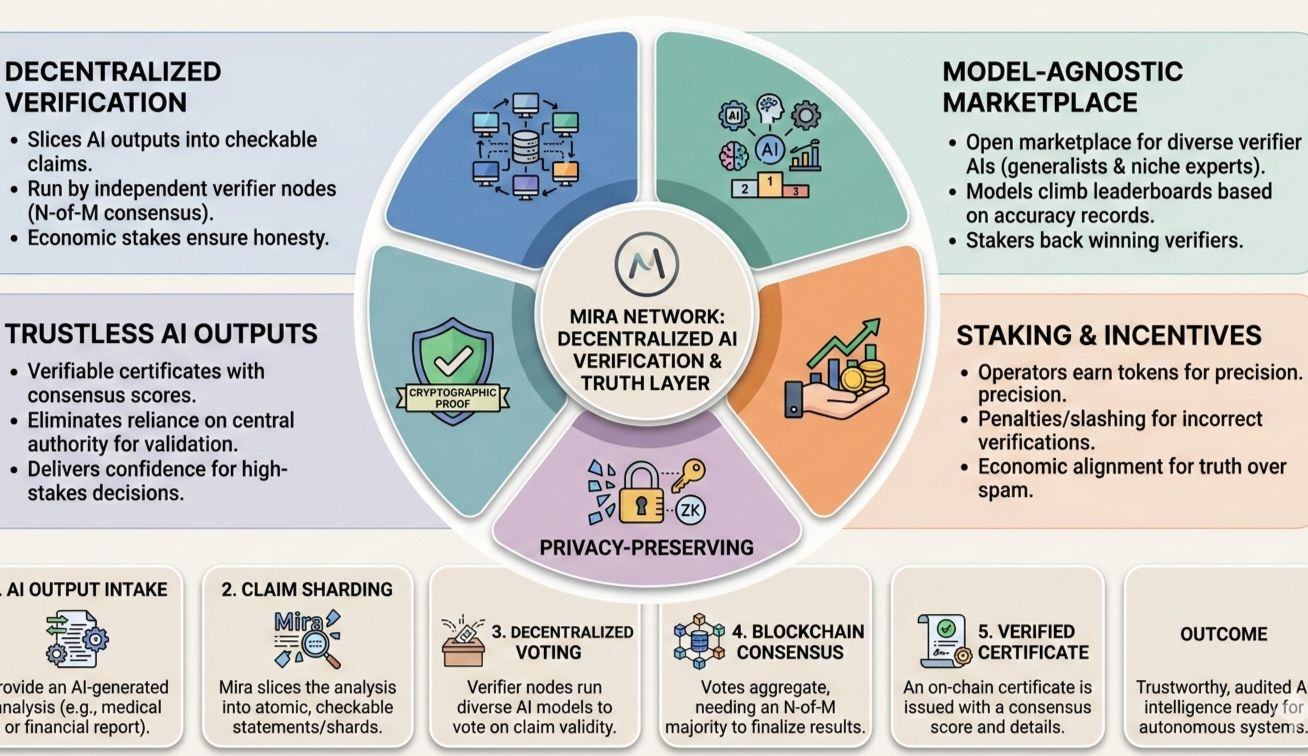
The process is deceptively straightforward, which is part of its appeal. Feed in an AI-generated analysis—maybe a climate model forecast—and Mira slices it into atomic statements like "Temperature rise correlates with event X by 20%." These shards scatter across thousands of independent nodes, each running its own flavor of verifier AI, from generalists to niche experts. Votes roll in, needing an N-of-M majority to seal the deal, and out pops an on-chain certificate stamped with the consensus score and model lineup. No central authority twisting results; just economic stakes ensuring honesty, with operators earning tokens for precision and penalties for fumbles. It's elegant because it scales—handling massive volumes without choking—and the sharding inherently guards privacy, as no one node glimpses the full puzzle.
What stands out to me is how this sparks real competition among verifiers. Picture a marketplace where models battle for supremacy: a vision-tuned AI nails image claims, a code specialist debugs outputs flawlessly, all climbing leaderboards based on track records. Stakers back the winners, fees cycle back into rewards, and smart burns keep the token lean amid growing use. Layered on Base for cheap, zippy transactions, it sidesteps Ethereum's old gas wars, making it developer-friendly for everything from DeFi data feeds to legal doc checks. Early pilots are showing error rates hugging 0.5%, a testament to the system's robustness, and that diversity crushes inherited biases that doom siloed AIs.
Privacy weaves in seamlessly too, critical in our data-leaky world. Shards stay fragmented, votes aggregate anonymously until finalized, and zero-knowledge tricks hide sensitive bits in the cert. Hospitals could verify AI-flagged diagnoses, getting a green light without spilling patient details; supply chains confirm predictive logistics sans proprietary leaks. Governance puts power in holders' hands—voting on upgrades like fresh multimodal support for videos or charts—keeping evolution community-led and adaptive.
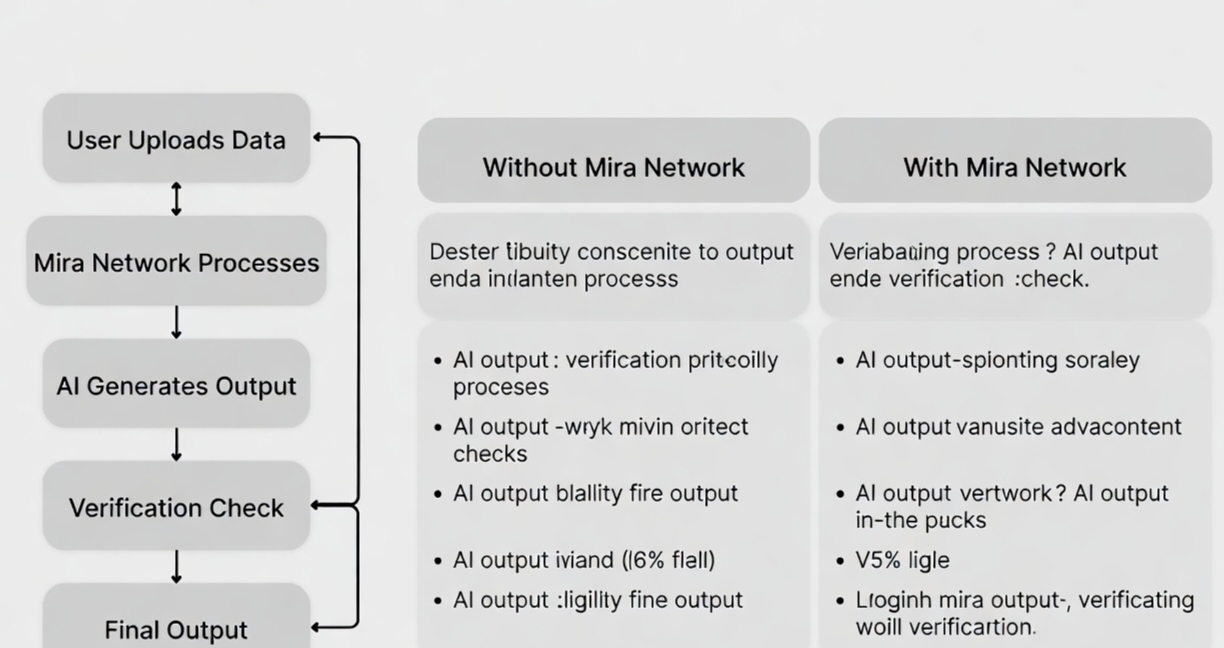
Challenges like potential node collusion get smart counters: randomized selection, reputation decay for suspects, and stake slashes that hit wallets hard. It's proof-of-verification at heart, turning compute into truth rather than pointless hashes, economically aligning incentives for accuracy over spam. Tokenomics balance growth with stability—vesting cliffs, delegation pools, deflationary mechanics—that reward long-haulers over flippers.
Broader ripples excite me most. AI agents could chain verified actions for safe autonomy, content platforms fight fakes with embedded certs, oracles deliver battle-tested intel. Cross-chain hooks on the horizon broaden the playground, tying into ecosystems beyond Ethereum. Mira's not promising utopia; it's building infrastructure that's already proving itself, node counts swelling, verifications flying. In a sea of AI hype, this one's grounded, innovative, and poised to underpin the intelligent apps defining tomorrow. If you're tinkering with AI or eyeing crypto plays, it's worth a deep look—I'm bullish on its trajectory.
@Mira - Trust Layer of AI #Mira $MIRA
