
Artificial intelligence is advancing faster than most technologies in modern history. AI systems can now write content, generate images, analyze financial data, answer complex questions, and assist businesses with decision-making. The capabilities continue to expand every year.
However, there is one major weakness that still affects nearly every AI system today.
Trust.
AI can sometimes produce answers that sound confident but are actually incorrect. This issue is commonly known as AI hallucination, where a model generates information that appears convincing but is not factually accurate.
As AI begins to influence important areas such as finance, education, healthcare, and research, this weakness becomes much more serious. If people cannot fully trust AI outputs, then relying on AI for critical decisions becomes risky.
Because of this challenge, a new idea is starting to gain attention in the technology world: AI verification.
One project working in this direction is Mira Network, a system designed to help verify whether AI-generated information can be trusted.
Understanding Mira Network
Mira Network is a technology platform that combines artificial intelligence and blockchain to create a verification layer for AI outputs.
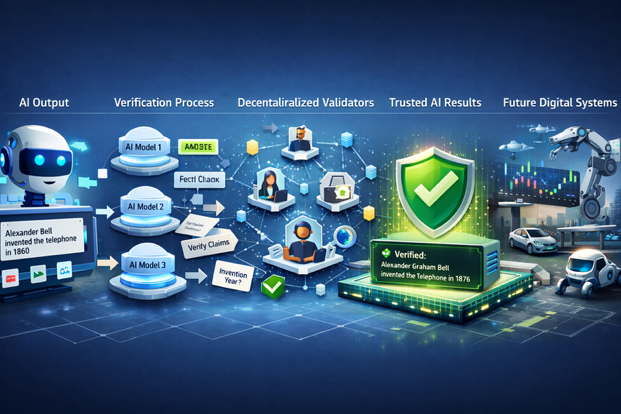
Instead of simply accepting answers from a single AI model, Mira introduces a process where those answers can be checked and validated before users rely on them.
In simple terms, Mira Network aims to function as a reliability layer for artificial intelligence.
Today, when someone asks an AI system a question, the response appears instantly. But there is usually no clear indication of whether the information has been verified.
Mira attempts to change this by adding an extra stage where AI-generated results are analyzed and confirmed through multiple systems.
You can think of it as a decentralized fact-checking mechanism for AI.
The Core Issue Mira Wants to Address
Artificial intelligence is extremely powerful, but it is not perfect.
Most AI models generate responses based on patterns and probabilities derived from training data. This means they predict what the most likely answer should be rather than guaranteeing that the answer is correct.
Because of this, several issues can appear.
AI may provide incorrect facts.
It may combine accurate and inaccurate information together.
It may produce answers even when it does not truly know the correct result.
In everyday situations this might only be inconvenient. But in serious environments such as financial analysis, legal research, medical information, or scientific work, accuracy becomes essential.
Mira Network is designed to help reduce these risks by verifying AI responses before they are trusted.
How the Mira Verification System Works
The technology behind Mira Network focuses on checking AI outputs step by step.
When an AI model produces a response, the system begins by analyzing the answer and separating it into smaller factual components.
Each individual statement can then be evaluated independently.
Multiple AI models are used to review those statements and determine whether they appear correct based on their own data and knowledge.
By comparing the conclusions from several models, the system can detect inconsistencies or agreement between them.
When enough verification sources confirm the information, the claim can be marked as verified. If the models disagree or cannot confirm accuracy, the information may be flagged as uncertain.
The results of this verification process can also be recorded on blockchain, which helps ensure transparency and prevents tampering.
The overall goal is to transform AI responses from unverified predictions into information that has been checked and validated.
What Makes Mira Network Unique
Many projects in the AI space are focused on improving the intelligence of models themselves. Companies compete to build larger systems with more computing power and more advanced training methods.
Mira approaches the problem from a different perspective.
Instead of creating another AI model, it focuses on ensuring that the results produced by AI systems can be trusted.
This makes the project different from most AI platforms.
The concept becomes even more important when considering the future of automation. AI systems may eventually interact with each other, complete tasks automatically, and make decisions without human involvement.
In such a future, verification systems may become necessary to ensure those automated actions are based on reliable information.
Mira Network aims to position itself as infrastructure that supports this trust.
The Purpose of the $MIRA Token
The Mira ecosystem also includes a native digital token known as $MIRA.
The token plays several roles within the network.
One important function is paying for verification services. Developers who want to check AI-generated outputs through the network may use the token to cover processing fees.
The token can also be used for staking. Participants who contribute computing power or operate verification nodes may need to lock tokens as collateral. This helps maintain honest participation in the system.
Another use of the token involves governance. Holders of the token may have the ability to vote on network upgrades or changes to protocol rules.
In addition, the token serves as an incentive mechanism that rewards contributors who help maintain and secure the verification network.
Why the Project Is Gaining Attention
Many investors and developers are watching projects that combine AI technology with blockchain infrastructure.
Both sectors are experiencing rapid development, and projects that connect the two fields often generate significant interest.
Mira Network is particularly notable because it targets a foundational challenge in artificial intelligence: reliability.
If AI continues to expand across industries, systems that can confirm the accuracy of AI outputs may become increasingly valuable.
Infrastructure platforms sometimes grow into major parts of the technology ecosystem if they solve a problem used by many applications.
This possibility is one reason why Mira Network has started attracting attention.
The Team Behind the Project
The team developing Mira Network consists of engineers and technology professionals with experience in artificial intelligence, software infrastructure, and distributed computing.
Several contributors have previously worked at large technology companies and research environments where they built scalable systems.
Their goal with Mira is to create a network capable of supporting future AI applications while improving transparency and trust.
Building a reliable verification layer for AI is technically demanding, but the team believes it could become an important component of the evolving AI landscape.
Potential Applications in the Future
If Mira Network successfully develops its verification infrastructure, the technology could support many different industries.
AI chat services could verify responses before delivering them to users.
Educational tools could ensure that AI-generated lessons contain accurate information.
Financial platforms could confirm market insights produced by AI models.
Autonomous software agents could verify data before executing transactions or automated tasks.
Over time, the project aims to contribute to an ecosystem where AI-generated knowledge is not only fast and powerful but also dependable.
Possible Challenges Ahead
Despite its promising concept, Mira Network still faces several obstacles.
Adoption will be critical. Developers and companies must integrate the technology into their systems for the network to grow.
Competition may also increase as other teams work on similar solutions for AI reliability and verification.
Technical challenges are another factor. Verifying large volumes of AI-generated content efficiently requires careful system design and significant computing resources.
Finally, like all blockchain-based projects, the value of the network’s token may fluctuate depending on market conditions.
Closing Thoughts
Artificial intelligence is reshaping how information is created and used. But as AI becomes more powerful, the need for reliable and verifiable outputs becomes increasingly important.
Mira Network is exploring a concept that could play a significant role in solving this problem.
By creating a decentralized system that verifies AI-generated information, the project aims to improve trust in artificial intelligence.
It is still early in its development, and the long-term outcome remains uncertain. However, the idea behind Mira Network reflects a growing recognition that the future of AI will require not only intelligence but also verification and trust.
If AI continues to expand across industries, technologies designed to validate its outputs could become essential parts of the digital world.
@Mira - Trust Layer of AI #Mira $MIRA
