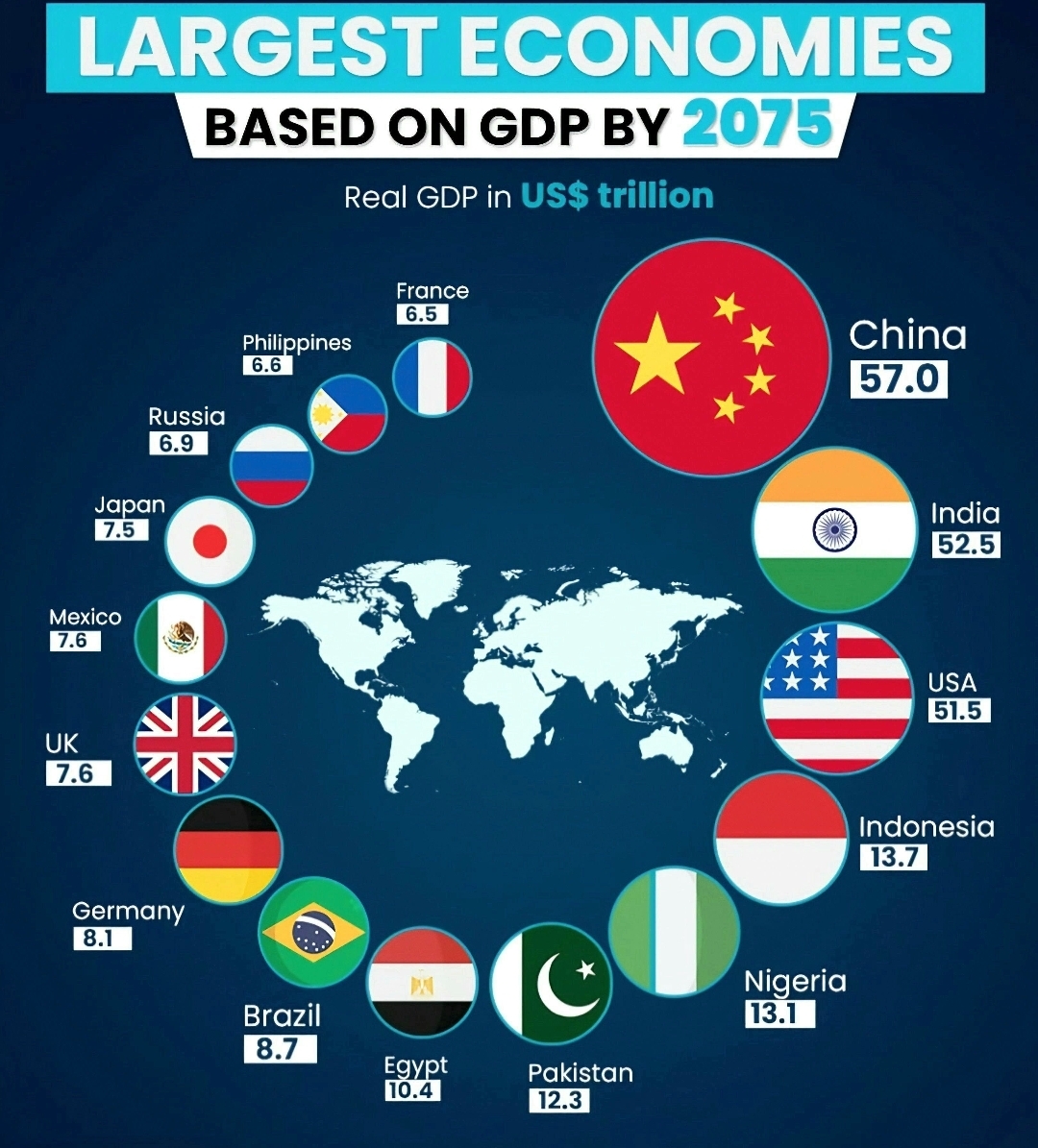
The global economy is expected to undergo a dramatic transformation over the next five decades. According to long-term projections from Goldman Sachs, the balance of economic power will shift significantly as emerging markets accelerate their growth, driven by expanding populations, technological development, and rising productivity. By 2075, several developing nations are projected to rise into the ranks of the world’s largest economies, reshaping global trade, finance, and geopolitical influence.
At the top of the list, China is projected to remain the world’s largest economy with an estimated GDP of $57 trillion, followed closely by India with $52.5 trillion. The United States, currently the largest economy, is expected to hold the third position with $51.5 trillion, maintaining a major role in global innovation, finance, and technology leadership.
One of the most striking trends in the projections is the rise of emerging economies. Indonesia, Nigeria, Pakistan, and Egypt are forecast to experience substantial economic expansion, largely fueled by young populations, urbanization, and rapid industrial development. These countries are expected to become major economic engines, reflecting a broader shift of economic activity toward Asia and Africa.
Meanwhile, several established economies such as Germany, the United Kingdom, Japan, and France are projected to remain among the top global players, although their relative ranking may decline as emerging markets grow at faster rates. These nations will likely continue to lead in advanced industries, innovation, and financial systems despite slower demographic growth.
Latin America is also expected to maintain a strong presence in the global economy. Brazil and Mexico are projected to rank among the top economies, benefiting from large domestic markets, natural resources, and expanding regional influence.
Overall, the economic landscape of 2075 is expected to be far more multipolar than today. Emerging markets will play a larger role in shaping global economic policies, trade flows, and investment opportunities. These projections highlight how demographics, technology, and long-term development strategies could redefine the global economic hierarchy in the decades ahead.