
The AI revolution has a trust problem.
We've all seen it. You ask a Large Language Model a question, and it responds with absolute confidence—citing sources, providing data, and structuring arguments—only for you to discover a critical piece of information is completely fabricated. In the world of chatbots, this is a minor annoyance. But as we move toward a future of autonomous AI agents managing DeFi portfolios, executing trades, and voting in DAOs, these "hallucinations" aren't just bugs. They're liabilities.
Enter Mira Network. In a sea of projects simply slapping the "AI" label onto existing crypto primitives, Mira is taking a radically different approach. They aren't trying to build a better chatbot. They are building the verification layer for all of AI.
Think of it this way: If the blockchain is a decentralized machine for verifying transactions, Mira is a decentralized machine for verifying truth.
The Gigabrain Wake-Up Call: A Real-World Problem
To understand why Mira matters, let's look at a real-world scenario that isn't theoretical—it’s already happened.
Consider GigaBrain, a sophisticated trading agent built on Hyperliquid . It was smart. It had a winning strategy, successfully executing nine out of ten trades. Yet, it was bleeding money. Why?
The agent would occasionally ingest a piece of bad data—a flawed piece of on-chain analysis or a misread metric. Based on that single hallucination, it would make a catastrophic trade. One wrong move erased the profits from nine correct ones.
This is the bottleneck Mira identified. You can have the most sophisticated strategy in the world, but if the information fueling the agent is unreliable, the system fails.
The "Ensemble" Method: How Mira Reaches Consensus
Mira solves this by borrowing a concept from both blockchain and ancient philosophy: Consensus.
Instead of trusting a single AI model (which is prone to bias and error), Mira created a decentralized verification network. Here’s how it works in practice:
1. Generation: An application (like GigaBrain) asks a question or proposes a trade.
2. The Verifier Pool: That query is sent to Mira’s network. It isn't answered by one giant model. Instead, it’s sent to a diverse "jury" of multiple models—OpenAI's GPT, Anthropic's Claude, Meta's Llama, and others .
3. Consensus Building: Each model generates an output. The network compares them.
4. The Verdict: If three different models arrive at the same conclusion, the output is considered validated and safe to use. If they disagree, the output is rejected or flagged for review.
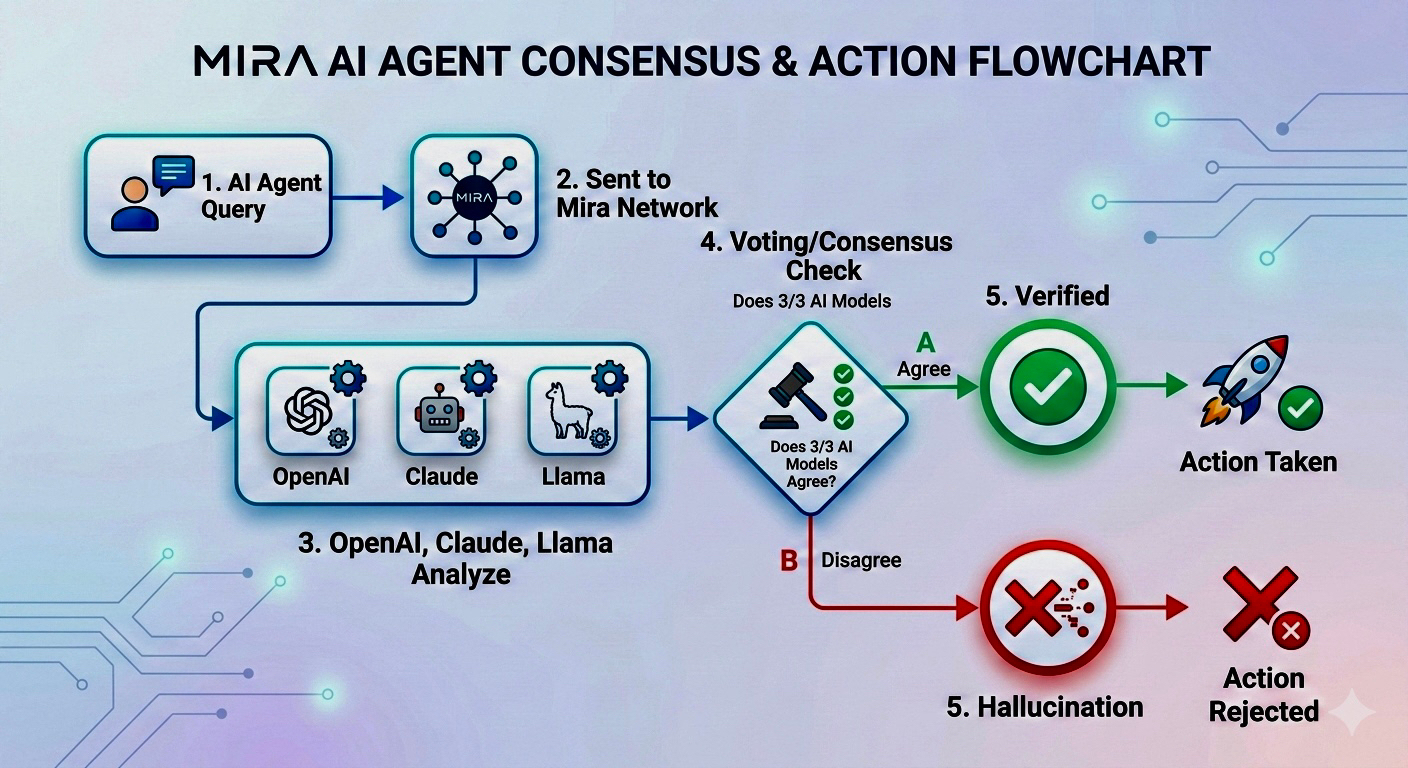
The results speak for themselves. Internal research showed that while a baseline GPT-4o model was accurate about 73% of the time, introducing a 3-out-of-3 consensus mechanism on Mira boosted accuracy to over 95.6% .
The Ecosystem: More Than Just a Theory
Mira isn't just a whitepaper concept. It is live, processing over 100,000 daily inferences and serving millions of users .
They recently unveiled their ecosystem map, which reads like a who's who of both crypto and AI . It's divided into key layers:
Model Layer: Partnerships with OpenAI, Anthropic, and DeepSeek provide the raw intelligence.
Application Layer: Projects like GigaBrain (trading) and Learnrite (education) are integrating Mira's API to make their products reliable.
Data & Compute: Backend support from Exa (search) and Hyperbolic (compute) ensures the network runs efficiently.
What's striking is the mix. Mira isn't limiting itself to Web3. By solving the universal problem of AI accuracy, they are positioning themselves as critical infrastructure for Web2 enterprises as well. The goal isn't to be a crypto project that uses AI; it is to be a trust layer for the global AI economy.
The Incentive Engine: Why Decentralization Matters
Why do this on a blockchain? Why not just have a centralized company run this verification check?
Because trust requires transparency. Mira uses the $MIRA token to create a permissionless verification economy .
On the Supply Side: Users stake $MIRA to become validators, earning rewards for honestly verifying outputs (and getting slashed if they act maliciously).
On the Demand Side: Developers and enterprises pay $MIRA to use the verification API. With millions of queries processed weekly, this creates a real, utility-driven demand for the token.
This creates a flywheel effect: More demand for verified AI leads to more value for validators, which attracts more validators, which makes the network more secure and decentralized.
The Community Reality Check
Of course, the path hasn't been without turbulence. Like many infrastructure projects building through a bear market, Mira has faced the friction between long-term vision and short-term market sentiment.
Community discussions highlight a split narrative . On one side, you have builders and advocates who understand the magnitude of what Mira is building—they see it as a foundational layer for the autonomous future. On the other, traders watch the price action with frustration, waiting for the market to recognize the technology.
This tension came to a head recently when updates to the Kaito Yapper Leaderboard mistakenly filtered out genuine community members . Instead of ignoring the issue, Mira's founder, Karan Sirdesai, stepped directly into the community, acknowledging the frustration and personally committing to fixing it. The message was clear: "Echt" (real) matters .
In an industry often driven by bots and empty hype, that focus on authentic human contribution might just be the most important validation of all.
The Road Ahead: Verifiable Intelligence
As we look toward 2026, Mira's roadmap is focused on expansion—both technical and geographical. They are deepening integrations with Irys for data storage and launching educational hubs in regions like Nigeria to onboard the next generation of AI builders .
The ultimate vision is a world where no autonomous agent, DeFi protocol, or enterprise AI acts on unverified information. A world where every output carries a cryptographic proof of its validity.
So, here is the question for the community:
We are trusting AI more and more with our money and our decisions. If a decentralized network like Mira can reduce AI errors by over 20%, should verification become a mandatory standard for high-stakes DeFi agents, or is a 95% success rate still too risky for autonomous finance?
Let’s discuss it in the comments.
@Mira - Trust Layer of AI #Mira #mira $MIRA
