
Imagine a world where a delivery drone not only navigates traffic but also negotiates its own charging fees, pays a warehouse robot for access to a loading bay, and verifies the identity of a Waymo vehicle before handing over a package, all without human intervention.
This isn't a scene from a novel, it is going to be the emerging reality being built by the Fabric Protocol. As of now most of the crypto world is dependent on speculation but OpenMind which is a Silicon Valley startup with roots in Stanford and Google DeepMind is dealing with a far more ambitious problem which is building the economic and coordination layer for the machine economy.
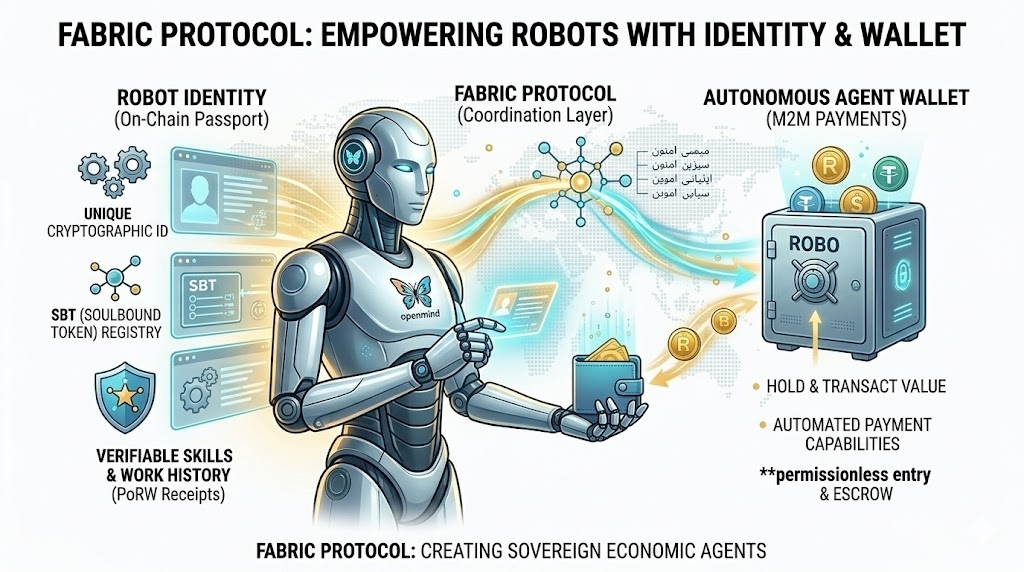
The Problem of a World of Isolated Machines
To understand why the Fabric Protocol matters, we first must look at the current state of robotics. Right now, we are living in a "knockoff phone era" of robotics, where there are over 150 hardware manufacturers and everyone is building their own proprietary closed-loop systems. A Unitree robot cannot easily share a learned skill with a Tesla Optimus bot. They are trapped in "single-vendor ecosystems," unable to communicate, share knowledge, or transact with one another.
The thesis of OpenMind's model is simple, If AI is the brain and robotics is the body, then coordination is the nervous system. Without all this, you just have expensive, isolated motion.
What Is the Fabric Protocol?
If OpenMind's first product, OM1, serves as the "Android operating system" for a single robot's brain, then Fabric is the decentralized social network and bank for those brains.
As a combination of "GPS, VPN, and handshake protocol for robots," Fabric Protocol is a decentralized coordination network that sits on top of the blockchain. It solves three specific problems that software alone cannot:
1. Verifiable Identity: In a digital world, how does one machine know another is who it claims to be? Fabric assigns every registered machine a cryptographic, on-chain identity. This allows robots to verify their location and credentials before interacting.
2. Trusted Collaboration: Once identities are verified, robots can share context and data. This enables what OpenMind calls "shared intelligence", if one robot learns to navigate a new obstacle, others on the network can instantly access that knowledge.
3. Machine Economics: This is the most disruptive aspect that by linking identity to a wallet, Fabric Protocol turns robots from simple tools into economic agents.
Robots Paying for Power
In late 2025, OpenMind partnered with Circle to demonstrate the world's first "USDC robot self-charging network" in Silicon Valley. Let's discuss how the Fabric Protocol worked in that scenario:
• A robot, running low on battery, navigated to a charging station.
• The station and the robot verified each other's identities via the Fabric network.
• The robot executed micropayment in USDC directly from its on-chain wallet to the charging station.
• The station released the power, and the robot resumed its shift.
Following all this for the first time, a machine acted as an independent economic participant rather than just a capital expense.
A Token Model Built for Work, Not Speculation
The ROBO token system has built a model that operates on an adaptive economic model designed specifically for machine-to-machine transactions.
Unlike traditional Proof-of-Stake systems, where passive holding earns rewards, the Fabric Protocol utilizes a "Proof-of-Contribution" mechanism. According to that mechanism, rewards are only generated by performing verified work, validating tasks, or completing jobs. To prevent a single corporation from dominating the network, operators must stake $ROBO as a "work bond" to register their hardware, aligning financial incentives with honest participation.
How ROBO is different from others
Considering the studies of both the crypto and robotics spaces for years, the OpenMind approach feels uniquely grounded. Usually, crypto projects build a token and desperately search for a use case. This token isn't just the product, it's a whole infrastructure. The Fabric Protocol simply provides the financial rails that the physical world urgently needs as automation leaves the factory floor and enters our chaotic, shared spaces.
As Pantera Capital, the lead investor in OpenMind's $20 million round, put it: "If we want intelligent machines operating in open environments, we need an open intelligence network". Fabric is that network.